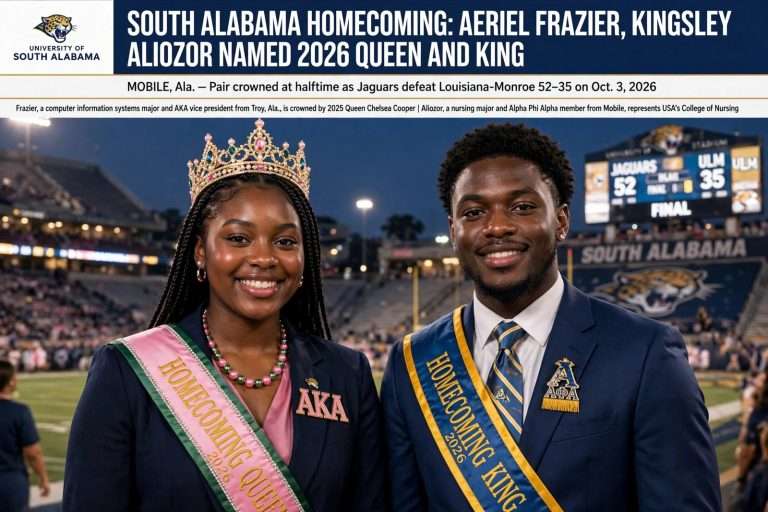
Mobile girl battling rare brain cancer challenges Nick Saban in Lemon Face Challenge
Eleven-year-old Mobile girl Aubreigh Nicholas, fighting a rare brain cancer, challenged Nick Saban in the Lemon Face Challenge for cancer awareness.
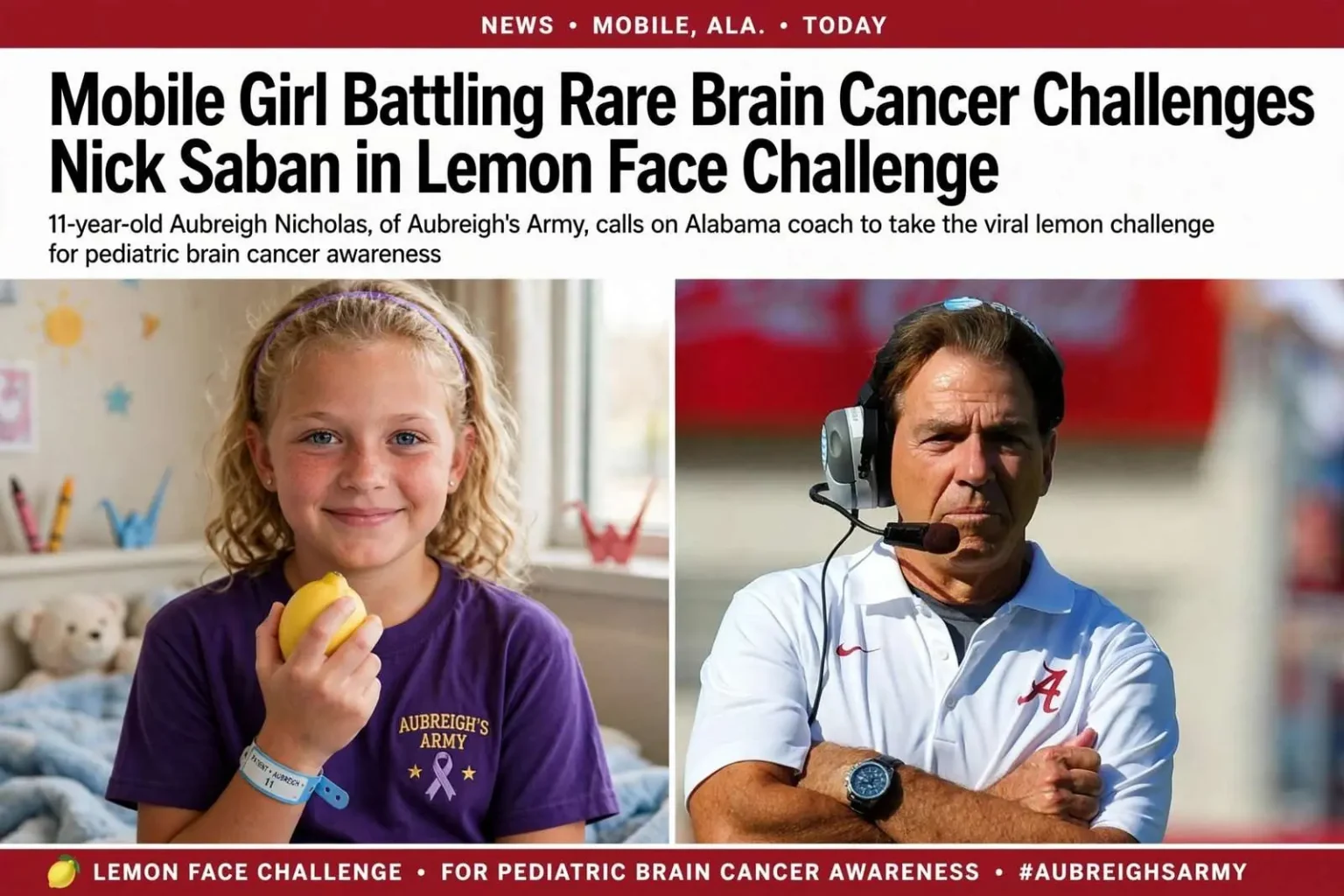
MOBILE, Ala. — An 11-year-old Mobile girl who is fighting a rare form of brain cancer has thrown down a sour challenge to one of the most famous figures in Alabama sports. Aubreigh Nicholas, whose family documents her fight on the Aubreigh’s Army Facebook page, posted a video challenging Alabama Crimson Tide head coach Nick Saban to take part in the Lemon Face Challenge on her behalf — and in doing so, put one of the state’s most-watched public figures on the spot for a cause that has touched families across the Gulf Coast.
The challenge is simple, and that simplicity is the point. Nick Saban has built his legend on preparation and control, the multiple-time national champion’s famously stern demeanor a fixture of Alabama fall Saturdays. Asking him to bite into a lemon on camera — and to enjoy it, or at least survive it — is exactly the kind of lighthearted ambush the Lemon Face Challenge was designed to create: an irresistible ask, delivered by a child, for a cause no coach could decline without explanation. The video of the challenge quickly made the rounds among Alabama fans, with supporters tagging the coach and urging him to accept.
What the challenge is: the Lemon Face Challenge works much like other viral awareness campaigns. Participants bite into a sour lemon, film their puckered reaction, and challenge friends — or in this case a championship football coach — to do the same while donating to childhood cancer research. The format borrows the mechanics of the ice bucket challenge era: a physical stunt anyone can perform, a video that spreads on its own comedy, and a built-in chain of nominations that turns one participant into many. The difference is the source — for the Lemon Face Challenge, the faces doing the puckering are doing it in honor of children like Aubreigh, whose fight with a rare brain cancer gave the campaign both its urgency and its face.
A campaign that spread across Alabama
The campaign spread across Alabama and beyond as families touched by pediatric brain cancer shared videos of politicians, athletes and local celebrities grimacing through the fruit. On social media, the lemon became a shorthand for solidarity with young cancer patients, and the videos accumulated into a rolling showcase of public figures willing to look foolish for a serious cause. Each post carried the same underlying message: childhood cancer research remains underfunded relative to its toll, and awareness campaigns like this one supply visibility that federal and pharmaceutical priorities do not.
Pediatric brain cancer is among the most devastating diagnoses in medicine, and the rare forms — the aggressive, difficult-to-treat tumors that strike young children — have historically drawn a fraction of the research funding that more common adult cancers receive. Families in Aubreigh’s position often become advocates by necessity, learning the landscape of trials, treatments, and fundraising while managing a child’s care. The Lemon Face Challenge gave Alabama families a vehicle that required nothing more than a lemon, a phone camera, and the willingness to make a sour face in public — and it let them channel grief and fear into something collective and forward-looking.
Aubreigh’s Army
Nicholas marked her 11th birthday with her mother the same week she posted the challenge, according to the family’s page, which has followed her treatment and rallied community support across the Mobile area since her diagnosis. The birthday post, like everything shared on Aubreigh’s Army, blended the ordinary milestones of a young life — a cake, candles, family around the table — with the extraordinary circumstances of an 11-year-old undergoing treatment for a rare brain tumor. That mix of everyday joy and hard news is what has drawn a devoted following to the page and kept the community engaged with her fight week after week.
The page has done more than document treatment. It has organized it — turning followers into volunteers, updates into fundraisers, and a family’s private ordeal into a network of support that shows up in hospital waiting rooms, benefit dinners, and comment threads full of encouragement. In an age when medical crowdfunding and awareness pages can feel impersonal, Aubreigh’s Army has operated the way Gulf Coast communities traditionally have: face to face, church by church, business by business.
The Mobile-area community has embraced Aubreigh’s Army with fundraisers and public shows of support, and her Saban challenge gave the cause one of its highest-profile potential participants yet. From benefit events to school fundraisers to businesses displaying signs of support, the region has repeatedly shown up for the family, turning a private medical battle into a shared community effort. The challenge video extended that support into the digital space, where it could travel far beyond the Gulf Coast — reaching Alabama fans around the country who had never heard of Aubreigh but knew exactly who Nick Saban was. Every share and every tagged nomination carried the family’s story further from Mobile, which is precisely what an awareness campaign for a rare disease needs most.
Why Saban mattered to this challenge
Choosing Saban as the target of the challenge was more than celebrity-chasing. In Alabama, the Crimson Tide coach occupies a position of cultural reach that few public figures in the state can match, and his participation in a viral cause carries automatic headlines. When public figures take on challenges like this one, the resulting videos multiply the campaign’s audience overnight, drawing national sports media attention to a childhood cancer cause that would otherwise never cross a highlight show. For Aubreigh’s Army, a Saban video would mean eyes, donations, and awareness at a scale local fundraisers cannot reach.
The challenge also fit the relationship between Alabama football and its youngest fans. Saban’s program has a long record of engagement with sick children — hospital visits, honorary team captainships, and personal gestures that have made the coach a familiar presence in pediatric wards around the state. A coach who has made time for Alabama’s sick children being publicly invited to pucker up for one of them was a natural progression, and the campaign’s organizers understood that the ask would be hard to ignore. Saban, after all, has built his public identity as much on discipline and seriousness as any coach in the country — which is precisely why watching him surrender to a lemon, for an 11-year-old from Mobile, promised to be the most effective video the campaign could ask for.
Viral charity, local stakes
The Lemon Face Challenge belongs to a lineage of internet-era charity campaigns that trade small embarrassment for real money. The formula has proven effective because it converts participation into visibility: every person who accepts a challenge becomes an advertisement for the cause, and every nomination extends the chain. The costs are trivial, the barrier to entry is nearly zero, and the emotional hook — in this case, children fighting brain cancer — does the persuading. What is lost in solemnity is gained in reach, and families like Aubreigh’s have found that reach to be worth far more than the awkwardness of a puckered face. The challenge also lowers the social cost of giving: people who might ignore a donation request will gladly film a lemon bite, and the video invites their friends to do the same.
The model has its critics, who note that viral campaigns can fade as quickly as they rise and that awareness does not automatically become research funding. But for rare pediatric cancers, where dedicated philanthropy is thin and federal grants are hard-won, the bursts of attention these campaigns generate are often the largest influx of public engagement a cause ever receives. Families measure the value differently: a campaign that raises even modest sums while connecting a handful of new families to treatment information and support networks has done real work.
For Mobile, the campaign is also a reflection of the city’s tight-knit character. The community support surrounding Aubreigh’s Army — the fundraisers, the social media following, the businesses and schools that have taken up her cause — illustrates how Gulf Coast communities mobilize around their own. An 11-year-old’s challenge to the most powerful coach in college football may have been posted from a family Facebook page, but it carried the weight of a community that had already committed itself to her fight.
Whether Saban takes the challenge — and whether his video, if it comes, sparks the cascade of donations and celebrity nominations the campaign hopes for — the video has already accomplished something concrete: it put a rare childhood cancer in front of an audience that spans the state, attached to a name, a face, and a family that Mobile knows well. The lemons, in this case, were never about the lemons.