Mobile Lands on New Ranking of the Worst Metros in America for Commuters
A HireAHelper analysis of census data ranks the Mobile metro No. 12 among midsize metros with the worst commutes in America.
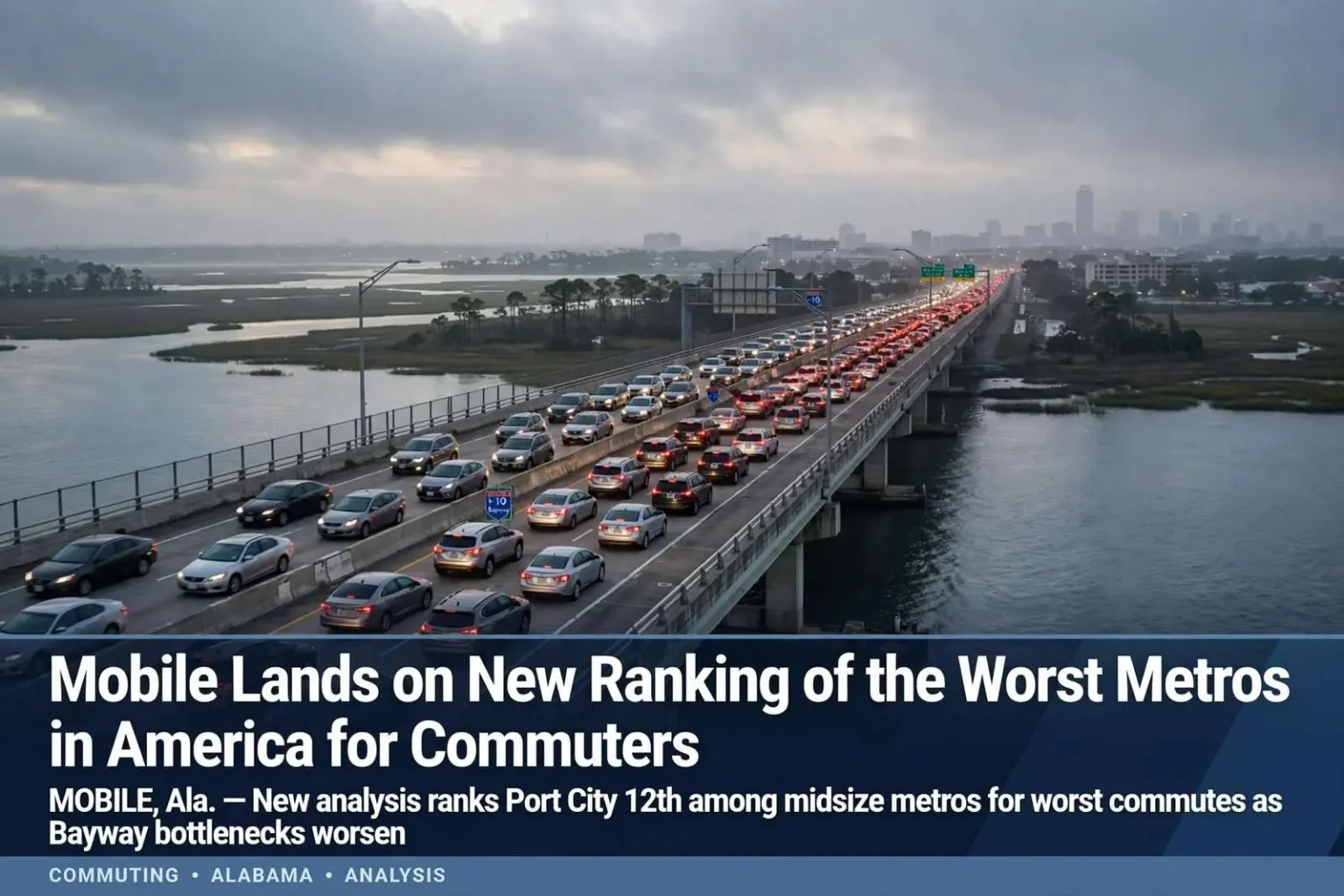
MOBILE, Ala. — Commuting in the Port City may be more painful than most residents realize. A new analysis of federal transportation data has placed Mobile among the midsize metropolitan areas Americans would be wise to avoid if they hate their drive to work.
The ranking, compiled by moving-services company HireAHelper using U.S. Census Bureau American Community Survey figures, scored metros on a weighted set of commuting factors and placed Mobile at No. 12 among midsize metros with the worst commutes — a distinction few locals would brag about, but one that lines up with the day-to-day experience of workers driving across the bay and around the city’s congested corridors.
For a metro area of Mobile’s size, the showing is a reminder that commute quality is shaped by more than population. Geography — with the Mobile Bay, the Mobile River, and the Mobile-Tensaw Delta carving the region into segments connected by a handful of bridges and tunnels — forces a disproportionate share of daily travel onto a few chokepoints that no amount of suburban road building has fully relieved.
How the Ranking Works
HireAHelper’s study drew on the American Community Survey, the Census Bureau’s ongoing household survey that captures commuting behavior, travel times, and transportation modes for every metro area in the country. By weighting multiple commuting factors together — travel times, congestion measures, and the share of workers facing difficult drives — the analysis produced a single score that ranks metros of similar size against each other.
The midsize category is where Mobile lands among America’s metros, competing against peer cities across the country rather than against giants like Los Angeles or Chicago. Placing 12th on that list puts the Port City in the worst third of its cohort — an unwelcome data point for a region trying to attract workers and employers.
Commute rankings like this one carry real economic weight. Employers considering a market look at quality-of-life measures, and a metro known for difficult drives can find itself explaining away a statistic that a competing city simply doesn’t have to answer for.
More Americans Are Off the Road Altogether
The analysis arrives amid a broader shift in how Americans get to work. Roughly two-thirds of U.S. commuters now drive alone, down from more than three-quarters before the pandemic — a drop driven largely by remote work, which accounted for 18% of American workers as of 2021.
That change, documented in the very Census data the ranking relies on, represents one of the most rapid transformations in American commuting habits ever recorded. The pandemic emptied highways in 2020, and while traffic has returned, millions of workers never resumed the five-day commute, splitting their weeks between home and office or abandoning the daily drive altogether.
For Mobile, the remote work wave cuts both ways. Fewer daily commuters can ease pressure on the region’s worst corridors, but the workers who must still show up in person — in healthcare, shipbuilding, petrochemicals, logistics, and the service economy that anchors the Gulf Coast — face the same bottlenecks as ever, with no option to log in from the kitchen table.
Alabama’s Other Commuter Trouble Spots
Mobile was not the only Alabama metro to draw unwanted attention in the study. Florence-Muscle Shoals ranked No. 1 among small metros to avoid for commuting, putting the Shoals at the top of a list no community wants to lead. Tuscaloosa came in at No. 7 on the same small-metro list, a reflection of the daily flows into and out of the university town and the highway corridors that funnel students and workers through it.
Birmingham-Hoover placed No. 9 among large metros, just behind Los Angeles-Long Beach-Anaheim — a striking comparison for Alabama’s largest metro, which now sits one spot behind the most famously gridlocked region in America. Birmingham’s inclusion on the large-metro list underscores that the state’s commuting challenges scale from its biggest city to its smallest metros.
Taken together, the results sketch an unflattering portrait of Alabama commuting across every size class. Four of the state’s metros appeared on national lists of the worst places to drive to work, spanning the Shoals in the state’s northwest corner to the Gulf Coast in the south.
Why Mobile Commutes Are Harder Than They Look
Mobile’s geography explains much of the problem. The city sits at the head of Mobile Bay, and the rivers and delta wetlands north of downtown divide the region into east and west halves linked by a limited set of crossings: the George Wallace and Jubilee Parkway twin spans on I-10 carrying the Bayway across the bay, the Bankhead and Cochrane-Africatown bridges over the river and upriver, and the tunnels beneath the river downtown.
Eastern Shore commuters from Baldwin County — Daphne, Fairhope, Spanish Fort, and beyond — funnel onto the Bayway every morning, joining through traffic on the I-10 corridor that links the Gulf Coast’s port cities. The result is a morning rush that bottlenecks at the tunnels and the bridge approaches, with crashes routinely snarling the entire region’s cross-bay travel for hours.
Within the city itself, commuters contend with corridors like Airport Boulevard, Government Street, and I-65, which carry heavy local traffic between the city’s spreading residential areas and its job centers — the hospitals, shipyards, industrial plants, and downtown offices that cannot be moved closer to the workforce.
What the Data Means for the Region
For South Alabama commuters, the findings suggest the region’s daily drives stack up poorly not just against neighboring Southern metros, but against cities nationwide. That matters for quality of life — long commutes are consistently linked in research to higher stress, less family time, and lower overall satisfaction — and for the economy, as businesses weigh how easily their workers can reach job sites.
The region’s major employers draw workers from across the metro area and beyond. Austal’s shipyard on the river downtown, the hospitals and universities clustered near midtown, the industrial complexes at Mobile’s port and in north Mobile County, and the retail and service economy spread across west Mobile all pull commuters from every direction — often across the same limited crossings.
Transportation planners have spent years studying the region’s chokepoints, most prominently the I-10 Mobile River Bridge and Bayway project, a proposed bridge-and-toll plan intended to replace the aging tunnels and expand cross-river capacity. The project has generated intense local debate over tolls, but the underlying problem it targets — a crossing network built decades ago for a much smaller region — grows more acute every year.
How Mobile Compares to Its Peers
In the midsize metro category where Mobile ranks 12th worst, the competition includes growing Southern and Western cities dealing with rapid population growth on infrastructure built for smaller populations. Mobile’s challenge is different: its population is not booming, but its geography concentrates traffic so sharply that average commutes still rank among the nation’s most difficult.
That distinction matters when the region markets itself. Cities bidding for new employers emphasize available workforce, and commute data feeds directly into that pitch. A ranking like this one is unlikely to decide a corporate location on its own, but it adds friction to the story a region tells about itself.
The counterweight is cost: driving in Mobile remains far cheaper than commuting in the nation’s largest metros, with housing near job centers far more affordable than in the coastal cities that dominate the top of large-metro lists. For many residents, a longer drive is the trade-off for a lower cost of living — a calculation the raw rankings don’t capture.
The Remote Work Wild Card
The pandemic-era shift documented in the Census data offers Mobile a partial path forward. Every worker who moves to a hybrid or fully remote schedule takes a car off the region’s worst corridors during rush hours, and Gulf Coast employers in fields like technology, insurance, and professional services have increasingly embraced flexible arrangements since 2020.
But the region’s economy is weighted toward industries that cannot go remote. The Port of Mobile — one of the fastest-growing deepwater ports in the nation — plus the shipbuilding yards, chemical plants, paper mills, and healthcare systems that anchor local employment all require workers on site. For them, the drive to work is not optional, and improvements must come from infrastructure, not broadband.
State and local officials have responded with a mix of projects: widening segments of I-10 and I-65, improving interchanges in west Mobile, and studying transit options for the corridors that carry the most workers. Transit remains a modest piece of the region’s commute picture, with the Wave Transit system serving the urban core but reaching only a fraction of the metro’s daily trips.
What Commuters Can Expect
Short of major construction, Mobile commuters can expect the familiar rhythm to continue: backups at the tunnels and the Bayway, crash-related closures that ripple across the region, and gradual increases in traffic as Baldwin County’s population growth sends more drivers west each morning.
The HireAHelper ranking will likely be revisited as new American Community Survey data arrives each year, and Mobile’s position will move with it — influenced by remote work rates, construction projects, and the region’s growth pattern. For now, the city sits 12th on a list of midsize metros that no chamber of commerce would quote in a brochure.
For residents, the practical takeaway is familiar: the drive to work in Mobile is worse than most Americans’, and fixing it will take years of infrastructure work that has only just begun to move from study to construction. Until then, the Port City’s commuters keep making the same crossings, over the same waters, that have defined travel in this region for generations.