
Mobile Launches Criminal Investigation Into Local Wrecker Services
Mobile launches a criminal probe of several wrecker services over alleged price gouging and bogus charges, delaying a new towing ordinance.
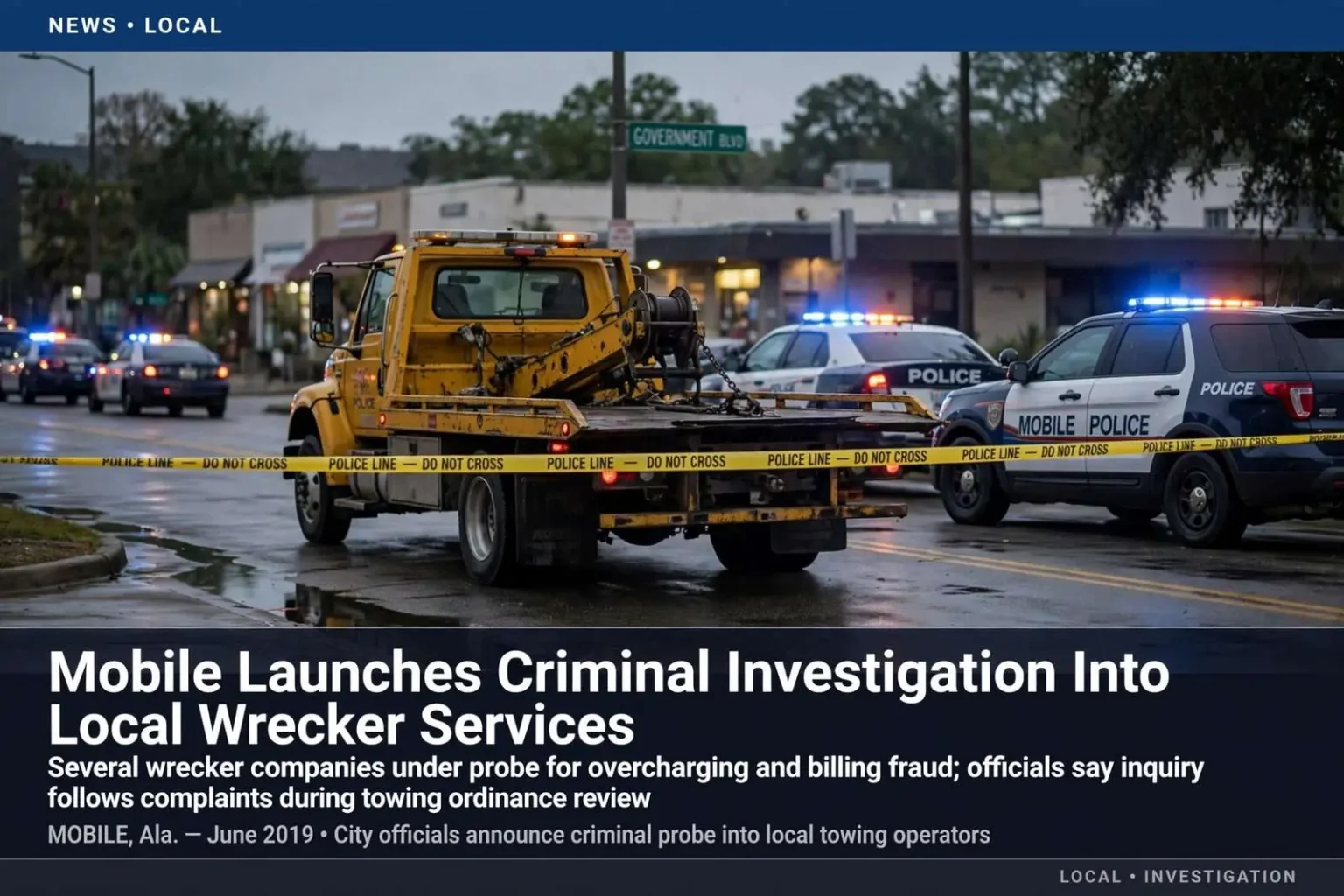
MOBILE, Ala. — Several wrecker companies operating in Mobile are under criminal investigation following allegations that they overcharged customers, billed for services they never performed, or otherwise gouged motorists, city officials announced in June 2019. The inquiry came to light during a City Council review of proposed changes to the city ordinance governing towing operations, and it has cast a shadow over a corner of the local service industry that most drivers only think about on the worst day of their week. For motorists stranded along Interstate 10, Government Boulevard, or any of the gridlocked corridors that thread through Mobile, the news raised an uncomfortable question: who is watching the tow truck when it hooks up your car?
The answer, city officials say, is now a criminal one. Investigators with the Mobile Police Department have been reviewing complaints and records tied to a handful of towing operators, and Public Safety Director James Barber told council members that the evidence gathered so far is serious enough to support potential criminal charges. The case is being worked in coordination with the Mobile County District Attorney’s Office, which would handle prosecution of any fraud or consumer-protection violations that emerge from the review.
How the investigation surfaced
Barber told council members that the problems emerged while officials were reworking the towing rules in response to complaints from within the industry itself. Wrecker operators had come forward to object to provisions of the proposed ordinance, arguing among other things about rates, rotation lists, and the conditions under which companies could be called to a scene. In sorting through those objections, the city began hearing about competitors’ billing practices — and some of what it heard went well beyond the ordinary griping that accompanies any proposed change to a regulated market.
What started as a policy dispute turned into an evidentiary one. Investigators reviewed reports of excessive charges, fees for services never rendered, and other inappropriate billing. Barber said the review substantiated enough of the allegations to support potential criminal charges for fraud or violations of the Alabama Consumer Protection Act, the state law that prohibits deceptive and unconscionable business practices and gives the Attorney General’s office authority to pursue violators. A referral to prosecutors, rather than a simple citation or license suspension, signals that the city believes the conduct at issue crossed the line from sloppy bookkeeping into criminal conduct.
The decision to involve prosecutors also explains why the ordinance revision itself was shelved. Barber asked the council to table the revised ordinance after police uncovered evidence that some companies had been operating well outside the existing rules, and members agreed to hold off rather than debate new regulations while a criminal case is quietly being built. Continuing to rewrite the rules in public, officials concluded, could complicate the investigation and tip off the companies under scrutiny.
Why the city was rewriting its towing rules
Towing in Mobile sits at the intersection of public safety and private enterprise in a way few other businesses do. When a wreck blocks a lane or a car dies in a travel lane, police or fire crews typically summon the next available operator, and the motorist on the shoulder has little practical ability to comparison-shop. That dynamic — a captive customer, an urgent situation, and a bill that arrives after the adrenaline fades — is precisely the environment in which billing abuses can flourish if oversight is loose. Cities across Alabama have wrestled with the same tension, using ordinances to set maximum rates, require itemized receipts, and rotate calls fairly among licensed companies.
Mobile’s existing framework was the product of earlier attempts to bring order to the industry, but enforcement has historically been complaint-driven, meaning problems surfaced only after a motorist took the trouble to challenge a bill. The proposed revision under consideration in June 2019 was intended to tighten those standards and give the city more leverage over operators who abused the system. Instead, the review of the rules became the vehicle for uncovering conduct that may land people in criminal court rather than administrative hearings.
The stakes for the companies involved are considerable. A criminal fraud conviction in Alabama can carry prison time and fines far beyond anything the city could impose through its licensing authority, and a referral to the District Attorney’s Office means the case will be handled with the full investigative tools available to law enforcement — subpoenas for business records, interviews with customers, and coordination with the state Attorney General’s Consumer Interest Division where the Alabama Consumer Protection Act is implicated. For an industry that depends on police rotation lists and city contracts for a large share of its calls, even the public disclosure of a criminal investigation can be an existential blow.
Not every operator is implicated
Barber stressed that not every towing company in the city is implicated — several, not all, are under investigation. That distinction matters in a market where many operators have built their businesses on legitimate work: clearing highway accidents at all hours, answering police calls in storms, and hauling disabled vehicles without complaint. Industry members who came forward with their objections to the ordinance, in fact, were instrumental in drawing attention to the conduct now under review, since operators who follow the rules have the most to lose from competitors who undercut them by padding bills.
The city’s approach also reflects a practical reality of the towing business: the difference between an honest charge and a fraudulent one is often a matter of documentation. A legitimate operator presents an itemized invoice that matches the published rate schedule and can produce records showing a winch-out was performed or a vehicle was stored for the days billed. An operator billing for services never rendered leaves a paper trail of invoices that describe work no witness saw and no photographic record supports. Investigators reviewing those records can sort the two with relative precision, which is why the review of billing practices was described as substantiating the allegations rather than merely repeating them.
What the Alabama Consumer Protection Act covers
The statute Barber cited, the Alabama Consumer Protection Act, was enacted in 2001 to give the state a comprehensive tool against unfair and deceptive trade practices. It prohibits misrepresenting the character or extent of services rendered, charging for services not actually provided, and engaging in unconscionable commercial conduct — categories that map directly onto the allegations described to council members. Violations can draw civil penalties from the Attorney General, and the conduct described in the Mobile case may also support traditional fraud charges handled by the Mobile County District Attorney’s Office, since fraud requires showing a victim was deceived into paying for something they did not receive.
For consumers, the Act and the city’s ordinance both exist to address the same power imbalance: a driver whose car has been towed generally cannot refuse the bill and drive away, because the vehicle is held until charges are paid. That leverage is what makes towing fraud particularly corrosive. A motorist who disputes an inflated invoice faces storage fees accumulating daily, and the practical choice is often to pay an unfair bill rather than fight one. Regulators and prosecutors who step into that market are, in effect, standing in for the consumer leverage that the transaction itself strips away.
What happens next for the ordinance and for motorists
The ordinance revision was shelved until the criminal investigation wraps up. Barber said the city intends to bring forward a rewritten ordinance afterward that offers stronger protection for consumers who need a tow, presumably incorporating whatever the investigation revealed about the loopholes and enforcement gaps that allowed the alleged abuse to occur. A post-investigation ordinance would be informed by evidence in a way a pre-investigation draft never could be, and officials will have a concrete record of how the worst offenders operated when they decide what standards to impose.
In the meantime, city officials have pointed motorists toward the remedies available now. Drivers who believe they were overcharged for a tow in Mobile can file complaints with the Mobile Police Department, which licenses and regulates wrecker operators within the city, and with the Alabama Attorney General’s Consumer Interest Division, which handles complaints under the Alabama Consumer Protection Act. Itemized receipts should be requested and kept whenever a vehicle is towed, including the date, the services billed, and the daily storage rate. Those records are precisely the kind of documentation investigators rely on, and in cases like this one they can help both individual consumers seeking restitution and prosecutors building a broader case.
For the companies not under investigation, the episode carries its own message. The same review that exposed alleged fraud also confirmed that the city is watching the rotation lists, the invoices, and the rates — and that operators who keep clean records have a city government now more attuned than ever to the difference. The revised ordinance will return to the City Council once the criminal case is resolved, and when it does, the bar for the towing industry in Mobile will likely be higher than it has ever been.