
Mobile Native and Emmy-Winning Filmmaker Mike deGruy Surveys Deepwater Horizon Damage Firsthand
Mobile-born filmmaker Mike deGruy toured the Gulf Coast after the Deepwater Horizon spill, describing oiled wetlands and upended fishing communities.
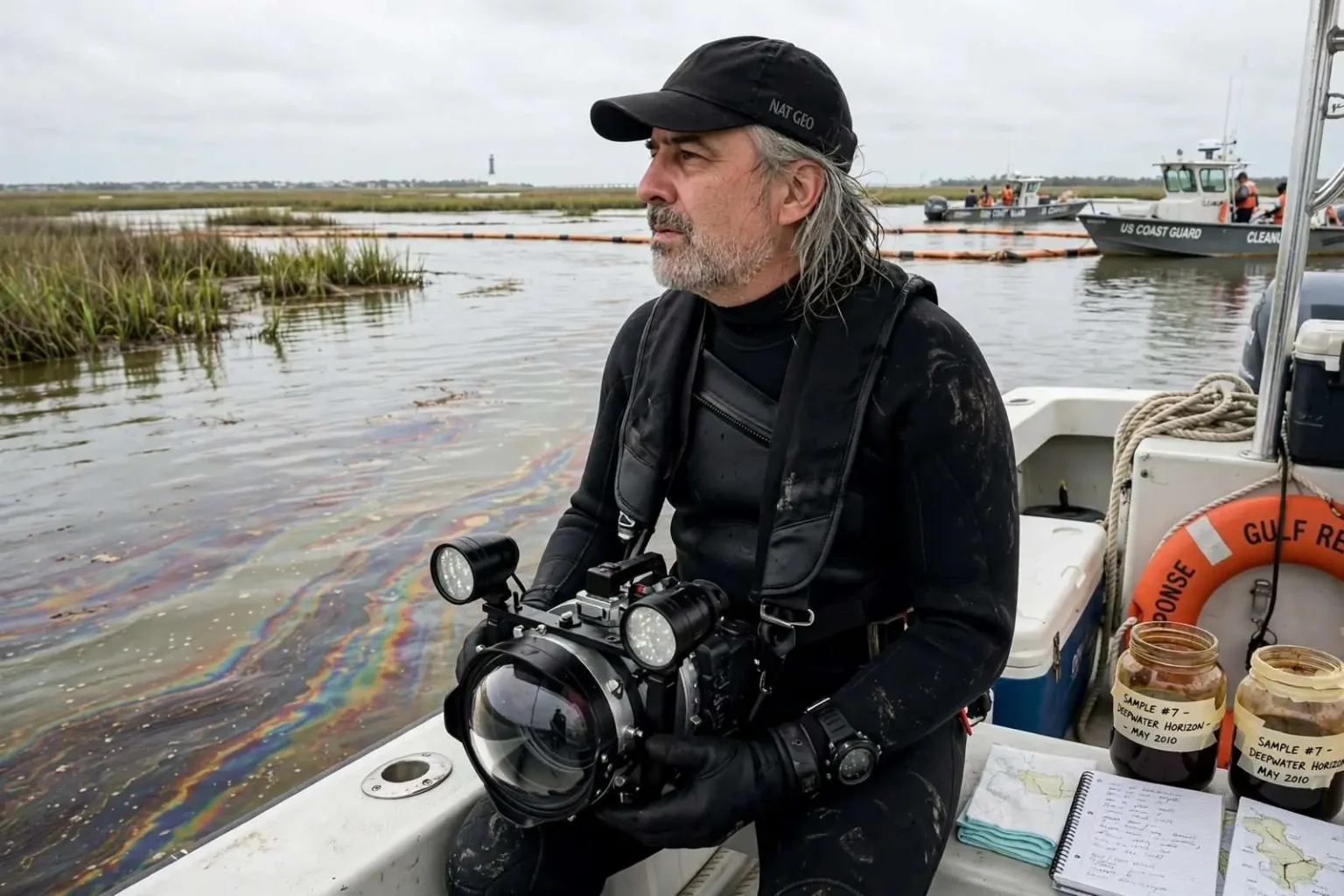
When the Deepwater Horizon well blew out in the Gulf of Mexico in the spring of 2010, Mobile native Mike deGruy did not wait to be asked. The Santa Barbara-based underwater filmmaker, known for decades of documentary work for National Geographic, PBS, the BBC and the Discovery Channel, dropped his other projects and flew home to the Gulf Coast to see the damage for himself. The rig disaster, which began with an explosion in April 2010 and led to months of oil flowing into the Gulf, quickly became one of the worst environmental emergencies in American history, and its effects washed ashore from Louisiana to the Florida Panhandle.
“I grew up in Mobile. I know that area well,” deGruy said. “A lot of the friends I grew up with are impacted by or are involved in the cleanup, and others even work in the oil industry itself, so this is very close to my heart.” That mix of connections — childhood friends pulling boom across the bay, others working on the platforms and vessels that serviced the offshore industry — gave his return a personal weight that few visiting journalists or documentarians could claim. He was not parachuting into an unfamiliar story. He was coming home to waters he had known since he was a boy.
He described Mobile Bay, the Mississippi Delta and Dauphin Island as the waters that shaped his childhood and, later, his career filming beneath the surface of oceans around the world. For a Mobile native of his generation, that geography was hard to escape. The bay lies at the bottom of the Mobile-Tensaw Delta, one of the largest river deltas and wetland systems in the country, and Dauphin Island guards the bay’s western passage to the Gulf. Those waters are connected ecologically to everything that happens offshore, which is precisely why a spill dozens of miles out in open water mattered so much to the communities ringing the bay.
DeGruy’s professional credentials made him an unusual and valuable witness. As an underwater cinematographer he had spent more of his life submerged than most divers ever will, filming marine life from Antarctica to the Pacific for the broadcasters whose nature documentaries reach hundreds of millions of viewers. He knew how a healthy reef looked on camera, how a healthy marsh smelled at low tide, and how fish behaved in clear water. That trained eye meant that when he described what he found along the Gulf Coast, he was speaking as someone who could compare the damaged waters against a lifetime of images from undamaged ones.
A Whistle-Stop Tour of the Coast
DeGruy spent weeks making what he called a whistle-stop tour through Louisiana, Mississippi, Alabama and Florida, meeting with residents, cleanup crews and government agencies and getting into the water himself where he could. The itinerary tracked the spill’s footprint. Oil came ashore first and heaviest in Louisiana’s marshes, then spread to the barrier islands of Mississippi and Alabama — including Dauphin Island, whose beaches became a staging ground for cleanup operations — and finally to the Panhandle beaches that anchor northwest Florida’s tourist economy. Each stop put him in front of a different slice of the disaster: shrimpers idled at the dock, coordinators in incident command posts, deckhands skimming sheen from protected bays.
Getting into the water was the part that set him apart. Where most coverage of the spill was shot from boats, helicopters and beaches, deGruy suited up and dropped beneath the surface to see what the oil and the response were doing below. Underwater, the story looked nothing like the aerial images of orange slicks. It was a question of haze, of particles, of what was settling into the grass and the sand, and whether fish and invertebrates were showing signs of exposure. His ability to work cameras underwater meant he could document conditions that shore-based observers literally could not see.
He then turned to scientists working to understand the spill’s long-term effects, spending significant time with researchers trying to determine what impact the oil and the chemical dispersants used to break it up would ultimately have on the Gulf. Universities across the Gulf Coast, along with federal agencies, launched research programs after the blowout to track contamination in sediments, marsh grass, fish stocks and food webs. The work was complicated by the sheer scale of the system: the Gulf receives the flow of the entire Mississippi River watershed, and its fisheries — from Gulf shrimp to red snapper to the oyster reefs of Mobile Bay and the Mississippi Sound — support communities with generations of accumulated local knowledge.
What Dispersant Does and Does Not Do
He was blunt about what he found. Dispersant, he explained, does not remove oil from the water column or make it disappear. “It doesn’t remove anything or make the oil go away,” deGruy said. “It might look better from above, but the oil is still somewhere in the water and it is still making it into the shorelines and the wetlands and causing serious destruction.”
His point went to the heart of one of the most debated response decisions of the entire spill. Dispersants work by breaking a floating slick into tiny droplets that sink and scatter through the water column, where microbes can eventually degrade them. The trade-off is that the oil leaves the surface — where it is visible, recoverable and largely avoidable — and enters the water itself, where it mixes with everything that lives there. From a boat or a helicopter, a treated patch of ocean looks clean. From beneath it, as deGruy could attest, the oil has not gone anywhere. It has simply changed form.
He added that dispersed oil is, in some ways, harder to clean up than a surface slick, since there is no longer a clear line between oil and water — just what he described as a murky mix of droplets clinging to everything they touch, including fish. A surface slick can be corralled with boom, burned off in controlled operations, or skimmed from the top of the water. Droplets suspended through dozens of feet of water cannot be boomed or burned. They drift with the currents, coat plankton and eggs, settle into the sediment, and wash into wetlands where mechanical recovery is nearly impossible. For fisheries managers, that created a persistent problem: how do you test and certify waters as safe when the contamination is distributed invisibly through the water column rather than sitting on top of it?
That concern carried directly into the fishing communities of the northern Gulf. In the months after the blowout, large stretches of state and federal waters were closed to fishing while agencies sampled catch for contamination, and consumers far from the coast began asking whether Gulf shrimp and oysters were safe to eat. Reopening decisions came in stages, but confidence returned more slowly than the openings did. DeGruy’s argument — that dispersing oil hides it rather than removing it — captured why many fishermen and scientists urged caution about how aggressively dispersants were used, especially near shore and over sensitive habitat.
A Way of Life Upended
DeGruy pointed to the human toll along the coast, particularly in the marshes and bayous of the Mississippi Delta, which he called one of the true natural gems of the world. The delta’s wetlands are the nursery grounds for an enormous share of the Gulf’s commercial species, and its towns — built around boats, docks, processing houses and a calendar set by seasons and tides — are among the most fishing-dependent communities in the United States. When those waters close or the catch loses its market, the damage is not measured only in acres of oiled marsh. It is measured in families with no income and no obvious way to replace one.
He estimated that a large share of the seafood eaten in the United States comes from that stretch of coastline, supporting generations of families who depend on the water for their livelihood. The claim reflected a reality Gulf residents know well: the waters off Louisiana, Mississippi and Alabama supply a substantial portion of the nation’s domestic shrimp, oyster and crab harvest, and the ports of the northern Gulf rank among the country’s most productive landing points. For communities from Bayou La Batre to the delta parishes, the sea is not scenery. It is the economy.
“At a flick of a switch, all that has been taken away from them,” he said of fishing communities suddenly cut off from their income. “Their lifestyle has completely changed virtually overnight.” The abruptness was the point he kept returning to. A hurricane damages a coast and the recovery begins immediately, with insurance claims and federal declarations and the familiar rhythm of rebuilding. A spill of this kind suspended the very activity — fishing — that defined the community, and left boat captains with vessels in the water they could not legally or profitably use while the response stretched on for months.
A Story That Had to Be Told
DeGruy, who went on to become a leading voice for ocean conservation before his death in a helicopter accident the following year, said at the time that the scale of the disaster demanded to be documented. “This is a story that simply has to be told,” he said, describing his return to the waters of his childhood as both a personal and professional obligation. For a filmmaker whose career had been built on showing audiences what lives beneath the surface, pointing a camera at damaged Gulf waters was a natural extension of the work — and, he made clear, something closer to a duty.
His death in 2012, in a helicopter crash in Australia while on a filming assignment, cut short one of the most distinctive careers in underwater cinematography. Colleagues across the documentary world mourned a filmmaker who had done as much as anyone to bring the hidden life of the oceans to television screens, and on the Gulf Coast he was remembered as a hometown success story who came back when the water needed him. The footage and testimony he gathered during the spill became part of the historical record of an event that residents of Mobile, Baldwin and the surrounding coastal counties still reckon with today.
What the Spill Meant for the Gulf Coast
For residents of South Alabama, the episode deGruy documented was not an abstract environmental story. Mobile Bay’s economy is tied directly to the water: commercial and recreational fishing, charter boats, tourism on Dauphin Island and the Eastern Shore, and the Port of Mobile, one of the busiest deepwater ports on the Gulf. When oil threatened the coastline in the summer of 2010, beaches that normally filled with families stood empty at the height of the season, and docks that normally buzzed before dawn sat quiet. The disaster arrived at the worst possible moment in the coastal calendar and stayed for months.
The spill also reshaped how the region thinks about offshore drilling and coastal protection. Cleanup operations brought thousands of workers and miles of boom to Alabama’s beaches and passes, and the recovery and restoration effort that followed has funded marsh and oyster reef projects, seafood industry assistance and long-term research into the Gulf’s health. The deepwater blowout made plain how connected the offshore platform fields are to the shallow bays and deltas behind the barrier islands — water that moves between them carries whatever it picks up along the way.
DeGruy’s whistle-stop tour, his dives, and his blunt explanations of what dispersant really does remain a useful accounting of those months, delivered by someone who could speak to both audiences at once: the national television audience that needed the story explained, and the local one that lived it. He saw the marshes of the delta, the islands of his childhood and the fishermen he grew up with all caught in the same event, and he described it with the authority of a native son and the trained eye of a man who had spent his life under the water. The Gulf recovered in the years that followed, but the record of what he saw — and what he warned about seeing oil pushed below the surface — stands as part of the coast’s memory of the Deepwater Horizon disaster.