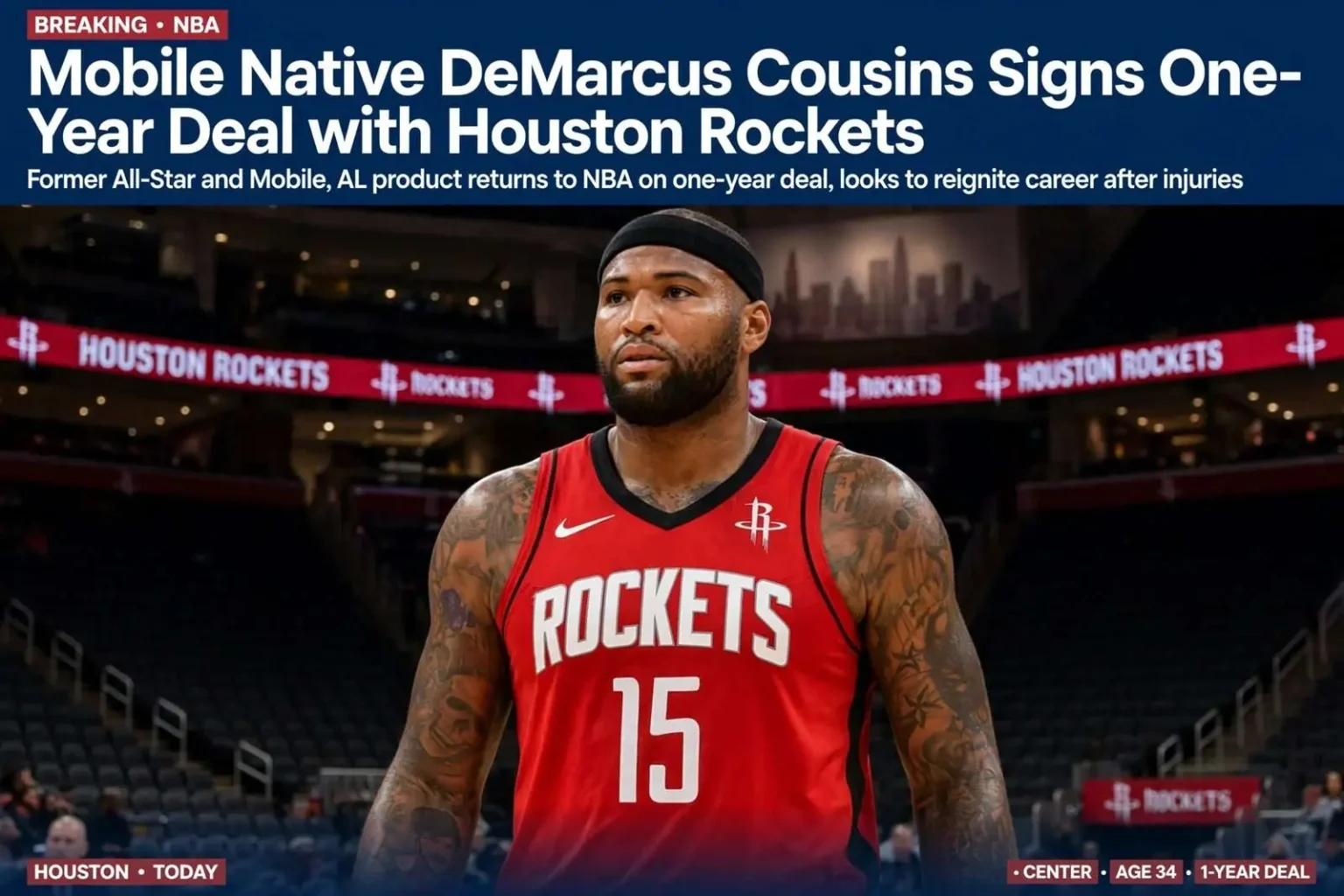
DeMarcus Cousins is getting another shot, and the former Mobile star is taking it in Texas. Multiple reports indicate that Cousins, the Mobile native once known around the NBA simply as “Boogie,” has signed a one-year deal with the Houston Rockets — the latest turn in a career that has been defined in equal parts by transcendent talent and merciless injury luck.
It has been a steep climb back for the big man. Cousins tore his Achilles tendon in 2018 while playing for the New Orleans Pelicans, an injury that has ended the careers of less gifted players, then signed with the Los Angeles Lakers — only to tear an ACL and sit out the entire 2019-20 season while rehabilitating. Two career-altering injuries in two years, with essentially no game action between them, left one of the most skilled centers of his generation starting over at an age when most players are in their prime.
Houston is now betting that the one-time All-Star can recapture at least a portion of the form that made him one of the league’s most dominant centers before the injuries. For the Rockets, it is a low-risk, high-upside calculation of the kind contenders and rebuilding teams alike have long made on wounded stars. For Mobile basketball fans, it is one more chapter for the most accomplished pro the city has produced.
From Mobile to the top of the draft
Cousins’s basketball story is inseparable from Mobile. He grew up in the city, played his high school ball in the area before finishing his prep career elsewhere, and emerged from the Gulf Coast as one of the most highly recruited big men in the country. A single season at the University of Kentucky under John Calipari was enough to make him a top-five pick, and he entered the league with a combination of size, footwork, passing vision and shooting touch that centers simply do not have.
The talent was never in question. Cousins averaged double-doubles year after year, became one of the league’s most productive offensive centers, and made the All-Star team repeatedly at his peak. He scored from the block, stepped out to shoot three-pointers like a wing, and passed out of double teams with a point guard’s eye — a skill set that foreshadowed the way the entire position would evolve and that very few players of any size have ever matched.
The complications were never just physical. Cousins’s intensity made him both a driving force and a lightning rod, drawing technical fouls and suspensions and complicating his standing with teams and referees. The talent, though, was never debatable, and for a stretch in the mid-2010s he was among the most productive players in the league on some of its least successful teams — first with the Kings, then briefly in New Orleans alongside Anthony Davis, where the pairing of two All-Star big men briefly promised to reshape the Western Conference playoff picture before injuries intervened.
The injuries that changed everything
Then came January 2018, and the Achilles. The torn tendon Cousins suffered while playing for the Pelicans is widely regarded as the most feared injury in basketball — a rupture that historically saps the explosiveness on which power forwards and centers depend. Worse luck followed: after joining the Lakers in free agency on a one-year deal meant to rebuild his value, he tore his ACL in a workout, erasing his 2019-20 season before it began.
The sequence meant Cousins went nearly two years without playing an NBA game, rehabilitating through a pandemic-disrupted league year while the roster around the league turned over. By the time he returned, he was no longer the player who anchored an offense — he was a veteran trying to prove he belonged at all, moving from team to team in short stints and fighting for minutes he once commanded by right.
Houston now offers the chance to play real minutes again. The Rockets, in a rebuilding phase and short on established interior talent, can give Cousins something contenders could not: a genuine role, a season’s worth of opportunity, and the stage on which to show what remains.
What Houston sees
The Rockets’ interest in Cousins fits a roster-building logic as old as the league. A one-year deal for an injured former star is the cheapest kind of lottery ticket in professional sports: the financial exposure is minimal, the locker-room risk is manageable, and the upside — even a partial return of Cousins’s old form — is the kind of production that cannot be bought anywhere else at that price. Young teams in particular take these fliers, because a veteran center can double as a teacher for the developing big men already on the roster.
For Cousins, the calculation is about proving durability. The questions about his game were never about skill; they were about whether his body could absorb an 82-game season and the nightly pounding that comes with playing center. A productive year in Houston — reasonable minutes, healthy knees and Achilles, evidence of the old burst — would reset his market entirely. Even modest production on a bad team would accomplish what short cameos elsewhere could not, and it would come against the young, physical frontcourts of the Western Conference, the sternest test his body will ever face again.
The fit on the floor has its own logic. A center with Cousins’s passing ability pairs naturally with young guards who can move without the ball, and his shooting range pulls opposing shot-blockers away from the rim in a way that opens driving lanes for the Rockets’ backcourt. If the legs are there, the rest of the game — the footwork, the touch, the vision — has historically come back to players of his caliber faster than the athleticism does. Houston’s coaches can deploy him in short bursts, manage his minutes carefully, and build around what his body allows rather than forcing the workload his old stardom once demanded.
Mobile’s basketball standard
Every chapter of the Cousins story lands differently in Mobile, which has produced professional athletes across every sport but has never had a basketball résumé to match his. The city’s high school gymnasiums have followed his career the way small towns follow their own — through the Sacramento years, the All-Star peaks, the trade to New Orleans, the championship pursuit that injuries derailed in Golden State, and now the long climb back through Houston.
Mobile’s basketball culture runs deep. The city and its surrounding communities have produced talent that went on to college stardom and professional careers, and Cousins stands at the top of that lineage — the player against whom every talented big man in the area is measured. Young players in Mobile gyms have grown up watching a hometown player dominate the NBA’s frontcourts, and his persistence through two catastrophic injuries has become part of the lesson he teaches by example.
The one-year deal in Houston is not the ending anyone in Mobile would have written for a player of his gifts. Careers of this arc — superstar production, catastrophic injury, exile and return — are rare, and how the Houston chapter goes will shape how the whole story is told. What is already settled is his standing in the city’s sports history: no basketball player from Mobile has ever accomplished more.
What to watch this season
The metrics that matter for Cousins in Houston are not the ones that made him famous. The scoring average that will draw notice is simply a proxy for whether he can stay on the floor — whether his body holds up across a season of real minutes for the first time in years. Foot speed on defense, the ability to finish at the rim, and how he looks landing after jumps will tell scouts more than any box score.
If the season goes well, the one-year deal becomes a springboard — a proving ground from which a contender might sign him the following summer for a playoff push that has eluded him throughout his career. If it goes badly, the Houston stint stands as the last serious chance for a player whose prime was taken by injuries rather than by decline.
Either way, the reports of the deal signal one thing with certainty: DeMarcus Cousins is not done trying. Mobile, which watched him grow from a highly touted teenager into an All-Star, will be watching the latest chapter from Houston with the same investment it has brought to every one before it.
There is also the matter of what a healthy, productive season would mean beyond Houston. Teammates, coaches and executives across the league have rooted for Cousins’s recovery, aware of how cruelly the injuries arrived at his peak. A comeback year would rewrite the final judgment on a career that, statistically, already belongs among the best of its era at the position, and it would give the Rockets exactly what rebuilding teams need most: proof that their program can restore value in players the rest of the league gave up on.