Mobile Opens Round-the-Clock Shelter as Arctic Blast Sends Gulf Coast Into the Teens
The James Seals Community Center opened around the clock with meals as an arctic blast sent Mobile and Escambia County into teens and single digits.
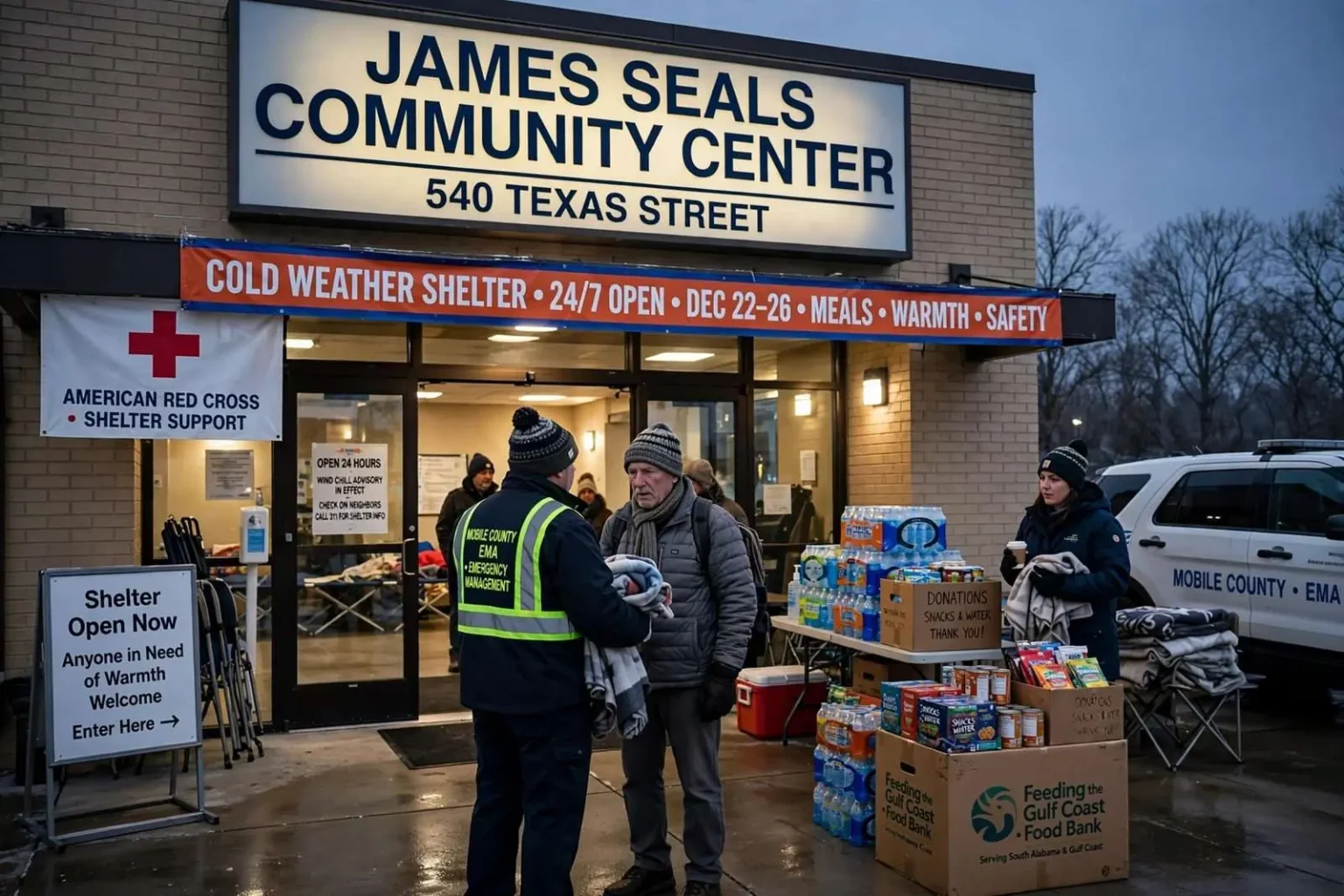
An arctic air mass pushed into the central Gulf Coast Thursday, sending wind chills into the teens and single digits and prompting Mobile officials to open an extended-hours cold weather shelter for anyone with nowhere warm to go. The activation marked the kind of all-hands response that Gulf Coast cities reserve for genuinely dangerous weather — not a hurricane in this case, but a cold snap of a severity the region rarely plans for.
The James Seals Community Center, 540 Texas Street, opened at 6 p.m. Thursday, Dec. 22 and remained around the clock until 6 a.m. Monday, Dec. 26 — covering the coldest stretch of what forecasters warned would be the region’s most dangerous cold snap in years. A wind chill advisory was in effect through Saturday morning, and the four-day window meant the shelter would operate through consecutive nights well below freezing, not merely a single cold evening.
Operating around the clock instead of overnight-only distinguishes an activation like this from the routine cold-night openings cities along the Gulf occasionally run. Residents who took refuge at the Seals Center did not have to leave during daytime hours to search for warmth elsewhere, which matters most for older adults, people with chronic illness and anyone whose exposure to the cold cannot be briefly endured and safely reversed.
Meals were provided at the center throughout the shelter’s operation, and organizers began accepting donations of snacks and water at the Seals Center starting Friday to keep supplies stocked. The donation point gave residents who wanted to help a direct, practical channel: contributions dropped off at the center went straight into the supply line supporting the people sleeping there that night.
A Coalition Assembled for the Cold
City officials said the effort was supported by the Mobile County Emergency Management Agency, the Mobile County Health Department, the American Red Cross and Feeding the Gulf Coast — a coalition mobilized because even brief sub-freezing weather can be life-threatening on the Gulf Coast. Each partner brought a distinct capability. The county EMA coordinated the response and communications that an activation of this length requires, while the Health Department connected the shelter effort to public-health outreach and medical support.
The American Red Cross contributes decades of sheltering experience, from staffing and intake procedures to feeding and cots, much of it built through the Gulf Coast’s long hurricane history. That disaster infrastructure is designed for storms, but a four-day arctic outbreak places comparable demands on it — dozens of displaced residents, round-the-clock staffing, and steady food service — and the organization’s local chapters routinely pivot that capacity to cold-weather events.
Feeding the Gulf Coast, the regional food bank serving south Alabama and neighboring stretches of the coast, supplied the food logistics that keep a shelter of this kind running across multiple days. Feeding operations at a congregate shelter involve more than delivering meals; they require reliable volume, timing that accounts for residents who arrive cold and hungry at odd hours, and the warehouse capacity to sustain service until the event ends.
Why such a coalition for a cold snap? The answer lies in how the Gulf Coast is built. Homes along the central Gulf Coast are rarely designed for single-digit wind chills — insulation is light, heating systems are sized for short mild winters, and exposed plumbing is a structural norm rather than a defect. Many residents also lack adequate heat at all, whether because of cost, failed systems or housing without any. When genuine arctic air arrives, it finds a housing stock unprepared for it.
Power demand compounds the problem. When temperatures drop far below the Gulf Coast norm all at once, heating systems run continuously and electric loads spike across the region, raising the risk of outages at precisely the moment when losing heat indoors becomes dangerous. Outages during a deep freeze also knock out the heat of neighbors who were fine at bedtime, which is one more reason round-the-clock shelter capacity matters — the population needing it can grow mid-event.
Emergency managers also emphasized the domestic side of the danger. Mobile County Emergency Management Agency officials urged residents to check on elderly neighbors, bring pets indoors, protect exposed pipes and dial 311 for information on shelter space during the freeze. Each item addresses a known pattern of cold-weather harm in the region: seniors living alone are among the most frequent victims of Gulf Coast cold snaps, pets left outside face hypothermia in conditions they would never encounter in a normal winter, and burst pipes cause damage that lasts long after temperatures recover.
Protecting exposed pipes in a Gulf Coast cold event is a task most residents rarely practice. The standard guidance — insulating or wrapping outdoor and exposed lines, opening cabinets under sinks, and allowing faucets to drip on the coldest nights — becomes urgent when overnight lows fall into the teens and hard freezes last for days. Homes built without freeze protection in mind can suffer pipe failures after a single hard night, and sustained sub-freezing stretches multiply the risk.
Why Gulf Coast Cold Is Different
Meteorologists have long noted that the same temperatures read differently on the Gulf Coast than they do farther north. A low of 25 degrees in a city built for snow is an inconvenience; the same reading in Mobile, where many homes lack the insulation, dual-pane windows and central heat considered standard in colder climates, is a genuine emergency. Wind chills in the teens and single digits — the forecast that triggered this activation — are events that most Gulf Coast residents encounter only a few times in a decade.
The timing of this event added to its danger. A multi-day outbreak spanning the Dec. 22-26 window meant the coldest nights arrived in succession, with no daytime recovery between them. Structures and pipes that endure one hard freeze can fail on the second or third; residents who lose heat on night one face a second and third night of danger; and the cumulative strain shows up in emergency calls, burst-plumbing disasters and hypothermia cases that a single-night event would not produce.
Community centers like the James Seals facility serve as the backbone of this kind of response across Mobile. The city’s network of neighborhood recreation and community centers gives emergency planners ready-made buildings in residential areas — large open rooms, kitchens, restrooms, parking and locations residents already know. Converting one into a cold-weather shelter is faster and more practical than erecting temporary facilities, and the Texas Street location places the Seals Center within reach of the central-city neighborhoods where the need for shelter is greatest.
The role of the 311 line deserves emphasis for residents navigating an unfamiliar emergency. Rather than requiring callers to track down which agency operates which shelter, the city’s information line consolidates the questions — where space is available, what hours apply, what donations are needed — into a single number. In events that change hour to hour, that single point of contact keeps residents from traveling across town to a shelter that has filled.
What Residents Were Asked to Do
Beyond the shelter itself, the response depended on ordinary residents looking out for one another. Checking on elderly neighbors — a knock on the door, a phone call, a verification that heat is working — remains the most effective safeguard in a regional cold event, because the people most at risk are often the least likely to ask for help. The same logic applies to pets, which cannot protect themselves from wind chills their coats were never built for, and to the many households where a small problem — a failed heater, a cracked window — becomes dangerous when the forecast turns historic.
The coalition’s four-day activation stands as an example of how Gulf Coast cities handle the cold events their infrastructure was never built for: open a known community center, keep it running around the clock, feed everyone who comes, and put the region’s emergency-management, public-health, sheltering and food-security organizations behind the effort. For the residents who spent the coldest nights of the outbreak at 540 Texas Street, the arrangement did exactly what it was designed to do — it kept them alive and warm until the arctic air finally moved on.
A Region That Learns From Every Freeze
Cold-weather sheltering has become a rehearsed drill along the central Gulf Coast precisely because these events, while rare, keep recurring. Every significant freeze produces lessons that carry into the next one: which buildings work best as shelters, how much food service a multi-day activation consumes, where donations bottleneck and how early the message needs to go out. By operating the Seals Center for four consecutive nights rather than one, city officials were applying the accumulated experience of past cold events to a forecast that demanded it.
The partnership structure matters as much as the building. No single agency in Mobile County maintains enough staff, cots, food and medical support to run a round-the-clock shelter for four days on its own during a holiday week. Splitting the burden — emergency management coordinating, the Health Department advising, the Red Cross sheltering, Feeding the Gulf Coast supplying — lets each organization operate within its normal capacity while the combined effort meets a demand far larger than any one of them faces alone.
For residents who followed the city’s guidance, the event also served as a checklist for the next freeze. Wrap the pipes before the low arrives, not after. Charge phones while the power holds. Identify the neighbors who live alone and the family members who will need a call. Keep the 311 number handy. None of these steps is difficult, and each one has outsized value when the region’s next arctic outbreak sends wind chills back into the single digits without much warning.