
Mobile Organizers Join Blackout Day Push to Steer Spending to Black-Owned Businesses
Mobile organizers backed Blackout Day 2020, urging shoppers to withhold spending for a day or direct it to Black-owned businesses across the region.
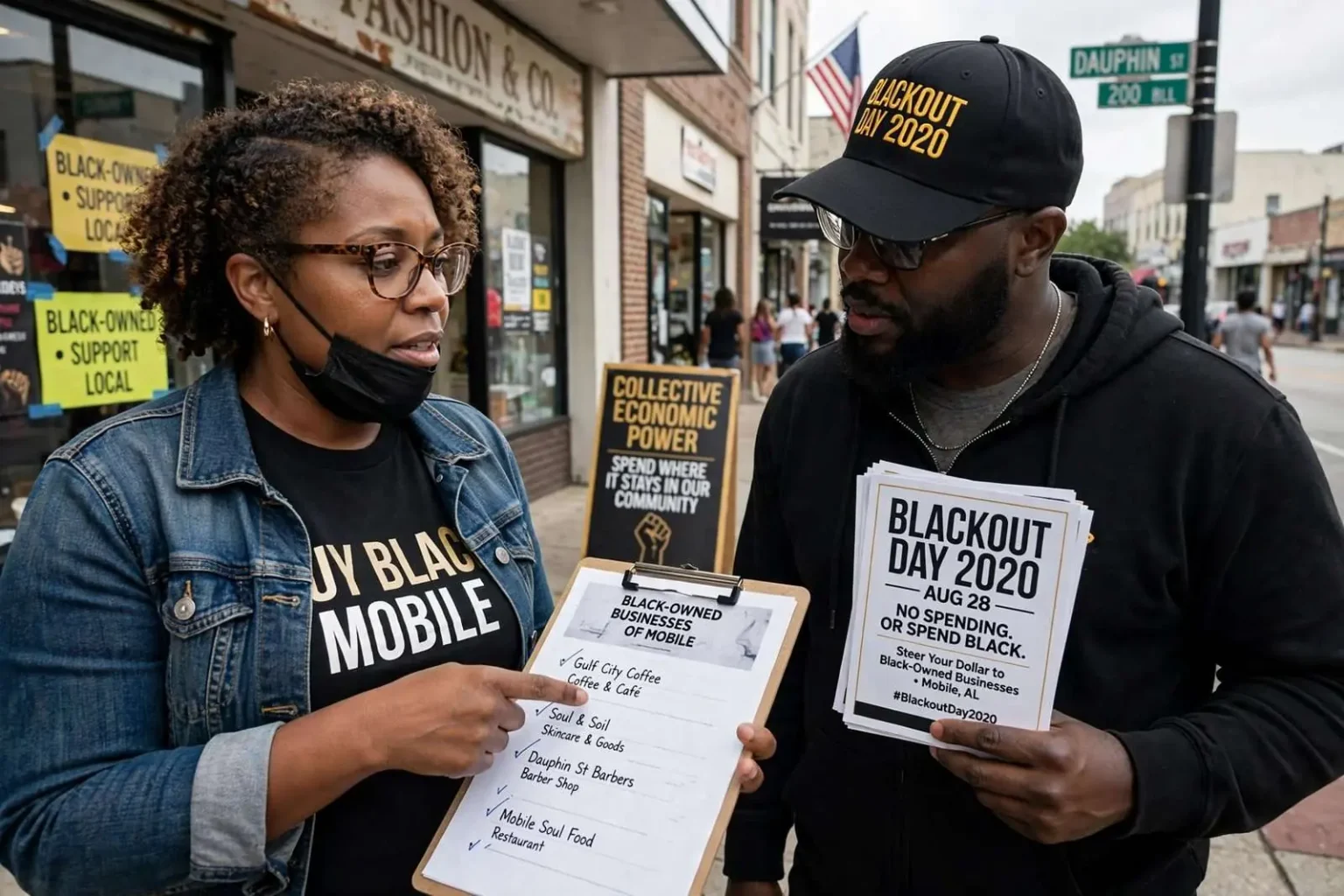
A national campaign asking Black Americans to withhold their spending for a single day, or to direct it exclusively to Black-owned businesses, drew organizers in Mobile into the effort. The campaign, called Blackout Day 2020, urged participants to demonstrate the scale of their collective economic power by simply not spending it — or by spending it only where it would circulate within the Black community. In Mobile, as in cities across the country, local organizers treated the day of action as both a protest and a lesson, pairing the boycott with practical tools that made it easy for residents to find Black-owned businesses to support.
The campaign, called Blackout Day 2020, grew out of a social media message posted in May by organizer Calvin Martyr, in the weeks after the deaths of Ahmaud Arbery and Breonna Taylor drew national attention. Protests spread further after the deaths of George Floyd and Rayshard Brooks during encounters with police. The spring of 2020 had already been transformed by the coronavirus pandemic, which closed businesses, cost millions of jobs and kept much of the country at home; the protest wave that followed Arbery, Taylor, Floyd and Brooks gave the economic-action idea a ready-made audience of millions already organizing online.
“If we can do it for one day, it would shut the whole system down,” Martyr said in the video that launched the campaign. The message spread rapidly across social media platforms, where users shared graphics, hashtags and countdown posts urging participation. The rhetoric was deliberately dramatic, but the underlying premise — that Black consumers could make their economic weight felt by temporarily withdrawing it — drew on a long tradition of economic protest in American civil rights history.
Martyr framed the idea as an economic tactic borrowed from the civil rights movement. “If we unite like they did in Montgomery, Alabama, when not one single Black person rode the bus,” he said. “That right there is what caused the civil rights legislation to come, because they touched them pockets.” The reference was to the Montgomery Bus Boycott of 1955 and 1956, when Black residents of Alabama’s capital — the majority of the bus system’s ridership — stayed off city buses for 381 days to protest segregation. The boycott helped end segregated public transit and cemented economic pressure as a signature strategy of the movement.
That history gave Blackout Day 2020 an Alabama resonance that organizers in Mobile did not have to explain. The state’s role as the crucible of the modern civil rights movement — Montgomery, Birmingham, Selma — is taught in its schools and marked in its museums, and the boycott Martyr invoked remains one of the most studied campaigns of nonviolent economic pressure in American history. Invoking it connected the 2020 campaign to a lineage that Alabamians, Black and white, know well.
The Local Push in Mobile
In Mobile, Kimberly Pettway has been among those encouraging residents to buy Black, arguing that the visibility of that spending is the point. “I think when people start to recognize how much we contribute to their day to day, they’re much more likely to adhere to the requests that we may have,” Pettway said. “But none of this will resolve without policy and legislation.” Her framing reflected a two-track approach common among the campaign’s local organizers: change individual behavior now, and press for structural change through government.
Pettway’s emphasis on policy underscored a recurring theme of the summer’s activism — that economic gestures, however symbolically powerful, were a starting point rather than a destination. Organizers across the country paired boycotts and buy-ins with voter registration drives, petitions and calls for specific legislative responses. In Mobile, that meant urging participants not simply to redirect a single day’s spending but to build lasting habits around where they shop, bank and invest.
Organizers locally maintained a working list of Black-owned businesses through the Buy Black Alabama and Black Owned Businesses of Mobile pages on Facebook, giving participants somewhere to look before spending. The pages functioned as crowd-sourced directories, mixing restaurants and barber shops with service providers, retailers and professional firms. For participants who wanted to honor the campaign’s spirit but did not know where to start, the lists converted a day of abstinence into a practical exercise in redirecting money toward neighbors.
Those directories addressed a problem that has long limited buy-black campaigns: consumers often say they want to support Black-owned businesses but cannot easily identify them, particularly outside of obvious categories like food service. By collecting and publicizing names, the Mobile-area pages lowered that barrier and gave business owners something valuable in return — visibility to a motivated audience precisely when interest was highest.
The effort also carried meaning beyond a single day’s transactions. Supporters argued that money spent at Black-owned establishments is more likely to stay in surrounding neighborhoods, support local hiring and build wealth in communities that have historically had less access to capital. In Mobile — a city whose history includes both a proud Black commercial tradition and the dislocations of urban renewal — the argument about where dollars circulate has deep local roots.
The Dollars Behind the Argument
Black Americans spent more than $1 trillion on consumer goods in 2018 alone, according to figures from Nielsen that organizers cited in making their case about collective purchasing power. The number became a centerpiece of the campaign’s social media messaging, repeated in graphics and videos as evidence that a coordinated withdrawal of even one day’s spending would be felt. Economists note that a one-day shift in consumption, by itself, moves few needles; the campaign’s organizers countered that the point was demonstration, not disruption — showing participants their own power so they would exercise it deliberately year-round.
The trillion-dollar figure also reframed Black consumers not as a niche market but as a national economic force, comparable to the gross domestic product of mid-sized countries. Marketers have long tracked that spending power, and the Nielsen data that circulated during Blackout Day had been compiled precisely because companies want to understand and reach Black audiences. Organizers turned the same statistic to a different purpose: if corporations considered that spending worth courting, Black consumers could consider it worth withholding.
Pettway said the exercise was as much about local pride as pressure. “Our dollar means a lot,” she said. “It helps us to kind of reflect on that and build this sense of community pride around the things we contribute to this society.” That emphasis on pride distinguished the Mobile effort from pure boycott messaging. The goal, as she described it, was not only to signal dissatisfaction to the wider economy but to encourage Black residents to see their own economic activity as an expression of community investment.
In a year when the pandemic had hit minority-owned businesses especially hard — early shutdown orders, uneven access to federal relief loans and reduced foot traffic fell hardest on small firms with thin reserves — the local push carried practical urgency. Encouraging spending at Black-owned establishments was, in the summer of 2020, also a survival strategy for businesses that lacked the reserves to endure a prolonged downturn. Organizers said as much when they urged participants to think of the campaign as mutual aid expressed through the marketplace.
Whether measured in one day’s redirected dollars or in longer-term shifts in buying habits, the campaign’s organizers in Mobile treated Blackout Day 2020 as the beginning of a conversation rather than its conclusion. The Facebook directories continued after the day passed, the policy demands remained on the table, and the history Martyr invoked — Montgomery’s bus boycott, “touching them pockets” — served as both inspiration and reminder that economic campaigns in Alabama have changed the country before.
For the city’s Black-owned businesses, the attention brought by the campaign offered exposure that advertising budgets rarely buy. For participants, it offered a concrete answer to a question that followed every protest that summer: what can one person actually do? The answer Mobile organizers gave was the same one the national campaign offered — spend deliberately, spend visibly, and spend where it builds something.
The campaign also unfolded against the backdrop of a national reckoning over race that had filled streets in Mobile and cities across the country. Demonstrations in the weeks after Floyd’s death drew crowds to downtown Mobile, as they did in Daphne, Fairhope and other Gulf Coast communities, and many participants described the economic campaign as a way to keep pressing when the marches ended. For organizers, that continuity mattered: boycotts, buy-ins, petitions and elections were presented as parts of the same toolkit rather than alternatives to one another.
Historians of the civil rights movement often point out that economic pressure worked in Montgomery precisely because it was organized, sustained and tied to specific demands — not because a single day of sacrifice alone changed minds. The bus boycott lasted more than a year, required an elaborate carpool system and weathered arrests and bombings before the Supreme Court struck down bus segregation. Blackout Day’s organizers borrowed the vocabulary of that campaign while acknowledging, implicitly, that a one-day action was a signal of intent rather than a finished strategy.
That distinction shaped how the Mobile effort was discussed afterward. Supporters pointed to the directories, the pride messaging and the policy demands as evidence that the campaign was designed to outlast its own headlines. Skeptics questioned whether short campaigns change much. Both camps, though, agreed on the underlying premise that Pettway put plainly: none of it resolves anything without policy and legislation, and the spending was meant to build the leverage to pursue both.