
Mobile Plans $10 Million McGregor Avenue Expansion With Roundabout at Dauphin Street
Mobile plans to widen McGregor Avenue and build a roundabout at Dauphin Street in an $8-10 million project mostly funded federally.
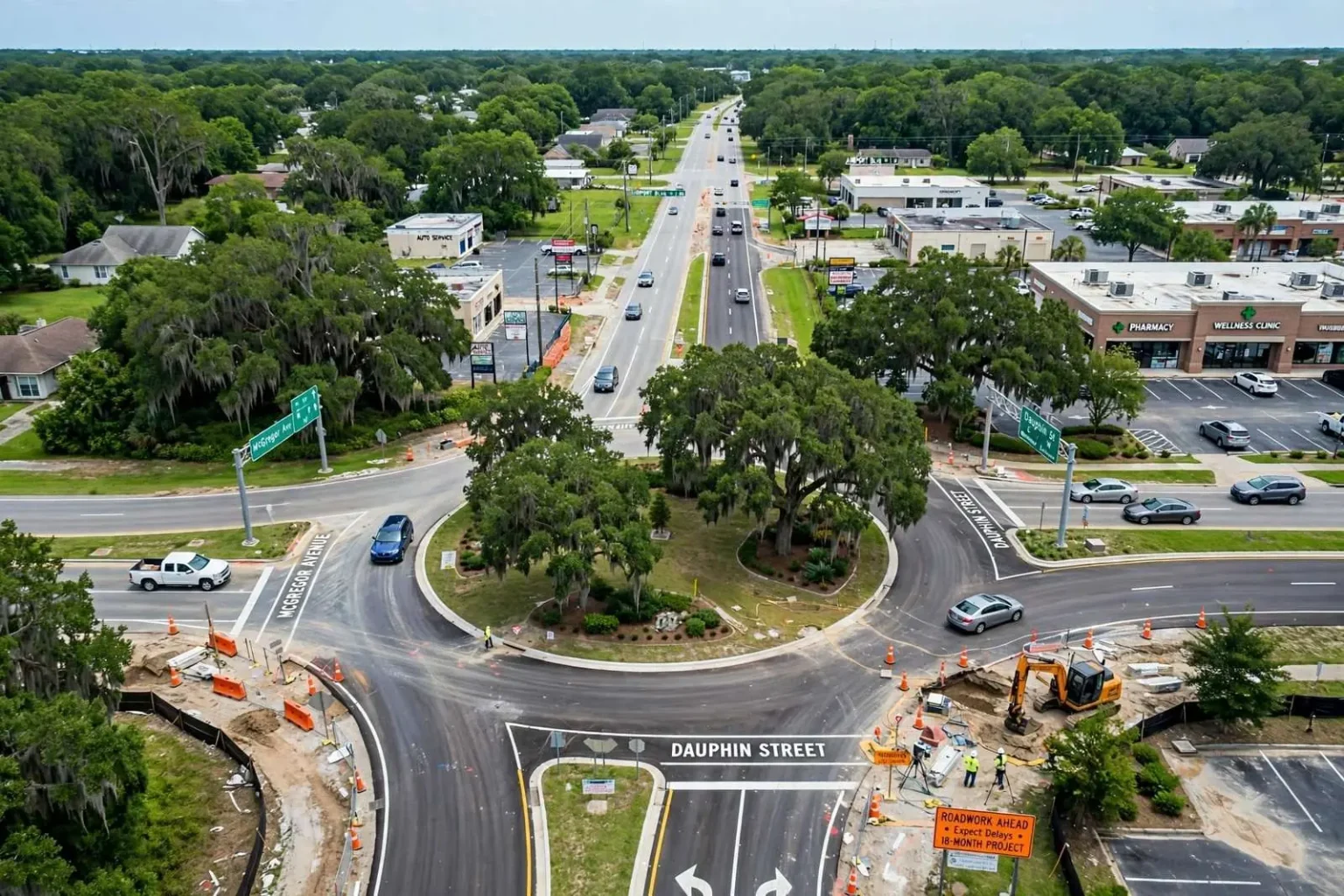
One of Mobile’s most frustrating commuter corridors is due for a major overhaul. City engineers have unveiled a plan to widen McGregor Avenue from two to three lanes and install a roundabout at its congested intersection with Dauphin Street, easing the daily squeeze between Dauphin Street and Airport Boulevard.
City Engineer Nick Amberger said the design directly targets a bottleneck drivers know well. “It’s very heavy traffic movement between Dauphin Street and McGregor hitting Airport Boulevard,” Amberger said. “All the designs in the study show that the roundabout should ease up the traffic there.”
Anyone who has driven McGregor Avenue during the morning or afternoon rush knows the pattern. The street threads through one of Mobile’s busiest residential and commercial corridors, carrying commuters from the Spring Hill and West Mobile neighborhoods toward the office towers, hospitals and retail centers clustered along Airport Boulevard. For much of its length, McGregor is a tight two-lane road with limited turn lanes, so a single driver waiting to turn left can stack up traffic for blocks — and the intersection with Dauphin Street, where two of the city’s most heavily traveled east-west and north-south routes meet, has long been one of the corridor’s worst pressure points.
The redesign addresses both problems at once. Adding a third lane gives through-traffic a way around turning vehicles, while the roundabout at Dauphin Street replaces a signalized intersection whose cycle times leave drivers idling through multiple lights at peak hours. Roundabouts keep traffic moving continuously at lower speeds, and transportation planners across the country have increasingly turned to them for exactly this kind of congested crossroads, where a signal can no longer handle the volume without long backups spilling into adjacent streets.
Federal Dollars Cover Most of the Bill
The project carries an estimated price tag of $8 million to $10 million, and the city is leaning on outside funding to get it built. The Metropolitan Planning Organization requested federal transportation money administered by the Alabama Department of Transportation, which will cover roughly 80 percent of the cost, leaving the city to fund the remaining 20 percent, according to ALDOT’s James Gordon.
That funding structure is standard for major urban road work in Alabama. The Mobile area’s Metropolitan Planning Organization — the federally mandated body that prioritizes transportation projects for Mobile and Baldwin counties — scores and ranks candidate projects and requests federal highway funds through ALDOT, which administers the money. The federal-local split means a project that would strain the city’s capital budget on its own becomes feasible, with Mobile’s share of an $8-to-$10-million project landing in the range of a couple of million dollars spread over the life of the work.
For city officials, the outside funding makes the timing attractive. Urban reconstruction projects of this scale typically move through years of study, design and funding cycles before a shovel ever hits the ground, and a corridor that is fully designed and fully funded is well ahead of the curve. McGregor Avenue’s overhaul has passed through that pipeline, and the study phase included traffic modeling of the roundabout concept — the analysis Amberger cited when he said every design examined showed the roundabout easing the congestion at Dauphin Street.
A Long Construction Window Ahead
According to Amberger, the project is fully designed and construction is expected to last about 18 months once work begins. Portions of McGregor Avenue will close during construction, and drivers will be steered by posted detour signs.
An 18-month construction window on a commuter corridor is a significant disruption, and city engineers are the first to say so. Work of this kind typically proceeds in phases — relocating utilities, rebuilding the roadway section by section, then finishing intersections last so that the new configuration opens all at once. Detour routes will push drivers onto parallel streets, and residents along McGregor should expect heavy equipment, lane closures and changed access to some driveways and side streets while the work is underway. Drivers who use the corridor daily are advised to build in extra time or find alternates before the closures begin rather than after.
Reaction among commuters has been mixed but largely hopeful. Some residents welcomed any relief for morning backups along Airport Boulevard, while others argued that added lanes alone won’t solve congestion on a corridor this busy.
The skepticism is a familiar refrain in growing Southern cities. West Mobile has added homes, schools and shopping for decades, and every capacity improvement seems to fill up within a few years of opening. Planners counter that the McGregor project is not trying to solve every congestion problem in West Mobile — it is engineered for the specific, measurable bottleneck between Dauphin Street and Airport Boulevard, where the study showed the worst recurring delays. The roundabout, in particular, is aimed at the crashes and the stop-and-go churn that plague signalized intersections under heavy load, and smoother flow there relieves pressure back up the corridor toward Old Shell Road and beyond.
What the Roundabout Means for Drivers
For drivers who have not used one, modern roundabouts take some getting used to. Traffic moves counterclockwise around a central island, entering drivers yield to vehicles already circulating, and speeds through the circle are kept low by design. The safety record is the main selling point: because there are no left turns across oncoming traffic and no high-speed, T-bone angle of impact, injury crashes at converted intersections typically fall sharply. Pedestrian crossings are placed away from the circulating lane, and the lower speeds make drivers more likely to see and stop for people in the crosswalk. The trade-off is learning curve and throughput limits for very large vehicles, which engineers account for with truck aprons that let trailers ride over the inner curb.
The McGregor Avenue project also reflects a broader push by the City of Mobile to modernize aging infrastructure along its most traveled corridors. McGregor connects some of the city’s oldest and most established neighborhoods, and the road bed, drainage and utilities beneath it have seen piecemeal repairs over the years rather than a full rebuild. Reconstructing the corridor gives the city a chance to bring those elements up to current standards at the same time the roadway is widened — work that would be far more expensive to do piecemeal later.
For now, commuters along one of Mobile’s most talked-about corridors are watching the calendar. When construction begins, the detours will test everyone’s patience for 18 months; when it ends, the daily squeeze between Dauphin Street and Airport Boulevard — the bottleneck Amberger and his engineers set out to fix — should finally start to loosen.
The corridor’s importance is easy to underestimate until you map what runs along it. McGregor Avenue serves as one of the primary north-south spines of West Mobile, funneling traffic between the Spring Hill neighborhood — with its historic homes, schools and the campus institutions nearby — and the dense commercial belt along Airport Boulevard, where grocery stores, restaurants, medical offices and retail centers generate a constant churn of turn movements all day long. In between sit dozens of residential streets whose only practical outlet is McGregor itself, which means the two-lane road collects neighborhood traffic from every block before delivering it into the Airport Boulevard clog.
That geometry explains why the intersection with Dauphin Street became the corridor’s choke point. Dauphin is one of Mobile’s longest east-west arteries, running from downtown all the way out toward the western city limits, and the traffic it delivers into McGregor at rush hour can exceed what the intersection was ever designed to process. Drivers heading south on McGregor toward Airport wait through signal cycles while Dauphin traffic passes; drivers turning from Dauphin onto McGregor do the same in reverse. The result is the stop-start crawl that commuters have complained about for years, and the kind of pattern that traffic models consistently show a roundabout untangling.
How the MPO Funding Process Works
For residents curious why the project is funded the way it is, the answer lies in federal transportation law. Congress funnels highway and surface-transportation money to the states, and the states program a share of it through metropolitan planning organizations in urbanized areas. The local MPO — a board of elected officials and transportation agency representatives from Mobile and Baldwin counties — maintains a long-range plan and a shorter-term transportation improvement program, and projects like the McGregor rebuild win a place on that list through the MPO’s scoring process. Once programmed, ALDOT administers the federal funds, handles letting and oversight for major work, and the local government pays its matched share.
The 80-20 split is the standard formula for many federal-aid projects, and it is why cities of Mobile’s size can attempt multi-million-dollar corridor rebuilds at all. Mobile’s 20 percent match on a project estimated between $8 million and $10 million is real money for a municipal budget, but it buys a $10 million reconstruction for a fraction of the cost, and the city engineers who prioritized the project argued the congestion relief along one of the city’s most-used commuter routes justified the local investment many times over.