
Mobile Police: Bomb Threat at Schillinger Road Walmart a Hoax
Mobile police determined a bomb threat that cleared the Walmart Supercenter on Schillinger Road was a hoax. No one was injured.
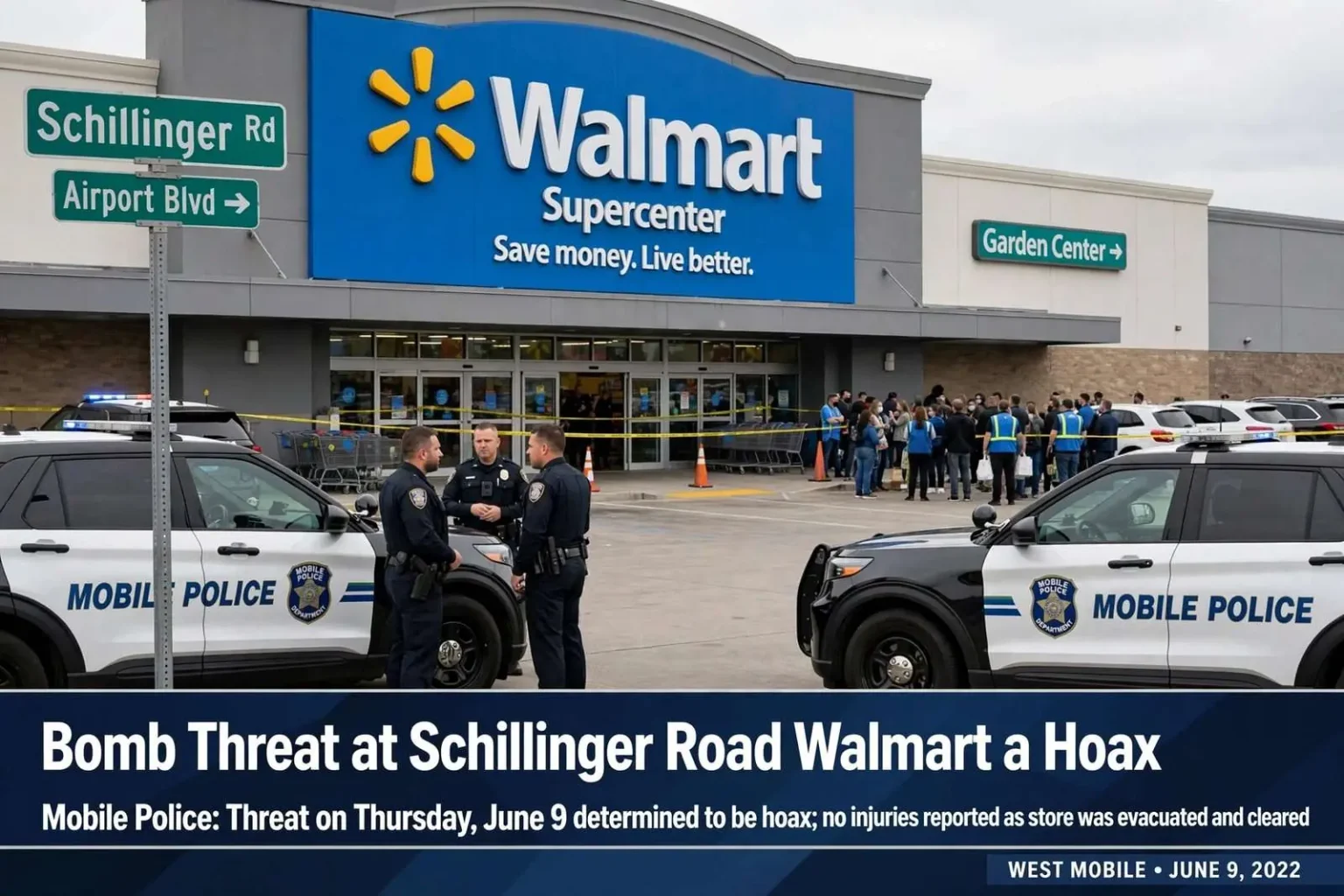
A bomb threat that emptied a busy Mobile Walmart Supercenter turned out to be a hoax, according to the Mobile Police Department. The threat was made Thursday, June 9, at the Walmart Supercenter on Schillinger Road near Airport Boulevard. A customer’s Facebook post described store management getting on the intercom and ordering everyone out of the building. Police said no one was injured.
The department did not say whether it had identified the person responsible or whether an arrest was expected, and the investigation’s status remained unclear. What was clear was the disruption: hundreds of shoppers and employees poured out of one of west Mobile’s busiest retail locations during business hours, first responders converged on the scene, and the store sat empty while officers cleared the building.
How the threat unfolded
The Walmart Supercenter on Schillinger Road sits in the heart of west Mobile’s retail corridor near the Airport Boulevard intersection, one of the busiest commercial areas on the city’s western side. When the threat arrived on Thursday, June 9, store management followed the standard script for such incidents: employees moved customers out of the building, and the store was emptied while police responded.
A customer at the scene captured the evacuation on Facebook, describing how management took to the intercom and ordered everyone out of the building. That post spread the news faster than any official channel could, reaching friends and family members of people inside the store within minutes. In an era when nearly every shopper carries a phone with a camera, the social media account of an evacuation has become as much a part of these incidents as the police response itself.
The police response
Mobile Police Department officers responded to the scene and worked to determine whether the store was safe. Clearing a building the size of a Walmart Supercenter takes time — the retail floor alone covers well over 100,000 square feet, and the building includes stockrooms, loading areas and garden sections that must all be checked. Officers said no one was injured in the evacuation, and the department’s preliminary determination was that the threat was a hoax.
Determining that a threat is a hoax does not mean the investigation ends. Police still work to trace where the threat came from, whether it was called in, written, or delivered in person, and who was responsible. The department did not say whether it had identified a suspect or whether an arrest was expected, and the status of the investigation remained unclear in the days after the incident.
Why bomb threats are treated seriously
Even a hoax threat consumes enormous public resources and puts people at risk. An evacuation of a crowded big-box store means moving hundreds of people quickly, including elderly shoppers, children and people with limited mobility, and it places employees in the position of managing a frightened crowd. Vehicles streaming out of the parking lot create traffic hazards, and responders who converge on the scene are unavailable for genuine emergencies elsewhere in the city.
That is why false reporting is a crime in Alabama. Under state law, falsely reporting a bomb or other destructive device is a felony, and a conviction can carry prison time along with restitution for the cost of the response. Prosecutors treat these cases seriously precisely because the threat emptied a store and mobilized a police response regardless of whether anyone actually placed a device.
The retail playbook
Large retailers maintain written procedures for bomb threats and similar emergencies, and the sequence described at the Schillinger Road store matches the standard playbook: take the threat seriously, evacuate without discussion, call police, and let officers make the decisions about reentry. Store employees receive training on moving customers out quickly and assembling them at a safe distance, and managers are responsible for accounting for staff once the building is clear.
The playbook reflects hard lessons from across the retail industry. A threat that proves false costs a store an afternoon of business; a threat that proves true and is ignored can cost lives. Management’s decision to clear the building — and to use the intercom to do it plainly and quickly — was the correct one, whatever the final finding about the threat’s origin.
West Mobile’s busiest retail corner
The Schillinger Road location serves a stretch of west Mobile where suburbs, schools and shopping centers have spread along Airport Boulevard, Schillinger Road and the surrounding arterials. The area’s Walmart Supercenter functions as more than a store — it is a grocery source, a pharmacy and a crossroads for a broad swath of the city’s western residential districts, which is why an afternoon evacuation there touched so many households at once.
The store’s location also shaped the response. West Mobile sits some distance from the police precincts and fire stations closest to downtown, and a major retail evacuation draws multiple units. Neighboring businesses along the corridor watched the scene unfold, and some customers who had planned to shop that afternoon simply drove to other stores, spreading the disruption through the area’s afternoon commerce.
Social media and the modern evacuation
The Facebook post that described the intercom announcement was a small detail with larger significance. Incidents that once became public hours later, through a press release or an evening newscast, now circulate in real time through the posts of the people standing in the parking lot. That speed carries benefits — family members learned quickly that their relatives were safe — and risks, since early accounts are incomplete and speculation fills the gaps official information has not yet filled.
Police departments increasingly monitor those channels during incidents, both to correct misinformation and to gather evidence, since posts and photos taken by bystanders often document details useful to investigators. In the Schillinger Road case, the customer’s post preserved an account of how the evacuation was conducted — management on the intercom, ordering everyone out — that became part of the public record of the day.
After the all-clear
Once officers cleared the building and determined no device was present, the store could be restocked and reopened, and customers filtered back in as word spread that the scene was safe. Employees returned to shifts interrupted mid-task, shopping carts stood where the evacuation had left them, and refrigerated goods were checked for the time they had spent without customers minding the cooler doors.
The lingering question after a hoax is always the person behind it. Bomb threats against retail stores most often come from individuals seeking disruption, revenge against a particular business, or a diversion from something else, and investigators pursue them through phone records, store surveillance and witness accounts. The Mobile Police Department’s statement that the investigation’s status remained unclear left that question open — and left open the possibility that charges could follow.
A false alarm with real costs
The June 9 episode ended without injury, which is the best outcome these incidents allow. But it consumed an afternoon of police work, emptied a store of several hundred people, and unsettled a busy west Mobile shopping corridor — all for a threat that proved false. For the customers and employees who filed out of the Schillinger Road Walmart while the intercom ordered everyone out, the day was a reminder that a threat, even a hollow one, is treated as real until proven otherwise.
For anyone tempted to make such a call, the case illustrates the stakes: a felony statute, a police investigation that continues after the store reopens, and the full weight of a department’s resources aimed at finding whoever made the threat. The hoax emptied the store for a few hours. The consequences, when the person responsible is found, last considerably longer.
What to do if a threat happens near you
The Schillinger Road evacuation offers a useful model for anyone caught in a similar incident. Move out promptly when store employees direct it — evacuation orders during a threat are not the moment to finish checking out or to question the decision. Take personal belongings only if they are within easy reach, leave the orderly flow of people rather than pushing past it, and once outside, move to the designated assembly distance rather than crowding the entrance, which keeps the area clear for responders.
Family members watching from afar should rely on official information rather than rumor. A post on social media may be accurate, but the police department’s statements and the store’s announcements are the sources that carry authority, and updated instructions about reunification or reentry come through them.
The pattern of threats to retail stores
Bomb threats against retail locations follow recognizable patterns nationwide. They spike during periods of social tension, they often arrive during peak shopping hours for maximum disruption, and the overwhelming majority prove false. That knowledge does not change the response — every threat is handled as if real — but it shapes the aftermath, where investigators work through the short list of usual motives and the evidence trail left behind.
Stores in high-traffic corridors like west Mobile’s Airport Boulevard and Schillinger Road area are attractive targets precisely because they are busy: a threat there guarantees a large evacuation, a heavy police response and plenty of attention. The Schillinger Road Walmart’s afternoon on June 9 fit the pattern exactly — a crowded store, a prompt evacuation, a full emergency response, and a hoax behind it all.
Where the case stood
As of the reporting following the incident, Mobile police had confirmed the essentials: a threat on Thursday, June 9, at the Schillinger Road Supercenter near Airport Boulevard, an evacuation carried out through the store’s intercom, a determination that the threat was a hoax, and no injuries. The department had not said whether a suspect had been identified or an arrest was expected, and the investigation’s status remained unclear.
That uncertainty is normal in the days after a hoax threat. Tracing the source takes time, and departments release details of arrests only when they are made. What residents of west Mobile could take from the episode was reassurance about the response: the system worked as designed, the store emptied quickly, no one was hurt, and the false alarm cost the community an afternoon rather than anything worse.