
Mobile Police identify 3 killed in Jeep-train collision on Dauphin Island Parkway
Mobile Police identified the three people killed when a Jeep Wrangler struck a train beneath the I-10 overpass at Dauphin Island Parkway.
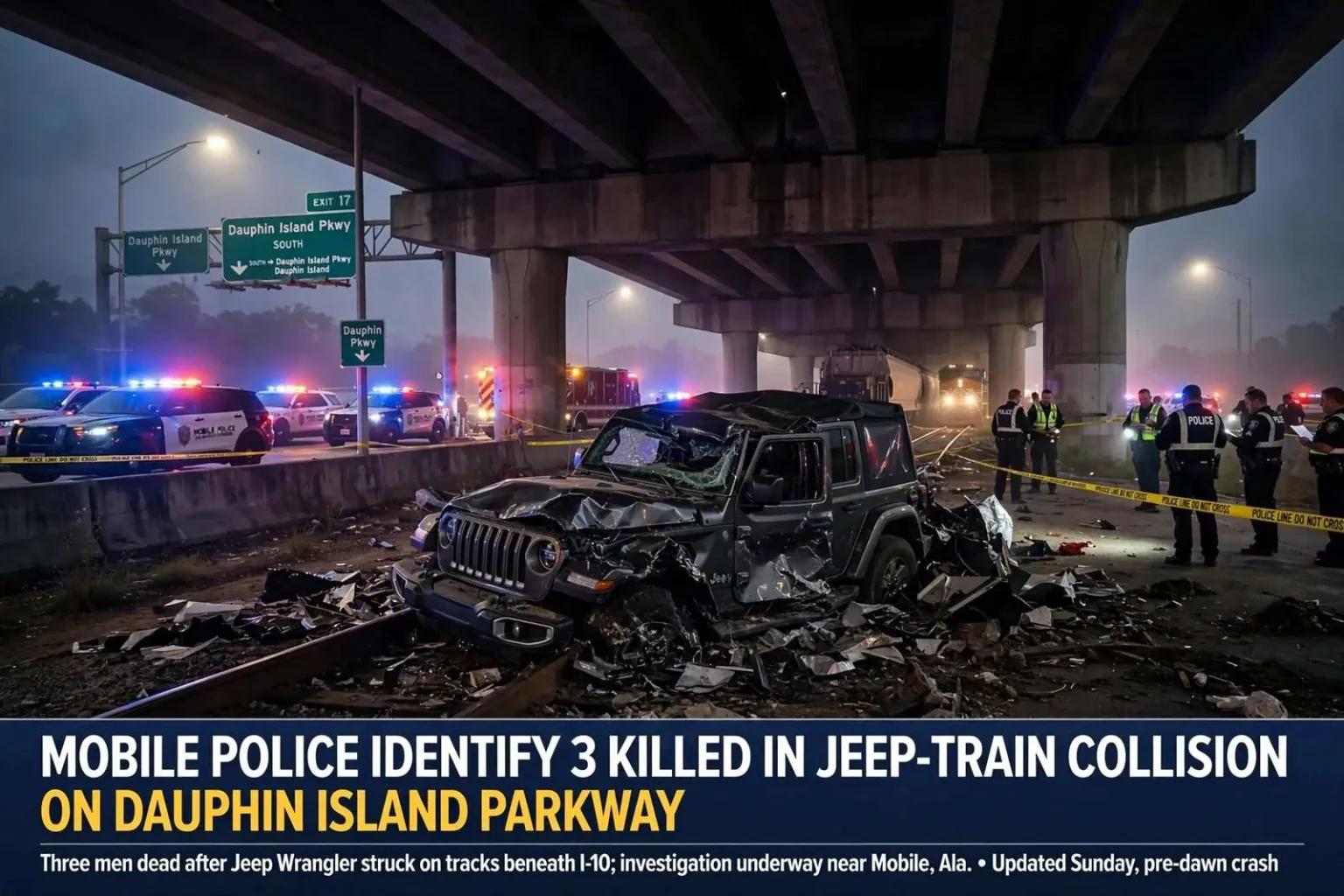
MOBILE, Ala. — Mobile Police have identified the three people killed early Sunday when a Jeep Wrangler crashed onto railroad tracks beneath the Interstate 10 overpass at Dauphin Island Parkway, in a collision that ended when a train struck the disabled vehicle.
The driver was 28-year-old Justin McCreary of Mobile. The two rear-seat passengers were identified as 27-year-old Jeremy Patterson of Eight Mile and 27-year-old Charles Gaston of Mobile, according to a release from Mobile Police Department public information officer LaDerrick Dubose. All three died in the crash, which occurred in the pre-dawn hours on the south side of the city.
Preliminary investigation shows the Jeep went off the exit ramp onto the tracks about 4:39 a.m. The ramp in question carries traffic from eastbound Interstate 10 down to southbound Dauphin Island Parkway, a curved connector that passes beneath the highway overpass and crosses the railroad line at the bottom. The front-seat passenger escaped as a train approached, but the train was unable to stop before striking the vehicle with the three others inside.
The Crash Sequence
The details released by police sketch a rapid, deadly chain of events. A vehicle leaving eastbound I-10 at the Dauphin Island Parkway exit came off the ramp, left the roadway, and came to rest on the railroad tracks that run beneath the overpass. At least one occupant — the front-seat passenger — was able to get out of the vehicle in the minutes before a train arrived. Three others, the driver and both rear-seat passengers, did not escape in time, and the train, which by the physics of its mass and speed requires a mile or more to stop even under full emergency braking, could not avoid the Jeep.
A fourth occupant, a female passenger, was taken to the hospital with non-life-threatening injuries. Her survival, like that of the front-seat passenger who escaped, reflected the narrow window between the vehicle coming to rest on the tracks and the train’s arrival — a window measured in minutes or less, and one that closed for the three occupants who were unable to free themselves from the wrecked Jeep.
The Scene and the Investigation
The eastbound I-10 exit to southbound Dauphin Island Parkway was closed for several hours while investigators worked the scene. Fatal crashes on or near rail lines bring a multi-agency response: Mobile Police conduct the investigation, railroad officials manage the train and the tracks, and the railroad’s own investigators document the collision under federal rules that govern train-involved accidents. The closure of the exit rerouted early-morning traffic while investigators reconstructed the vehicle’s path and documented the scene.
Investigators in such crashes work to answer a series of questions: why the vehicle left the ramp, how fast it was traveling, whether impairment or a medical event played a role, and why the occupants who died were unable to escape the vehicle before the train arrived. Vehicle damage from a train impact is extensive, and reconstructing the pre-impact positions of the occupants is part of the process that determines the official account of what happened.
The Intersection Where the Crash Happened
The site beneath the Interstate 10 overpass at Dauphin Island Parkway is one of the more complicated interchanges on Mobile’s south side. Dauphin Island Parkway — known to locals as the DIP — runs south from the city toward the communities along the bay and ultimately to Dauphin Island itself. The highway overhead carries Interstate 10 traffic between the George Wallace Tunnel downtown and the Bayway bridges across Mobile Bay, and the exit ramp from eastbound I-10 curves down to the parkway, crossing railroad tracks that serve the Port of Mobile’s line along the area.
Rail crossings adjacent to highway ramps present a known hazard combination: a driver who loses control on a curve can end up on the tracks, and a vehicle stopped on the tracks there may have limited escape options in the moments before a train arrives. The tracks beneath the overpass carry freight traffic through the corridor, and trains operating through urban Mobile move at speeds that make stopping distances enormous — a fully loaded freight train can take more than a mile to halt, which is why a disabled vehicle on the tracks is treated as an immediate emergency by railroad dispatchers.
Trains and Disabled Vehicles: A Recurring Gulf Coast Tragedy
Collisions between trains and stranded vehicles are among the deadliest crashes that occur on the nation’s rail network, and they follow a grimly consistent pattern. A vehicle leaves the road for any of a dozen reasons — speed on a curve, impairment, a medical emergency, weather, or another collision — and comes to rest on the tracks. The occupants who can move get out; the ones who are injured, trapped, or disoriented do not. Trains cannot swerve, and their stopping distance means that even a crew that sees the vehicle ahead has little chance of halting in time.
Federal statistics have documented for decades that vehicle-train collisions at crossings and along rail lines kill far more often than ordinary road crashes of comparable frequency, because the force involved is so much greater. The safety guidance repeated by railroads and safety agencies is blunt: if a vehicle is stuck on the tracks, get everyone out and away from the vehicle immediately, and move at an angle toward the train — away from the point of impact — because debris from a collision scatters far beyond the tracks themselves.
The Victims
The three men killed were identified by police as Justin McCreary, 28, of Mobile, the driver; and Jeremy Patterson, 27, of Eight Mile, and Charles Gaston, 27, of Mobile, both rear-seat passengers. Eight Mile is a community in northern Mobile County along the U.S. Highway 45 corridor, one of the neighborhoods within the wider Mobile area from which the Jeep’s occupants had come. The release from officer LaDerrick Dubose, the department’s public information officer, gave the names, ages, and hometowns in the standard form police use when they have notified or are working to notify the victims’ families.
The crash left the survivors — the front-seat passenger who escaped and the female passenger hospitalized with non-life-threatening injuries — as witnesses to what happened in those minutes on the tracks. Their accounts, along with the physical evidence from the scene, would inform the final determination of why the Jeep ended up where it did in the dark at 4:39 on a Sunday morning.
How Mobile Police Investigate Fatal Crashes
Fatal traffic crashes in Mobile are investigated by the police department’s traffic unit, which handles reconstruction and prepares findings for prosecutors when criminal charges are possible. A reconstruction involves measuring and photographing the scene, mapping the vehicle’s path from the ramp to the tracks, documenting the damage from the train impact, and gathering any available camera footage — from the railroad’s own crossing cameras, from nearby businesses, or from sources along the corridor. Toxicology testing of the driver is standard in fatal crashes, and the results become part of the case file weeks later.
The hours-long closure of the eastbound exit to southbound Dauphin Island Parkway reflected the scale of that work. Investigators cannot reopen a scene involving a train strike until the railroad’s obligations are satisfied, the wreckage is documented and removed, and the roadway itself is inspected for damage. Traffic was routed around the closed exit while the work proceeded, with the interchange returning to normal service later in the morning.
The Railroad’s Role in the Aftermath
The train crew, which escaped injury, was subject to the railroad’s own post-incident procedures, including testing under federal regulations, while the railroad’s dispatch records — including any radio traffic and the train’s speed and braking data — were preserved for investigators. Railroad police and safety officers also participate in the scene response, and the railroad typically assists in clearing the tracks and restoring service on the line, which carries freight traffic through the corridor beneath the overpass.
Collisions involving trains and vehicles also trigger review by federal safety authorities, which track every highway-rail incident in the national database used to grade crossings and allocate safety funding. The circumstances of the Mobile crash — a vehicle leaving a highway ramp onto tracks, rather than a collision at a gated crossing — fall into the category of incidents that grade crossings cannot fully prevent, and which instead direct attention to ramp design, lighting, and the barrier treatment of the areas where roads and rails meet.
A Sunday Morning Loss
By the time the eastbound exit reopened, three families in Mobile and Eight Mile had lost sons in their twenties, and two other occupants of the Jeep had survived — one by getting out in time, one by suffering injuries that were not life-threatening. The crash joined the long list of vehicle-train fatalities in Alabama, a state whose rail corridors cross hundreds of roads and interchanges like the one at Dauphin Island Parkway.
For the neighborhood around the interchange, the aftermath was brief but stark: the closed exit, the stalled train, the emergency lights beneath the overpass in the dark, and the news that followed identifying Justin McCreary, Jeremy Patterson, and Charles Gaston as the three who did not escape. The Mobile Police Department’s investigation would produce the official account of the 4:39 a.m. crash, but the essentials were already known — a Jeep off the ramp, a train that could not stop, and the narrow margin between the two passengers who got out and the three who did not.