
Mobile Police Investigate Shots Fired Near Angus Drive and Pleasant Valley Road
Mobile police investigated reports of shots fired near Angus Drive and Janwood Drive close to Pleasant Valley Road after a disorderly conduct call.
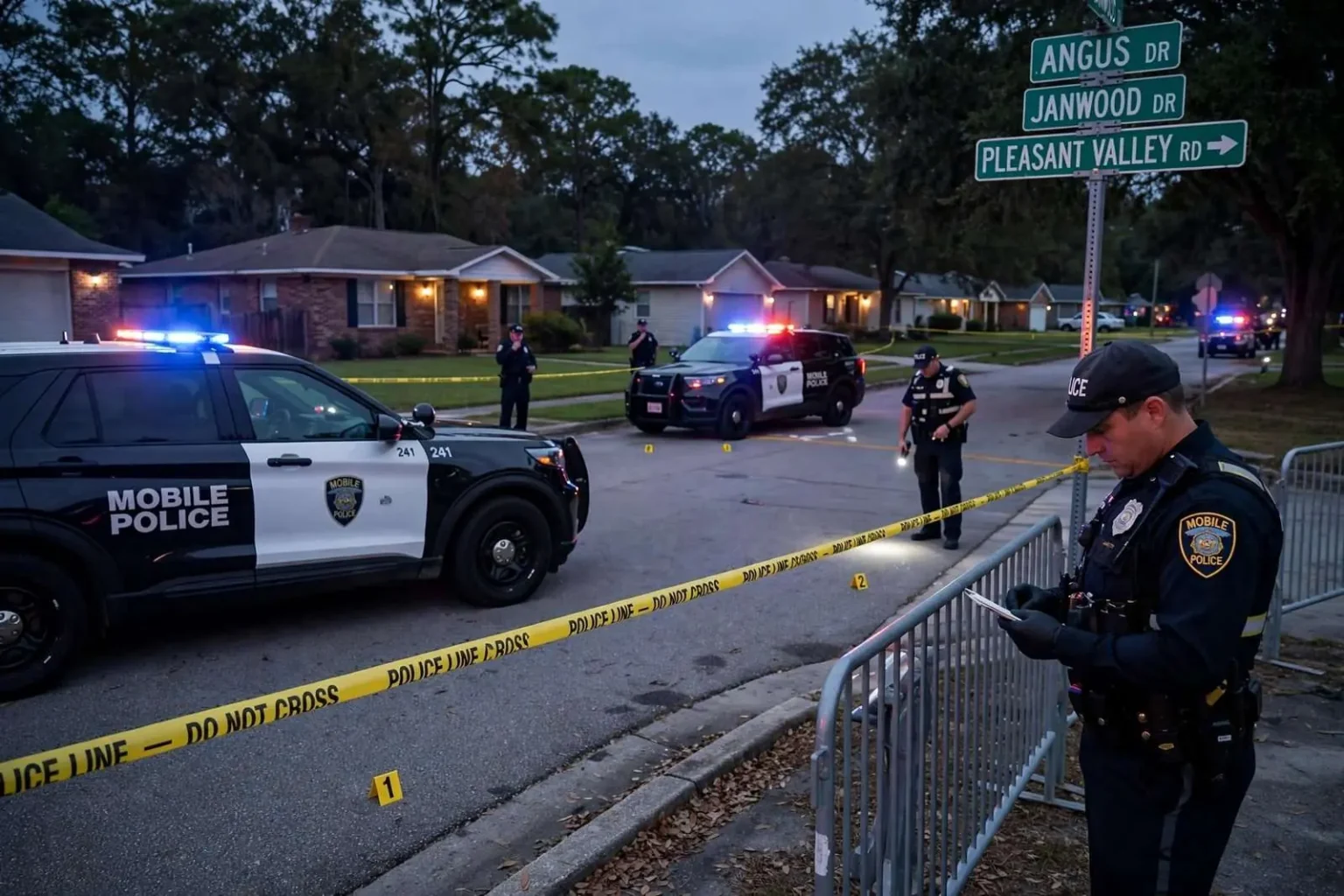
Mobile police were investigating a shooting reported near the intersection of Angus Drive and Janwood Drive, close to Pleasant Valley Road, Wednesday evening. Officers were called to the scene around 6:30 p.m. on a report of disorderly conduct. While they were en route, dispatchers advised that shots had also been fired in the area. No further details about victims or suspects were immediately available as the investigation continued.
The sequence of the calls — a disturbance report that escalated into reports of gunfire while officers were still on the way — is a pattern Mobile police know well. Disturbance calls are among the most common reasons residents dial 911, and they are also among the most unpredictable. What begins as a loud argument, an altercation between neighbors, or a dispute at a residence can escalate to violence within minutes, which is why dispatchers update responding officers continuously and why officers treat en-route upgrades as a change in the entire nature of the call.
The neighborhood around Angus Drive and Janwood Drive sits in west Mobile near Pleasant Valley Road, a corridor of established residential streets between Airport Boulevard and Government Boulevard. It is the kind of area where most evenings pass quietly, with families coming home from work and school activities filling the streets in the early evening hours — the same hour when Wednesday’s calls went out.
How Mobile police handle shots-fired calls
When dispatch advises that shots have been fired, the priority for responding officers shifts immediately. The first tasks are locating any victims, identifying a scene, and securing the area so that medics can enter safely if someone is hurt. Officers sweep the streets around the reported location, look for shell casings, damaged vehicles, and homes struck by gunfire, and begin canvassing for witnesses while memories are freshest.
Shots-fired investigations are difficult for reasons both practical and human. Gunfire at dusk is often heard but rarely seen clearly; residents may know they heard several pops but cannot say from where or in which direction. Evidence such as casings can be scattered across yards and roadways, and the people who know the most — sometimes the participants themselves — often leave before officers arrive. That is why police consistently ask the public to call in not only emergencies but details afterward, including descriptions of vehicles and the direction any suspects fled.
The Mobile Police Department, one of the larger municipal departments in Alabama, investigates hundreds of shots-fired reports each year across the city’s districts. Each report generates a follow-up by detectives even when no victim comes forward, because gunfire that hits no one one night can kill someone the next. The department also tracks patterns of shots-fired calls to direct patrols to the blocks where they cluster.
What a disorderly conduct call means
The initial call in Wednesday’s case was for disorderly conduct, a charge and complaint category that covers a wide range of disruptive behavior — loud arguments, fights, threats, and disturbances that alarm residents. In practice, disorderly conduct calls are one of the most frequent complaints police answer, and they carry inherent risk for everyone involved: the people arguing, the neighbors within earshot, and the officers approaching a scene they cannot yet read.
Residents who reported the disturbance Wednesday did exactly what safety officials ask. Calling early, before a situation turns violent, gives officers a chance to intervene, and the en-route update that shots were fired shows how quickly these calls can change. Dispatchers in Mobile and across the country are trained to keep collecting information as officers drive, passing along new reports of gunfire, injuries, or fleeing suspects so that arriving officers know what they are walking into.
For neighbors, the aftermath of a shots-fired call is often defined by uncertainty. Without confirmed victims or suspects, rumors fill the space that facts leave open, and police departments generally withhold preliminary details rather than release information that could prove wrong. That was the situation Wednesday night: an active investigation, a quiet residential block, and no public answers yet about who fired shots or why.
The west Mobile neighborhood context
The streets near Angus and Janwood drives are part of the patchwork of mid-century and newer subdivisions that fill west Mobile between its main commercial arteries. Pleasant Valley Road connects the Airport Boulevard corridor with Government Boulevard and Spring Hill Road, carrying local traffic past schools, churches, and neighborhood parks. Residents there are accustomed to occasional police activity like any part of a city of Mobile’s size, but gunfire reports in the immediate area stand out against the otherwise residential character of the blocks.
Citywide, the Mobile Police Department partitions the city into precincts and patrol areas so that officers who answer calls repeatedly on the same streets develop familiarity with residents and recurring problems. Community meetings and neighborhood associations in west Mobile have historically worked with the department on issues ranging from traffic to vacant properties, and shots-fired reports typically prompt increased patrols in the affected blocks while an investigation is active.
Gunfire and its ripple effects on a block
Even when no one is struck, gunfire changes a street. Families keep children indoors the following evening. Drivers who use the block as a cut-through take another route. Residents who heard the shots but saw nothing wrestle with whether to report what they know, and police departments work to reassure them that tips can be given without becoming publicly involved. Mobile Area Crime Stoppers accepts anonymous tips, and the department encourages anyone with information about shootings to come forward, emphasizing that even small details — a description, a direction of travel, a license plate fragment — can move an investigation forward.
The hours just before and after dark are statistically among the most common for gunfire reports, and the 6:30 p.m. timing of Wednesday’s calls falls squarely in that window. Officers on evening shift balance these calls with the ordinary volume of disturbances, wrecks, and medical assists that fill a week, which is why several units often respond together to a shots-fired scene to clear it efficiently and return to service.
What residents can expect as the investigation continues
In cases like this, the next steps follow a familiar rhythm. Detectives review any surveillance video from homes and businesses in the area, since doorbell and security cameras have transformed shots-fired investigations in recent years. Evidence technicians process the scene for casings and damage. Investigators follow up with anyone treated at a hospital for gunshot wounds, since victims sometimes seek care without calling police, and they cross-check reports from neighboring beats for related incidents.
Publicly, the department may release updates if an arrest is made or if the case connects to a broader pattern. Until then, the information available is what officers reported Wednesday night: a disturbance call around 6:30 p.m., an advisory while officers were en route that shots had been fired near Angus Drive and Janwood Drive close to Pleasant Valley Road, and an active investigation with no confirmed details about victims or suspects.
Police and community leaders alike repeat the same closing advice in the wake of incidents like this one. Report what you saw or heard, even if it seems minor. Keep cameras recording. Look out for neighbors, especially older residents and families with children, who feel the effects of nearby gunfire most acutely. And when a dispute in the neighborhood begins to boil over, call police early — because the difference between a disturbance call and a shooting call, as Wednesday evening demonstrated, can be only a few minutes.
The broader effort against gunfire in Mobile
Shots-fired calls like Wednesday’s fit into a larger, ongoing effort by the Mobile Police Department and its partners to reduce gun violence across the city. The department has used focused patrols in areas where gunfire clusters, partnerships with federal prosecutors on firearm cases, and community outreach programs aimed at young people most at risk of becoming involved in violence. Faith leaders and neighborhood associations have also played visible roles in recent years, hosting vigils and meetings after shootings and pressing for continued attention to the blocks where incidents repeat.
Technology has become a bigger part of that effort as well. Cameras at intersections and in public housing communities, automatic license plate readers along major corridors, and the explosive spread of home security cameras have all given investigators more to work with than they had a generation ago. Detectives routinely ask residents near a shooting scene to preserve and share footage, and many cases that once stalled for lack of witnesses are now advanced by a single clip from a doorbell camera.
For the residents of the streets near Angus Drive and Janwood Drive, the practical takeaway from Wednesday evening is familiar advice that bears repeating. Lock up and light up, as neighborhood watch organizers put it: lock vehicles and homes, and keep porches and yards lit at night, since poorly secured cars are a frequent target in areas where gun incidents occur. Report suspicious activity as it happens rather than the next morning. And when officers canvass the block after a shooting, talking to them briefly and honestly is one of the most effective things a resident can do for the neighborhood’s long-term safety.
As of Wednesday night, the investigation remained active, and the Mobile Police Department had not announced any arrests or identified anyone hurt. More information will be released if the department’s follow-up produces charges or establishes whether anyone was injured. Until then, the incident stands as one more reminder on a west Mobile block that the line between a loud disturbance and gunfire is thin, and that the people who live there — the ones who called it in — are the first and best line of defense their streets have.