
Mobile Police K-9 apprehends stolen-vehicle suspect near Jerry’s Fireworks
A Mobile Police K-9 apprehended a stolen-vehicle suspect who fled on foot near Jerry's Fireworks on Old Pascagoula Road, police said.
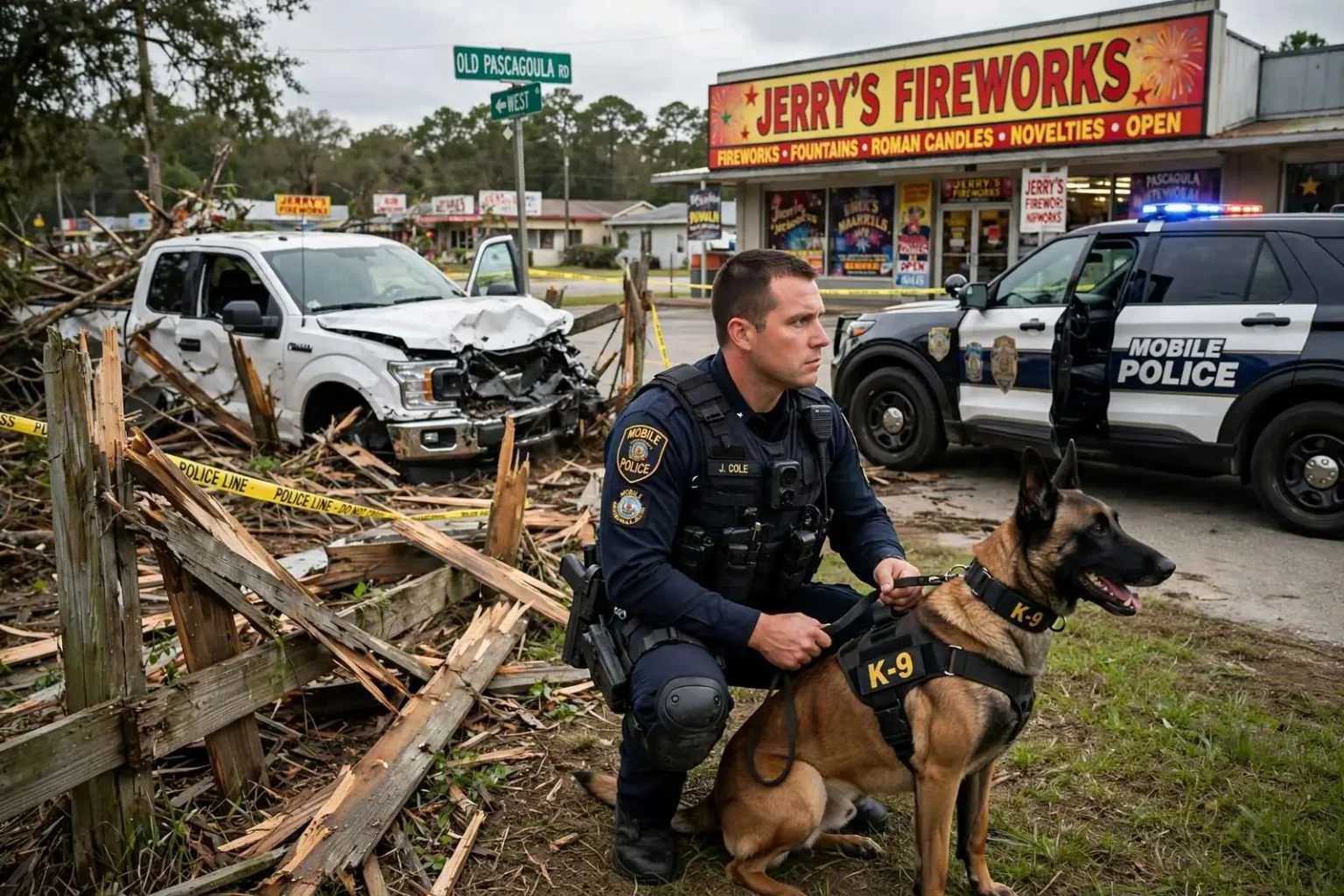
MOBILE, Ala. — A man in a stolen vehicle was taken into custody by a Mobile Police K-9 after a short pursuit that ended near Jerry’s Fireworks on Old Pascagoula Road, according to the Mobile Police Department. The arrest capped a brief but eventful afternoon chase through a part of west Mobile where residential streets meet the busy commercial corridor of Old Pascagoula Road, and it ended the way vehicle pursuits often do: with the driver on foot and a police dog closing the distance faster than any fugitive can run. No injuries to officers or the public were reported in the incident, which unfolded over the span of only a few minutes.
On Thursday afternoon, officers spotted a suspected stolen vehicle turning onto Old Pascagoula Road and followed it as it turned onto Firetower Road. The initial sighting was the product of routine patrol work — officers trained to recognize stolen-vehicle indicators on the street, from the vehicle’s description to the behavior of its driver — and the decision to follow rather than immediately light up the vehicle reflected the calculated pace of a pursuit’s opening moments, when officers are confirming the theft and positioning for a stop while keeping speeds manageable through commercial traffic.
From Blue Lights to a Dead End
When police activated their blue lights, the driver turned onto Sonya Drive, drove to a dead end and jumped out while the truck was still rolling. The truck crashed into a fence. The sequence — a fleeing driver trying to shed a pursuit on side streets, only to find the streets run out — is among the most common endings to vehicle chases in west Mobile’s grid of residential cut-throughs, where the connecting roads between major corridors are short and frequently dead-end into neighborhoods or wooded tracts. A moving vehicle abandoned mid-flight is one of the more dangerous artifacts of such pursuits, and the fence it struck absorbed an impact that could otherwise have traveled into a yard, a porch or a passerby.
The driver fled through a wooded area and was apprehended by a K-9, suffering a bite to the ankle. The wooded tracts that line the edges of west Mobile’s neighborhoods are familiar escape routes for fleeing suspects, offering cover and broken sight lines that frustrate officers on foot. This is precisely the work police dogs are deployed for: a K-9 team can track a scent line through brush and darkness far faster than a line of officers can sweep it, and the dog’s trained apprehension — a bite to a limb that ends the flight without gunfire — is considered a use of force that, in most cases, avoids far more dangerous outcomes.
How K-9 Apprehensions Work
Mobile Police K-9 teams train continuously for exactly this scenario. The dogs are conditioned to pursue a fleeing person on command and to hold them by the arm or leg until officers arrive to take custody, and their handlers are responsible for calling the apprehension off the moment the suspect stops resisting or surrenders. A bite to the ankle, as in this case, is the textbook result: painful and medical attention-worthy, but rarely life-threatening, and far less dangerous than a foot chase that might end in a struggle, a weapon or a crossing of busy roads. Departments across the country treat K-9 apprehensions as serious uses of force subject to review, and the brief medical attention and custody that follow are standard.
Some drug material was discovered during the stop. The discovery added a potential charge to what was already a felony case built on the stolen truck, and it illustrated how routine vehicle stops routinely cascade: a suspected stolen vehicle becomes a pursuit, a pursuit becomes an apprehension, and the search incident to securing the vehicle turns up evidence of an unrelated offense. Each layer of the case will be documented separately, and prosecutors ultimately weigh the full stack of potential charges — theft of the vehicle, eluding, and any drug offense — when deciding what to file.
The investigation is ongoing and final charges have not yet been determined. That closing note in the police account is more than boilerplate. The man taken into custody at the scene had been arrested on probable cause, but the formal charging decision belongs to the district attorney’s office after detectives complete their work: confirming the truck’s stolen status and its owner, tracing the route of the pursuit for potential eluding charges, documenting the drug material through the property and evidence process, and reviewing the K-9 apprehension as a use of force. The man remained in custody pending that process, and the full accounting of the case will emerge in court records rather than in the initial police summary.
The Corridor Where It Ended
The pursuit’s route traced a slice of west Mobile that locals know well. Old Pascagoula Road is one of the area’s oldest thoroughfares, a commercial spine lined with businesses of every description — including Jerry’s Fireworks, the roadside landmark near which the arrest concluded — and it funnels traffic between Theodore and the neighborhoods west of the city. Firetower Road and the short residential streets that branch off it, including Sonya Drive, carry that commercial traffic into quiet subdivisions, which is why pursuits that leave the main road so often end in sudden dead ends and struck fences within a few blocks of the corridor.
For the residents along the route, an afternoon pursuit is a jarring interruption — blue lights flooding a street where the biggest event is usually school traffic, a K-9 ranging through the woods behind their homes, and a damaged fence standing as evidence of how close it all came. Police note that the quick termination of the pursuit near a commercial landmark, rather than deeper into the neighborhood, was in this case the least dangerous resolution available.
Stolen Vehicles and the Work of Patrol
Vehicle theft remains one of the most common serious property crimes in Mobile, and the recovery of stolen vehicles through alert patrol work is a daily occurrence across the city’s precincts. A stolen truck spotted on the move presents officers with one of their most familiar dilemmas: pursue and risk the dangers of a chase, or disengage and lose the vehicle and possibly the suspect. Departments across Alabama balance those risks with pursuit policies that weigh the seriousness of the underlying offense, traffic conditions and the likelihood of apprehension by other means — including, as in this case, the K-9 unit that ended the flight once the driver abandoned the truck and ran.
The case now moves from the street to the paperwork: reports, evidence, charging decisions and, eventually, a courtroom. For the police department, it was an afternoon’s work — a sharp-eyed patrol shift, a disciplined pursuit, and a police dog whose speed through the woods did what a dozen officers on foot could not.
What Happens to the Truck, the Fence and the Case
The aftermath of a pursuit like this one involves a long list of small restorations and formalities. The stolen truck, having traded its rolling escape for a meeting with a fence, goes to impound and the evidence process: photographed where it struck, processed for fingerprints and any additional evidence, and held until its owner can reclaim it and insurance questions are settled. The fence owner along Sonya Drive files the kind of property damage claim that cities and suspects’ restitution processes deal with after chases, and the neighborhood settles back into its usual quiet once the tow truck leaves.
The man who jumped from the moving truck faces the slower machinery. Ankle bite wounds receive medical evaluation as a matter of protocol before booking, and the arrest itself generates the file that detectives will build on: the officers’ accounts of the initial spotting and the pursuit, the K-9 handler’s use-of-force documentation, the evidence log for the drug material and the theft report that started it all. Whether the case resolves as theft, receiving stolen property, attempting to elude and drug charges — or some combination — will be sorted out in the weeks after the arrest, far from the wooded lot where it ended.
The K-9 Officer’s Perspective
For the K-9 team, the afternoon was a demonstration of why the unit exists. Police dogs deploy on exactly the calls that most test a department’s options: a fleeing suspect in terrain where officers can’t see, a flight through woods where a foot chase could end in darkness with a hidden person, a situation where the alternatives are a prolonged search, a dangerous confrontation or an escape. The dog tracked the driver’s scent line through the brush, closed the distance and applied the trained hold that turned a manhunt into an arrest in minutes. Handlers will tell you the dogs are the department’s most effective officers at ending flights without shots fired, and this arrest was a clean example — difficult terrain, short timeline, suspect in custody before dark.
The team will get another deployment soon; K-9 units across Mobile answer calls nearly every shift, from building searches to tracks like this one. The afternoon’s work will appear in the unit’s statistics alongside hundreds of similar deployments, and the bitten ankle will heal. The truck’s owner gets the vehicle back, the fence gets patched, and the neighborhood gets its quiet afternoon back — the standard arithmetic of a pursuit that ended as well as pursuits can.