Mobile police make arrest in DHR bomb threat
Mobile Police arrested Karen Stallworth in connection with an Aug. 16 bomb threat that forced evacuation of a Department of Human Resources building.
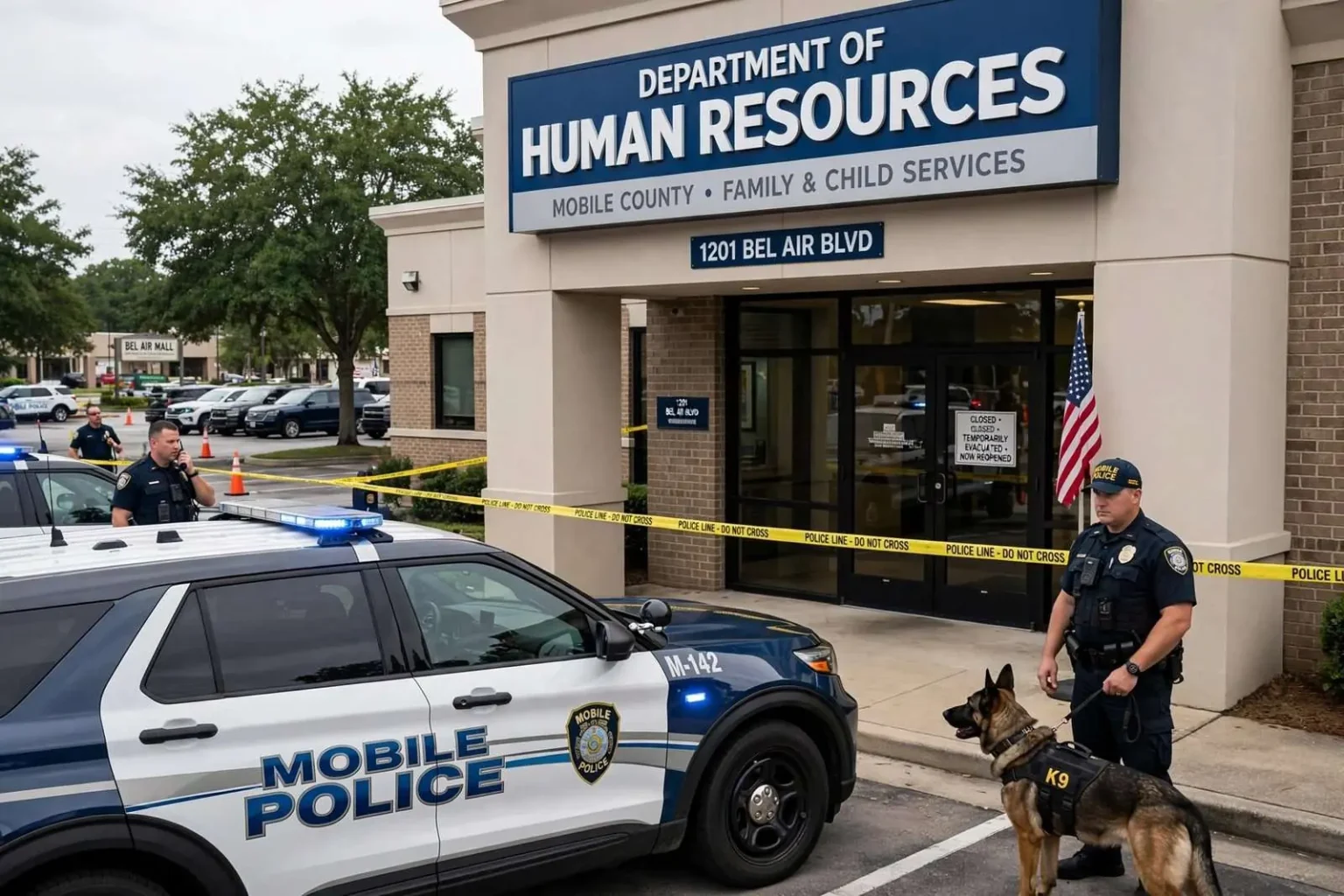
MOBILE, Ala. — Mobile Police have made an arrest in connection with an Aug. 16 bomb threat at the Department of Human Resources building on Bel Air Boulevard, closing out an investigation that disrupted operations at one of the city’s busiest public service offices. Police said Karen Stallworth called the office and left a voicemail claiming a bomb was going to explode in the secretary’s car. No bomb was found, and no injuries were reported.
According to police, the threat arrived by telephone voicemail on Aug. 16, prompting an immediate response from officers and building security staff. The DHR building was evacuated for about an hour while bomb-sniffing dogs checked whether the threat was credible. Investigators treated the call as a genuine threat until the search was complete, clearing both the interior of the building and the parking areas around it, including the location referenced in the voicemail.
The search turned up no explosive device, and employees and visitors were eventually allowed back into the building to resume normal operations. Police continued working the case after the scene was cleared, tracing the call and the circumstances behind it, and announced the arrest after the investigation was complete.
What happened at the Bel Air Boulevard building
The Department of Human Resources building on Bel Air Boulevard sits in one of Mobile’s busiest commercial corridors, near the Bel Air Mall area where office complexes, retail centers, and medical facilities share the same road network. The facility houses county-level DHR services that hundreds of Mobile County residents rely on daily — family assistance programs, child protective services, adult protective services, and related social service functions. A disruption at the building means postponed appointments, delayed case work, and confusion for families who may already be navigating difficult circumstances.
When the voicemail surfaced on Aug. 16, staff followed standard evacuation procedure for a bomb threat: clear the building, move occupants to a safe distance, and let trained personnel and detection dogs do the search. Evacuations of that kind require employees to leave workstations mid-task, secure files, and shepherd visitors out of the building, all within minutes. For roughly an hour, the parking lots and surrounding grounds served as a staging area while the sweep was underway.
Bomb-sniffing dogs play a central role in responses like this one. Trained detection pairs can clear large buildings far faster than human searchers working alone, and they provide a level of certainty that visual inspection cannot match. The dogs are trained to sit or otherwise signal near explosive residues and devices, allowing handlers to isolate any area of concern without endangering the search team.
How Mobile police handle bomb threats
The Mobile Police Department’s response to a bomb threat follows a well-established protocol shaped by federal guidance. The first priorities are life safety — evacuating the threatened area, establishing a perimeter, and keeping curious onlookers and traffic away from the scene. Only after those steps are underway do investigators begin the work of establishing whether the threat is credible, tracing its origin, and identifying the person responsible.
Threats delivered by telephone voicemail offer investigators a preserved recording, which is often enough to move a case forward quickly. A recorded voice can be analyzed, shared with other agencies, and compared against prior incidents, and metadata attached to the call can establish when and where it was placed. That evidence trail is what allows departments to move from an anonymous-sounding threat to a named suspect, as happened in this case.
Under Alabama law, making a false report of a bomb or other explosive device is a serious criminal offense. A person who threatens that a bomb will explode commits a felony in many circumstances, and the potential penalties can include years in prison and substantial fines — consequences that apply even when no device exists and no one is physically harmed. Prosecutors treat these cases seriously because of the disruption, expense, and fear a single call can generate.
The arrest drew attention to the ripple effects that a threat against a public building produces. Beyond the hour-long evacuation itself, a response of this scale ties up patrol officers, dispatchers, and detection resources that may be needed elsewhere in the city. Mobile Fire-Rescue and other agencies routinely stand by at scenes like this as a precaution, and the cost of the response — personnel hours, equipment use, and administrative follow-up — is borne by the public regardless of whether the threat turns out to be real.
Public servants at DHR offices face an added dimension of risk because of the nature of their work. Child welfare and family services caseworkers regularly interact with people in crisis, and the agency has historically been a target for threats and hostile encounters in a way that few other government offices are. Law enforcement officials have long advised agencies in that position to maintain threat reporting procedures, visitor screening, and established evacuation routes so that staff know exactly what to do when a call like the one on Aug. 16 comes in.
The wider pattern of threats against public buildings
The Aug. 16 incident fits a national pattern in which government buildings, schools, courthouses, and other public facilities absorb a steady volume of bomb threats, most of which prove to be false. The FBI and Department of Homeland Security issue periodic advisories about threat waves — including coordinated swatting campaigns and hoax calls designed to disrupt operations — and encourage agencies to treat every threat as credible until proven otherwise. That posture, born of experience, is precisely why a voicemail claiming a bomb in a specific vehicle produced a full evacuation and a dog sweep.
For the public, the practical guidance remains consistent. Anyone who receives or overhears a bomb threat should report it immediately by calling 911 rather than forwarding the message or waiting to see whether it proves false. Callers should note the exact wording of the threat, the time it was received, and any details about background sounds or the apparent identity of the speaker, because those details become the backbone of the subsequent investigation. Employees should never touch or move suspicious packages, and they should leave the area by established routes rather than gathering near entrances.
Businesses and agencies along Bel Air Boulevard and elsewhere in Mobile have increasingly invested in threat preparedness in recent years — evacuation drills, employee training, and coordinated relationships with police and fire departments. That preparation showed in the speed of the Aug. 16 response: the building was cleared promptly, the search was completed methodically, and operations resumed the same day.
What the arrest means going forward
With an arrest made, the case moves into the court system, where prosecutors will weigh the evidence gathered from the voicemail and the subsequent investigation. Cases of this type typically proceed through Mobile County’s court processes, and the outcome depends on the specific charges filed and the defendant’s record. Police did not release additional details about the arrest in the initial announcement.
Officials used the resolution of the case to remind the public that hoax threats carry real consequences for the person who makes them. A recorded voicemail, a traceable phone number, and a building full of witnesses make these among the most solvable categories of offenses that police investigate, and departments have shown growing willingness to pursue charges even against first-time offenders.
Employers across the region also watched the case with interest because it illustrates how quickly a threat can move from a phone call to a criminal charge. Workplace threat policies in the Mobile area increasingly direct employees to preserve any threatening message exactly as received — voicemails are kept un-deleted, screenshots are saved, and written threats are handled by the edges only — so that investigators inherit a clean evidentiary record. Human resources departments along commercial corridors like Bel Air Boulevard have added bomb-threat response cards near front desks, listing exactly who to call and what information to capture while the caller is still on the line.
Police also emphasized that reporting a threat promptly is the single most valuable thing a recipient can do. The interval between a threat and a full evacuation is when the risk is highest, and minutes matter — not only for clearing the building but for giving responding officers the best chance of controlling access roads, staging equipment, and beginning the trace before the trail degrades.
For the employees and visitors who spent an hour in a parking lot on Aug. 16 while dogs swept their workplace, the arrest closes the loop on a disruptive and frightening episode. The building on Bel Air Boulevard went back to serving the Mobile County families who depend on it, and the investigation that followed the all-clear delivered an answer before the trail went cold.
South Alabama News will update this story as more details become available from the Mobile Police Department.