
Mobile Police Search for McDonald’s Burglary Suspect
Mobile Police are searching for a suspect who pried open a McDonald's drive-thru window and stole a cash register at 2692 Government Boulevard.
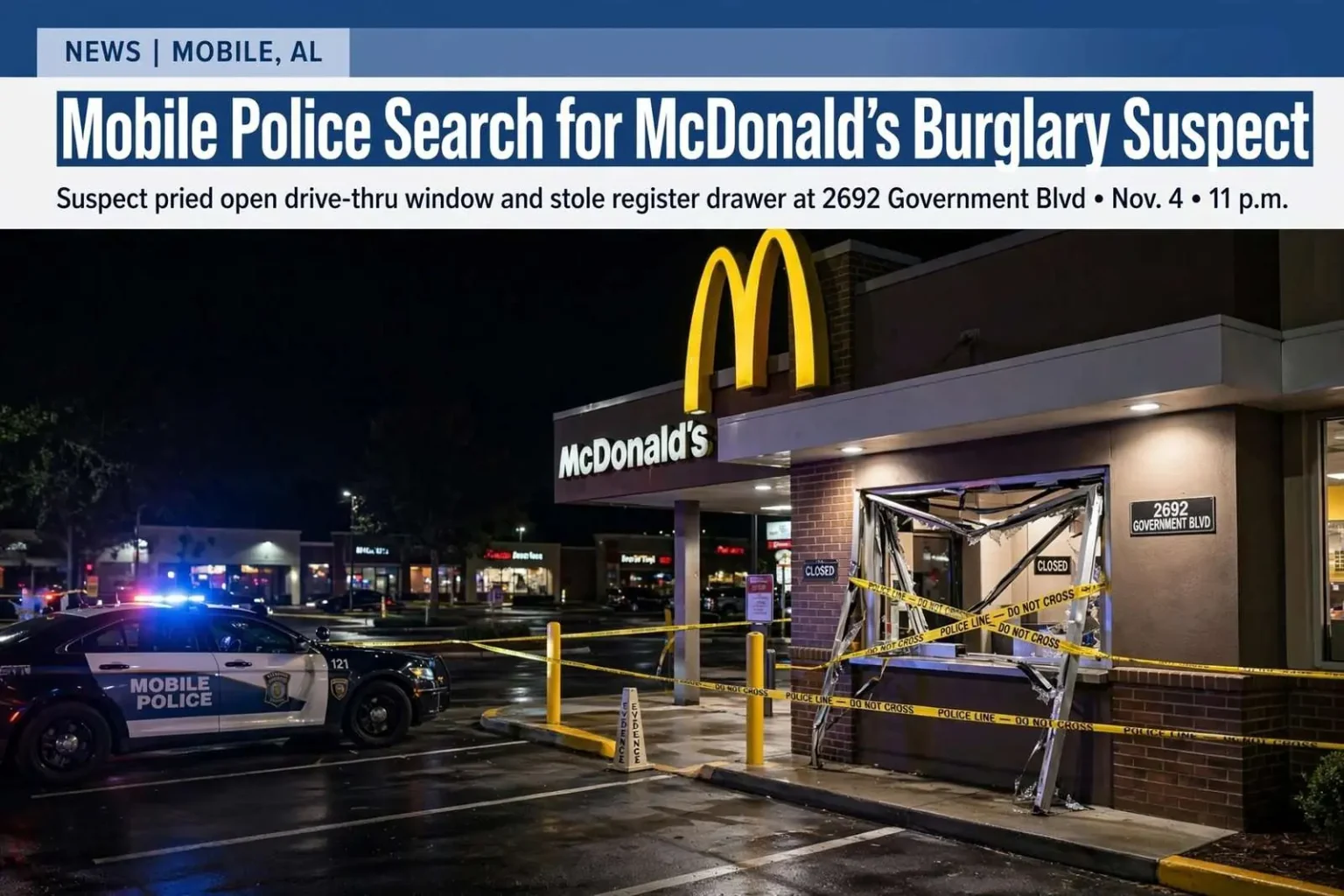
Mobile Police are looking for a suspect who pried open a McDonald’s drive-thru window and stole a cash register drawer full of money. The burglary happened at the McDonald’s at 2692 Government Boulevard on Nov. 4 around 11 p.m., according to the Mobile Police Department. Anyone with information about the suspect is asked to call Mobile Police at 251-208-7211.
The late-night break-in occurred at one of the busy restaurants along Government Boulevard, one of Mobile’s oldest and most heavily traveled east-west commercial corridors. Investigators say the suspect forced open the drive-thru window, the point of entry that has become a familiar target in commercial burglaries across the city, and removed the entire register drawer before leaving the property. The restaurant was closed at the time, and no employees were present or injured during the incident.
Burglaries of this kind are worked by investigators who pull together whatever the scene offers: footage from the restaurant’s own cameras, images from neighboring businesses along the corridor, points of entry and exit, and any trace evidence left behind. Because the break-in happened around eleven at night on a major artery, police will also be looking for any passing drivers who may have captured the suspect or a vehicle on dashboard cameras or phones. The department’s request for tips at 251-208-7211 is a standing invitation for anyone who noticed unusual activity near the restaurant that night to come forward.
Government Boulevard and Its Overnight Economy
Government Boulevard stretches across west Mobile as a strip of restaurants, retail shops, motels and service businesses, with fast-food locations among the most visible landmarks along the route. The corridor sits between Spring Hill Avenue and Airport Boulevard, feeding traffic toward the medical district, the downtown area and the interstate. Its restaurants close at staggered evening hours, and the overnight period after closing, when buildings are empty and parking lots are dark, is when commercial properties along the route face their greatest exposure to break-ins.
Drive-thru windows are a recurring weak point cited by police and restaurant security consultants. The window is built to slide open for service, its frame can be pried with simple tools, and on the other side sits the restaurant’s register station. Chains have responded over the years with reinforced window tracks, roll-down security shutters, time-drop safes that empty registers at intervals, and camera coverage of the drive-thru lane. Whether a given location has those measures in place varies by franchise, and the damage visible after a break-in often tells investigators how much resistance the suspect encountered.
A stolen register drawer creates consequences beyond the cash itself. The drawer holds the restaurant’s till for the shift, and its loss means the store must rebuild its cash float before reopening. Damage to the window and frame typically forces a closure of the drive-thru lane until repairs are completed, which costs the business sales during some of its busiest morning hours. For a late-night or early-shift crew arriving to find the damage, the break-in is also a jarring reminder of the property crimes that can touch any commercial strip. Neighborhood associations along the corridor keep in touch with their precinct officers about such incidents, and increased visibility from patrol cars in the nights that follow a break-in is one of the most visible deterrents a department can offer.
How Mobile Police Work Commercial Burglaries
The Mobile Police Department, one of the larger municipal departments in Alabama, handles hundreds of commercial burglaries each year across its patrol precincts. The first officer on scene documents the point of entry, checks for anyone still inside the building, and preserves whatever the suspect touched. Investigators then canvass the corridor, request camera footage from nearby businesses and apartments, and compare the method of entry against other recent break-ins, since burglars who succeed with one technique tend to repeat it at similar targets along the same arteries.
Register drawer thefts present a particular evidentiary angle: removing the drawer with cash inside usually means the suspect left the scene quickly, often on foot at first, and then moved to a vehicle or a nearby hiding spot. Police frequently recover such evidence when a suspect is stopped for an unrelated reason or when footage from gas stations and convenience stores along the escape route picks up the trail. That is why the department asks specifically for information about the suspect rather than only the incident, since sightings in the hours after a burglary can be as valuable as reports from the scene itself.
Under Alabama law, breaking into a commercial building with intent to commit a crime is burglary in the third degree, a Class C felony, and the classification rises if the building is a dwelling or if the offender is armed. A theft of the register drawer adds a separate theft charge in most indictments, and prosecutors can stack the counts when a case is solved. The potential penalties reflect how seriously the state treats break-ins that expose commercial property to loss.
The Role of Surveillance Video and Public Tips
Nearly every commercial burglary case in Mobile now turns on video. Restaurants along Government Boulevard operate exterior cameras over the drive-thru lane and register area, neighboring businesses cover much of the adjacent parking, and the corridor’s traffic cameras add another layer of coverage. Investigators spend the first days after a break-in collecting and reviewing footage, enhancing images of the suspect’s movements and clothing, and extracting frames for release to the public when identification stalls.
Released images routinely generate the tips that close these cases. Residents along Government Boulevard and the surrounding west Mobile neighborhoods are often the first to recognize a face, a walk or a vehicle from the footage, and callers to the department’s line at 251-208-7211 can pass along those observations directly. Mobile also has an active Crimestoppers program, which allows tipsters to provide information anonymously and to qualify for cash rewards when a tip leads to an arrest, an option many callers prefer when they have concerns about being identified.
Police ask witnesses to preserve their own evidence as well. A driver whose dash camera recorded the restaurant’s parking lot late on the night of Nov. 4, or a resident whose home camera faces the corridor, can contact investigators before the footage is automatically overwritten, since most consumer systems retain recordings for only days or weeks. Time is the enemy in video-based investigations, and detectives emphasize that calling sooner rather than later protects the evidence that may identify the suspect.
What the Investigation Means for the Corridor
Break-ins along a commercial corridor rarely stay isolated. Police crime analysts track patterns by location, method and time of day, and a single offender or small group can account for a string of similar burglaries across several weeks. When the McDonald’s case is compared with other after-hours entries along Government and neighboring corridors, investigators look for the same signature: a pried window, a targeted register, a fast exit. Identifying that pattern lets patrol officers concentrate overnight checks on the businesses most at risk while the search for the suspect continues.
For store managers and franchise owners in the area, the incident prompts the security reviews that follow every corridor break-in. The standard checklist includes testing camera angles and recording quality, confirming that safes are being used on schedule so that overnight losses stay small, improving lighting around drive-thru lanes and rear doors, and asking police for extra patrol passes during closing hours. Mobile officers assigned to business liaisons work with merchants on exactly those steps, and the department credits hardened targets with pushing burglars toward easier locations.
Court Outcomes in Commercial Break-In Cases
When suspects in register-drawer burglaries are identified and arrested, the cases typically proceed through the Mobile County court system with a set of standard counts: third-degree burglary for the forced entry and a theft count for the money taken. Prior records weigh heavily in how these cases resolve, and repeat offenders face elevated exposure under Alabama’s sentencing framework. Business owners who were victims are kept informed by the district attorney’s victim-witness office, and restitution for the stolen cash and damaged property can be ordered as part of any sentence. Detectives note that a single arrest frequently clears several open corridor cases at once, which is why each tip matters beyond the individual restaurant involved.
Anyone with information about the Nov. 4 burglary at the McDonald’s on Government Boulevard, including details about the suspect’s appearance, direction of travel or any vehicle involved, is urged to call Mobile Police at 251-208-7211. Callers who wish to remain anonymous can route their tips through the city’s Crimestoppers program, and even fragmentary details, the sound of breaking glass noticed by a neighbor, a figure seen crossing the parking lot, can supply the thread investigators need to pull the case together.