
Mobile Police to Hold Safety Checkpoints Thursday
Mobile Police will hold safety checkpoints Thursday, Jan. 20, from 4 to 10 p.m. on Houston Street and Sage Avenue. Drivers should expect brief stops.
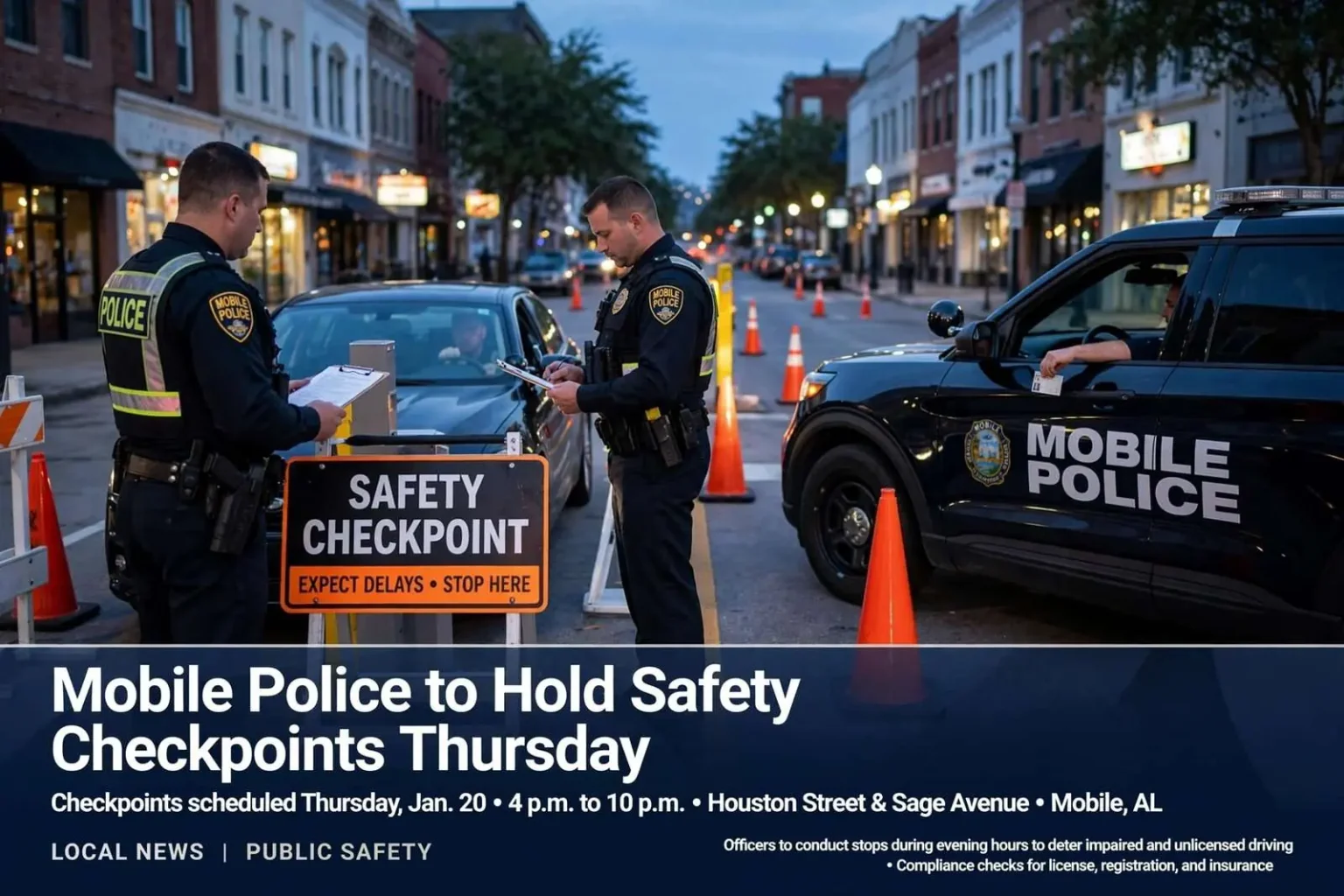
Mobile Police will conduct safety checkpoints Thursday, Jan. 20, from 4 p.m. to 10 p.m. Officers will monitor the following areas: Houston Street between Government Street and Duval Street, and Sage Avenue between Airport Boulevard and Old Shell Road. The department said it also conducted a safety checkpoint in December.
Safety checkpoints are a recurring tool in the Mobile Police Department’s traffic enforcement strategy, aimed at catching impaired drivers, unlicensed motorists and other violations during hours when crash risk is elevated. The Thursday evening window — late afternoon into night — covers the transition from rush hour to the hours when impaired driving becomes statistically more common. Announcing the checkpoints in advance is standard practice and part of their deterrent effect: drivers who know enforcement is happening are less likely to take the risks the checkpoints are designed to catch.
The Locations
Houston Street runs through a busy section of the city between Government Street and Duval Street, a corridor lined with businesses and residential streets in midtown Mobile. Government Boulevard itself is one of the city’s main east-west arteries, and the Houston Street segment between Government and Duval carries commuter traffic feeding into downtown and the medical district. Enforcement at that location during the evening commute and into the night places officers where traffic volume and route diversity make violations more likely to surface.
Sage Avenue between Airport Boulevard and Old Shell Road runs through another heavily traveled midtown stretch. Old Shell Road and Airport Boulevard are both major thoroughfares, and Sage connects them through neighborhoods and commercial blocks near the Spring Hill corridor. The area sees steady school and commuter traffic, and its proximity to restaurants and businesses along Airport Boulevard makes it a logical enforcement point during evening hours when traffic patterns shift.
At a safety checkpoint, officers stop vehicles at a predetermined pattern — often every vehicle or every few vehicles — and check for license validity, registration, insurance and signs of impairment. Checkpoints conducted in Alabama must follow constitutional guidelines established by state and federal courts, including neutral stopping patterns, visible signage, minimal delay for drivers and a supervising officer on site. Departments that follow those requirements are able to use the checkpoints both as enforcement and as a highly visible deterrent.
What Officers Look For
The violations that surface most often at checkpoints include driving without a license or with a suspended one, expired registrations, lapsed insurance — a persistent problem in Alabama, which consistently ranks among the states with the highest rates of uninsured motorists — and impaired driving. Officers trained in detecting impairment watch for signs such as the smell of alcohol, slurred speech and slow document handling, and drivers suspected of intoxication are moved to a secondary area for field sobriety evaluation. Those arrests then proceed through the standard process at Metro Jail and the municipal court system.
The department’s mention of a December checkpoint reflects the steady rhythm of such operations throughout the year. Mobile Police have historically concentrated enforcement details around holidays and heavy travel periods, when impaired driving tends to spike, and the results are reported through the department’s public information channels. Traffic safety campaigns in Alabama are also supported by state-level initiatives, including the “Drive Sober or Get Pulled Over” mobilizations that the Alabama Law Enforcement Agency coordinates with local departments during peak seasons.
For compliant drivers, passing through a checkpoint typically takes less than a minute. The department advises motorists to have their license, registration and proof of insurance ready, and reminds drivers that any motorist can decline a warrantless search while still complying with an officer’s lawful instructions. Checkpoints like Thursday’s are announced in advance so that residents can plan routes and, more importantly, so that anyone who might otherwise drive impaired thinks twice before getting behind the wheel.
Checkpoint operations in January carry particular weight for traffic safety planners. The weeks after New Year’s combine winter darkness with post-holiday routines, and evening hours between 4 p.m. and 10 p.m. capture both the commuter peak and the early evening period when alcohol-related crashes begin to climb. Nationwide data from the National Highway Traffic Safety Administration consistently show that impaired-driving fatalities cluster in nighttime hours, which is why departments schedule enforcement windows that extend into the evening rather than limiting them to daylight.
Enforcement and Community Response
Mobile Police announce checkpoint locations ahead of time, a practice that balances effectiveness with transparency. While some residents question why the locations are public, departments point out that the announcement itself prevents impaired driving by giving would-be offenders a reason to stay off the road or find a sober ride. Courts have also weighed the balance between enforcement and driver rights, and advance publicity is one of the practices that helps checkpoints withstand legal scrutiny.
The two locations announced for Thursday give officers coverage on different sides of midtown — one closer to downtown and the medical district, one deeper into the residential and commercial blocks near Spring Hill. Both corridors connect to the city’s larger grid, meaning the checkpoint’s deterrent message reaches drivers well beyond the streets being monitored. Traffic apps and word of mouth tend to spread the word quickly once operations begin, multiplying the visibility of the detail.
Mobile’s traffic safety record gives the department’s efforts context. The city and its surrounding county see hundreds of injury crashes a year, with impairment, speed and distraction as the leading contributors. Enforcement details work in tandem with engineering improvements and education campaigns as part of the broader strategy to reduce serious crashes, and departments across Alabama share results through state traffic records programs that guide future deployments.
Residents with questions about Thursday’s checkpoints can contact the Mobile Police Department’s traffic division. Drivers who encounter a checkpoint should reduce speed as they approach, follow officers’ directions and keep documents accessible. The department reiterated that its goal is not citations for their own sake but fewer crashes, fewer injuries and fewer families affected by impaired drivers — an objective shared by the residents of the neighborhoods along Houston Street and Sage Avenue where officers will be stationed Thursday evening.
The neighborhoods along the two checkpoint corridors are among midtown Mobile’s most established. Houston Street’s stretch between Government and Duval passes blocks of older homes, churches and small businesses that have anchored the area for decades, while Sage Avenue between Airport Boulevard and Old Shell Road threads through a mix of residential streets and commercial frontage serving the Spring Hill area. Residents in both areas are generally familiar with periodic enforcement details, and many welcome the visibility, particularly near intersections where speeding has been a recurring complaint.
Safety checkpoints also generate local debate whenever they are announced. Civil liberties advocates emphasize the importance of neutral, nondiscriminatory operation, and Mobile Police — like departments across the country — are expected to document their stopping patterns and the demographic data from each detail. When operations follow the constitutional framework, courts have found, the intrusion on motorists is minimal compared with the public safety benefit of removing impaired and unlicensed drivers from the road.
Insurance, Licenses and the Cost of Noncompliance
The violations most commonly written at checkpoints carry real consequences beyond the initial citation. Driving without insurance in Alabama exposes a motorist to fines and license suspension under the state’s Mandatory Liability Insurance law, and an at-fault crash without coverage can leave a driver personally liable for damages that run into tens of thousands of dollars. Driving on a suspended license compounds penalties with each stop, and a first DUI conviction in Alabama carries mandatory jail time or community service, fines and license suspension. Officers often note that the checkpoint citation many drivers see as a nuisance is far less costly than the crash it may have prevented.
The January 20 operation follows the department’s December checkpoint, part of the holiday-season enforcement push that runs across Alabama each year. State and local agencies coordinate those seasonal campaigns with federal safety grants distributed through the Alabama Department of Economic and Community Affairs’ law enforcement traffic safety program, which funds overtime hours for impaired-driving and seat belt enforcement. The grants allow departments to field larger details than routine staffing would permit, concentrating officers on the corridors where crash data shows the greatest risk.
Thursday’s checkpoints run from 4 p.m. to 10 p.m., and drivers traveling in the areas of Houston Street or Sage Avenue during those hours should expect brief delays. The department’s reminder to the public is consistent with its message at every such detail: buckle up, put the phone down, keep documents current, and never drive after drinking. The safest checkpoint is one that never has to write a ticket — because every driver who reached it had already made the right choice on the way there.