
Mobile ranks 61st among nation’s ‘Most Fun Cities’
A WalletHub study ranks Mobile 61st out of 182 U.S. metros in its 'Most Fun Cities' list, with the Port City placing 37th for nightlife and parties.
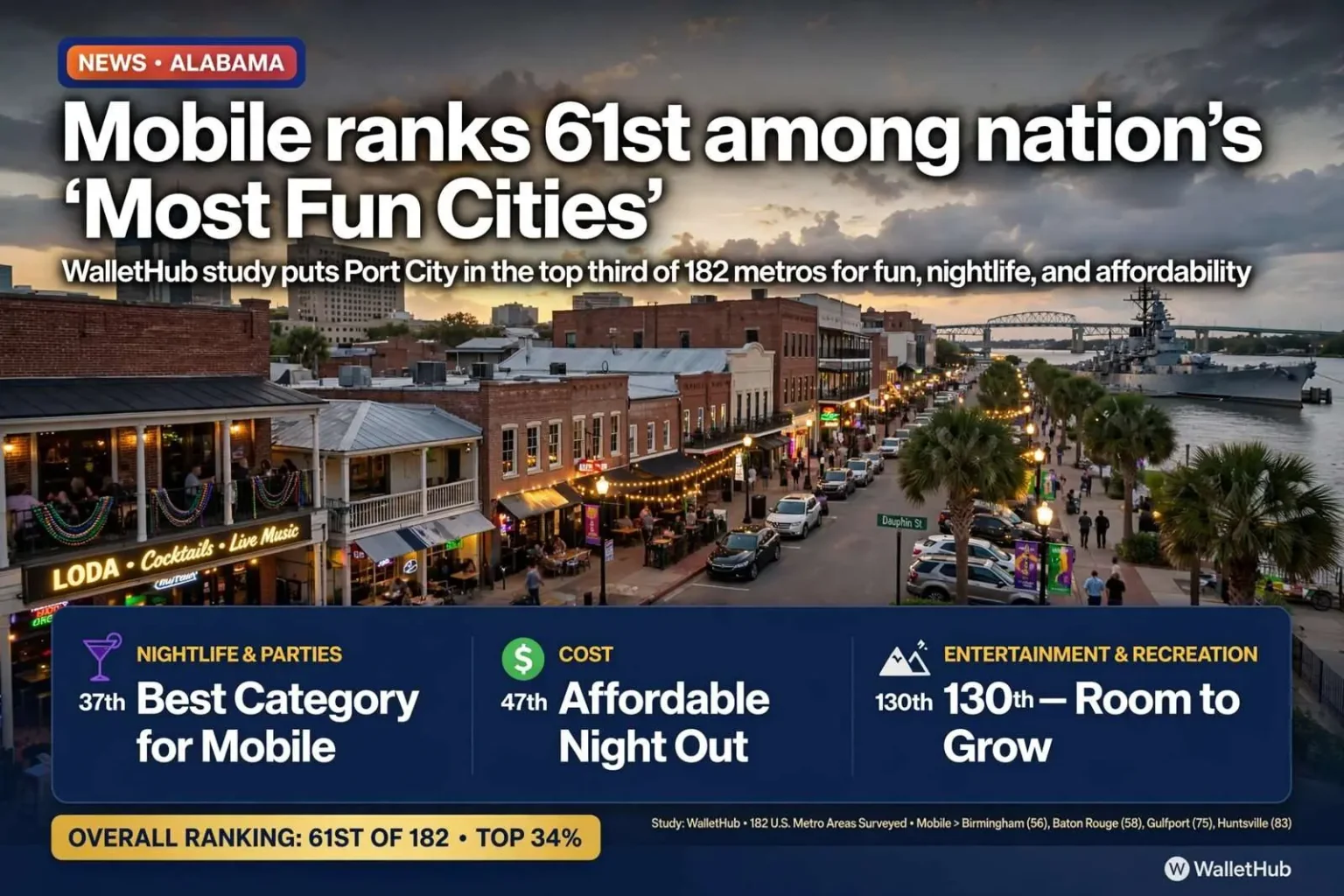
Mobile landed in the top third of the country’s “Most Fun Cities” in a new ranking from the personal-finance website WalletHub, a study built to measure which American metropolitan areas offer the best blend of things to do, nightlife and affordability. The Port City came in 61st out of 182 metropolitan areas surveyed, a placement that put it ahead of a number of larger and better-known Southern markets and gave local officials another data point in a long-running argument: that Mobile’s calendar of festivals, ballgames and nights out offers more than its size would suggest.
WalletHub scored cities across three broad categories: Entertainment & Recreation, Nightlife & Parties, and Cost. The study drew on dozens of weighted indicators, and researchers weighed factors ranging from the number of restaurants, festivals and fitness centers per capita to the average price of a beer and a movie ticket. Taken together, the categories were meant to answer two questions at once — how much fun a metro area actually offers, and how much of a dent that fun leaves in a household budget.
Mobile performed strongest in Nightlife & Parties, where it placed 37th, its best showing of the three categories and the clearest signal that the city’s bar scene, live music rooms and late-night dining compare favorably with metros many times its size. It ranked 47th on Cost, reflecting a general affordability that has long been one of Mobile’s selling points for young families, students and retirees deciding where to settle. The city’s weakest category was Entertainment & Recreation, where it came in 130th, a reflection of the thinner supply of attractions and recreation businesses that even mid-sized metros tend to face when stacked against the largest markets in the country.
What the ranking measured
The Nightlife & Parties category looked at far more than the number of bars. WalletHub’s indicators in that grouping touched on the density of nightlife options per capita, the time it takes to reach them, and the share of residents old enough to enjoy them. For Mobile, the strong finish there tracks with the concentration of venues in and around downtown — the LoDa entertainment district along Lower Dauphin Street, the blocks of restaurants and music rooms around Dauphin and Government streets, and the cluster of bars and stages that have multiplied near the convention center and the stadium district as downtown’s residential population has grown.
The Cost category mattered as well, and it is the one that separates Gulf Coast metros from many of the highest-profile cities in the ranking. A night out that would strain a budget in a coastal megacity — parking, dinner, a show and a round of drinks — tends to cost noticeably less in Mobile, where the price of a movie ticket or a beer sits well below what the most expensive metros in the survey reported. WalletHub’s researchers treated that affordability as a genuine component of fun, on the theory that a city’s amusements mean little if most residents cannot afford to enjoy them regularly.
The Entertainment & Recreation category, where Mobile ranked 130th, was the drag on the city’s overall score. That grouping captured the widest range of amenities: fitness centers and sports leagues, performing arts venues, amusement and theme parks, marinas, golf courses, museums and other recreation businesses measured against population. Mid-sized metros almost always trail the biggest markets there, simply because a metro of Mobile’s size supports fewer of everything. The city’s defenders note that the count-based methodology does not fully weigh quality — a single world-class attraction can anchor a summer’s worth of activity — but the raw numbers are what they are.
The surrounding region offers its own lessons in the ranking. Among nearby metros, New Orleans finished 12th, a reminder of what a major tourism economy built over generations can do for a city’s fun metrics — the Big Easy’s festival calendar, restaurant density and nightlife are essentially unmatched among Gulf Coast metros, and its Entertainment & Recreation and Nightlife scores reflected that. Birmingham (56) and Baton Rouge (58) also ranked ahead of Mobile, each benefiting from larger populations and big-university nightlife economies in the case of Baton Rouge.
Behind Mobile, Gulfport (75), Huntsville (83), Montgomery (132) and Jackson, Mississippi (150) all landed lower. Huntsville’s finish drew particular attention in Alabama, given the Rocket City’s rapid growth and national headlines in recent years; its strong economy has not yet translated into a nightlife and entertainment footprint to match. Montgomery’s 132nd-place finish underscored the challenge smaller capital-city metros face in supporting a dense downtown entertainment scene, while Jackson’s position near the bottom of the top 182 reflected the economic pressures the Mississippi capital has carried for years.
One notable omission: Pensacola was not included in the survey. The Florida Panhandle’s best-known beach metro — a destination that draws crowds from across the Southeast for its beaches, bars and festivals — was left out of the 182-metro field, a gap locals were quick to point out. WalletHub’s rankings typically follow metropolitan statistical area definitions and available data, and whatever the reason, Pensacola’s absence removed one of Mobile’s most natural comparisons from the table.
How Mobile’s entertainment scene stacks up
For residents, the ranking is less a verdict than a snapshot. Mobile’s entertainment identity has always rested on a handful of pillars: the city’s Mardi Gras tradition, which predates New Orleans’ and fills downtown with parades and balls for weeks each winter; a minor-league ballpark downtown that doubles as a year-round events venue; a museum district anchored by history, art and science institutions; and a festival calendar that stretches from spring through the holidays. Add the waterfront, the USS Alabama Battleship Memorial Park across the bay causeway, and the proximity of Baldwin County’s beaches, and the region offers a range that a raw count of businesses understates.
The nightlife strength also reflects a downtown that has been steadily rebuilt over the past two decades. Once dominated by closed storefronts after the evening exodus, blocks of Lower Dauphin now hold a concentration of bars, cocktail rooms, music venues and late-night kitchens that keeps sidewalks active on weekends. Events such as outdoor concerts and seasonal markets have layered on top of that base, and each new residential development downtown adds customers within walking distance.
The affordability score, meanwhile, is the quiet engine behind the rest of it. A metro where entertainment and housing costs remain moderate can support more regular nights out per household — more league seasons joined, more festival weekends attended, more dinners out — than a higher-cost market with an identical amenity list. WalletHub’s inclusion of beer-and-movie-ticket prices alongside counts of fitness centers and restaurants is an acknowledgment that frequency matters as much as variety.
What it means for the Port City
Rankings like this one circulate widely because they serve two audiences at once: residents deciding whether their city measures up, and outsiders deciding whether to visit, move or invest. A 61st-place finish out of 182 puts Mobile in the top third nationally — an objectively strong result for a metro of its size — and ahead of several state capitals and Sun Belt boomtowns. Economic development recruiters and tourism promoters can cite it; skeptics will note the 130th-place Entertainment & Recreation score as the ceiling the city still has work to break through.
The gap between Mobile’s nightlife rank (37th) and its recreation rank (130th) is arguably the most actionable finding. Nightlife density is comparatively cheap to grow: a new music room, cocktail bar or restaurant opens in an existing downtown building. Recreation infrastructure — parks, sports complexes, marinas, family attractions — requires capital, land and often public investment. Cities that have climbed this particular ladder have typically done so by pairing private investment in entertainment districts with public spending on trails, waterfront access and event spaces that broaden what a metro offers beyond the bar district.
There is also a seasonal dimension the study’s single snapshot cannot capture. Mobile’s fun economy is heavily calendar-driven: Mardi Gras alone packs months’ worth of activity into a few winter weeks, and the spring and fall festival seasons bring series of large downtown events that no per-capita business count quite reflects. Residents weigh those peaks against quieter stretches; a survey measuring an average day will read differently than one timed during Carnival.
For households deciding how to spend their weekends, the practical takeaway is simpler. The study’s affordability findings say the cost of participating — a movie, a meal, a night of live music — remains low by national standards. Its nightlife finding confirms the density downtown already delivers on Friday and Saturday. And its recreation score sketches the to-do list: more family-oriented attractions, more recreation options, and more reasons to get outside beyond the beach season. Cities rarely top these lists on their first attempt, and Mobile’s position in the top third, with clear category-level strengths and weaknesses, gives residents and civic leaders alike a map of where the next gains would come from.
Until the next edition of the survey, the ranking’s bottom line for the Gulf Coast is straightforward: New Orleans remains the region’s undisputed fun capital, Birmingham and Baton Rouge hold narrow edges on Mobile thanks to size, and the Port City leads the rest of Alabama and Mississippi’s metros in the study — a standing its nightlife districts earned one weekend at a time.