
Mobile Romance Author Angela Quarles Signs ‘Must Love Chainmail’ at Firehouse Wine Bar
Mobile author Angela Quarles signs her new time-travel romance 'Must Love Chainmail' Aug. 22, 4-6 p.m., at Firehouse Wine Bar on St. Francis Street.
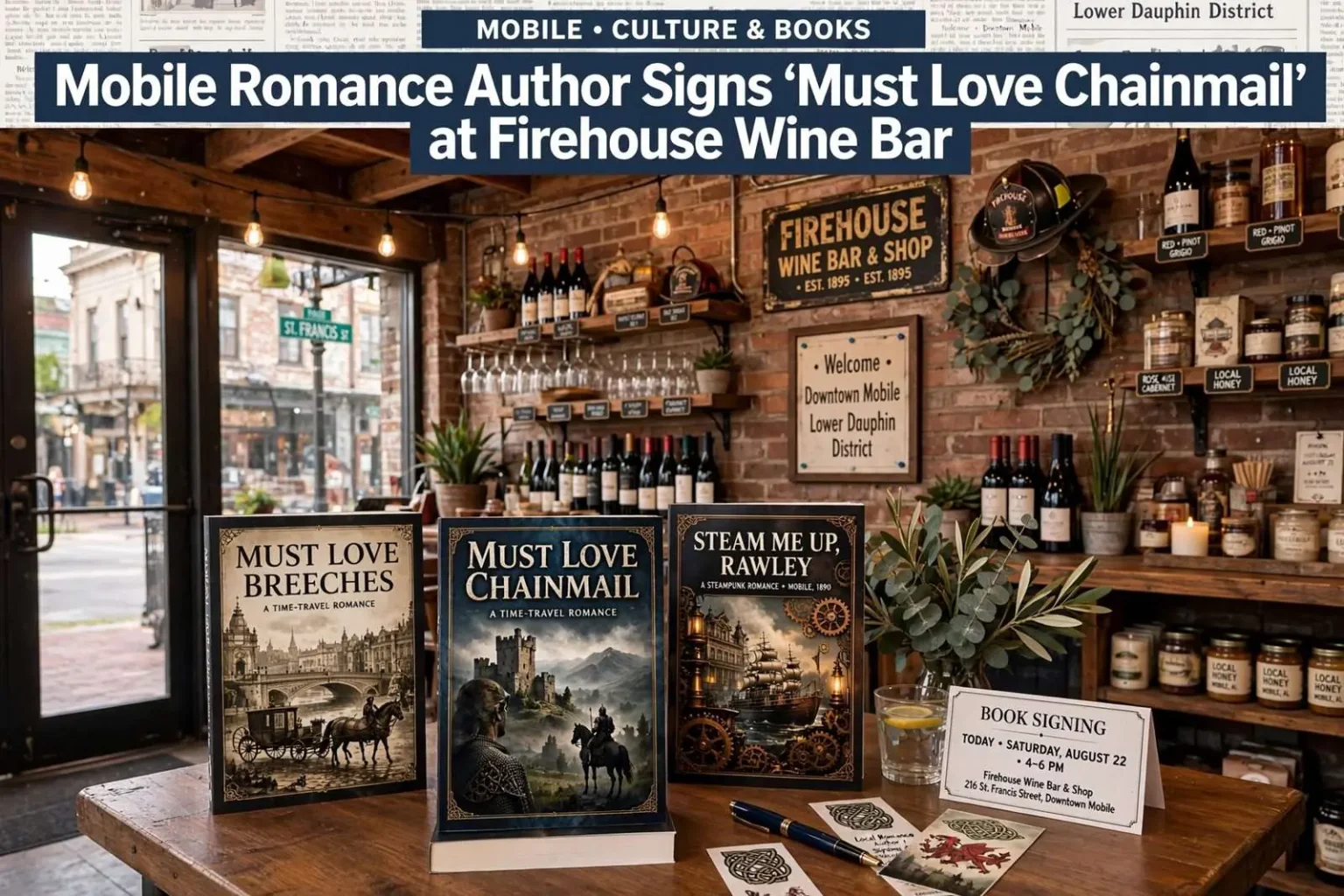
Local author Angela Quarles is back with her latest time-travel romance, Must Love Chainmail, and she’s celebrating with a hometown book signing this Saturday, August 22, from 4 to 6 p.m. at the Firehouse Wine Bar & Shop, 216 St. Francis Street in downtown Mobile. The event puts the Mobile writer in one of downtown’s favorite gathering spots with her newest novel on the table — and a growing list of readers who have followed her from one time period to the next.
The new novel follows an American expat living in Wales who accidentally wishes herself back to medieval Wales — straight into the middle of Madog’s Rebellion of 1294, and into the path of a half-Norman, half-Welsh knight. As the two embark on a perilous journey through the heart of Wales, each encounter pulls them closer together even as it pushes their goals further out of reach.
A setting with real history behind it
The rebellion Quarles chose for her backdrop is no invention. Madog’s Rebellion — the 1294 uprising led by Madog ap Llywelyn against the rule of England’s Edward I — was one of the major Welsh revolts of the medieval era, an attempt to throw off English control of Wales a decade after Edward’s conquest had stripped the Welsh of their independence. Setting a time-travel romance in the middle of it gives the heroine the classic peril of the genre: a modern woman, marooned in a war, whose survival depends on a man whose loyalties are torn between his Norman father and his Welsh mother.
That half-and-half heritage puts the hero at the story’s center of gravity, since the rebellion forced everyone in Wales to choose sides. Romance readers have long embraced time travel for exactly this kind of collision — modern expectations against medieval reality, where the hero and heroine must bridge not just personalities but centuries. The journey through the heart of Wales that structures the novel gives the story its geography: mountain country, contested castles and a countryside at war.
A growing catalog of local-flavored romance
Quarles made her name with Must Love Breeches, a time-travel romance set in 1834 London that debuted last year, and readers can expect plenty of the same chemistry in the new release. Her catalog also includes Steam Me Up, Rawley, a steampunk romance set in Mobile itself, in the year 1890.
That Mobile novel makes Quarles unusual among romance writers — an author using her own city as a historical setting. Mobile in 1890 was a port city on the rise, thirty years past the Civil War and building itself into the cotton-exporting powerhouse of the New South, with streetcars, grand homes on Government Street and a Mardi Gras tradition that predated New Orleans’ own. Steam-powered machinery, transatlantic shipping and Victorian social rules gave the era the mix of technology and formality that steampunk romance plays against — and for local readers, the pleasure of recognizing streets and customs they know from the other side of the centuries.
Together the three books show a writer comfortable across settings: 1834 London, medieval Wales and 1890 Mobile, each demanding its own research and its own voice. Time-travel romance asks that of its authors — the mechanism that moves a character between centuries must feel plausible within the story, and the historical world must be detailed enough to convince readers who know the period. Quarles’ willingness to jump from Regency London to medieval rebellion suggests a writer building a career on range as much as romance.
The signing at the Firehouse
The Firehouse Wine Bar & Shop on St. Francis Street has become one of downtown Mobile’s favorite venues for exactly this kind of event — a converted space a block off Dauphin Street where wine, conversation and local culture mix easily. A Saturday afternoon signing from 4 to 6 p.m. suits the room: readers can browse, talk with the author and make an evening of it in the Lower Dauphin entertainment district, where dinner and music wait a block away.
All three titles will be available for signing at Saturday’s event. Readers who can’t make it can find her books locally at Bienville Books and the Urban Emporium, or in electronic editions from the usual online retailers.
The local availability matters to Mobile’s reading community. Bienville Books, the independent bookstore in downtown Mobile, has long been the city’s anchor for local authors, and the Urban Emporium — a shop of local makers and finds — extends that reach into the shopping districts where visitors and residents browse. For a hometown writer, having physical shelf space in her own city is both a sales channel and a badge of belonging.
Romance, time travel and the indie publishing wave
Quarles’ rise tracks one of the significant publishing stories of the era: the transformation of romance by independent publishing. Romance readers have always been the most voracious and most loyal in popular fiction, and the arrival of accessible e-book publishing let writers like Quarles reach those readers directly, building catalogs across niches — time travel, steampunk, historical — without waiting on the traditional gatekeepers. The genre’s subgenres function as communities of their own, each with readers who track new releases and devour them in series, which rewards authors who can write quickly across connected worlds.
Time travel itself has been a staple of romance since the genre’s early paperbacks, for a reason readers understand instinctively: it supplies the ultimate outsider heroine, someone whose modern expectations clash instructively with the era’s constraints, and it gives the hero a woman unlike any his world could have produced. The best of these books, like the best historical fiction, use the distance between centuries to talk about what actually changes and what never does — love, ambition, loyalty and the pull of home.
A hometown audience
For Mobile readers, Saturday’s signing offered a double pleasure: meeting a writer whose work is read well beyond the Gulf Coast, and seeing their own city — the Mobile of 1890 — treated as worthy material for historical fiction. Authors from this region have long drawn on local history for literary fiction; romance, the best-selling category in American publishing, has been slower to claim it. Quarles’ Mobile novel puts the Port City’s Victorian era on the same shelf as London and medieval Wales, which is precisely the kind of claim a hometown audience enjoys endorsing.
The event itself fits the rhythm of downtown Mobile’s cultural calendar — wineries and bookstores hosting local writers, the Dauphin Street corridors humming on Saturday afternoons and evenings, a city that has invested heavily in restoring its historic core. A book signing in a converted firehouse on St. Francis Street, steps from the entertainment district, is the kind of occasion downtown revitalization was meant to produce: local talent, local venue, local readers, and a novel that carries Mobile’s name out to the wider world of genre fiction.
Where to find the books
For those who miss Saturday’s signing, the routes to Quarles’ work remain open all week: Bienville Books downtown, the Urban Emporium for the browsing crowd, and the electronic editions carried by the major online retailers for readers who consume their romances on a reader rather than in paper. Between the three books — one in 1834 London, one in 1294 Wales, one in the Mobile of 1890 — new readers have a catalog that stretches across eight centuries and two continents, all of it written by an author who lives blocks from where her Victorian romance is set. That is a rare thing in genre publishing, and Mobile’s readers have the rare pleasure of a hometown writer who has made their city part of the story.
Inside Must Love Chainmail
The premise of Must Love Chainmail puts its heroine in the worst possible travel mishap: an American expat already living in Wales, a casual wish, and a sudden arrival in 1294 — the year Madog ap Llywelyn raised the standard of revolt against Edward I. Medieval Wales at war is no place for a tourist. Castles were being besieged, the countryside was being fought over, and a woman without family, money or language that fit the era would have depended entirely on the goodwill of whoever found her. That the finder is a knight of mixed Norman and Welsh blood — a man whose own identity divides along the war’s battle lines — gives the novel its central tension.
The journey through the heart of Wales that carries the plot gives Quarles room for what the genre does best: two people forced together by circumstance, discovering that their goals and their hearts are pulling in opposite directions. Each encounter on the road draws the pair closer while pushing the heroine’s way home and the hero’s cause further apart — the classic time-travel dilemma in which falling in love means choosing a century.
Mobile’s literary shelf
Quarles occupies a distinctive spot on Mobile’s literary shelf. The city’s most famous authors have written literary fiction and journalism — Pulitzer winners among them — but genre fiction set in the city itself is rare, and romance rarer still. Steam Me Up, Rawley’s 1890 Mobile is the city of the streetcar suburbs and the growing port, when Mardi Gras societies were becoming the civic institutions they remain and the grand homes of the historic districts were new. For readers who live among those houses, a steampunk romance set a few blocks away is a novelty worth the shelf space — history delivered with its corsets and machinery intact.
The Saturday signing, from 4 to 6 p.m. at the Firehouse Wine Bar & Shop at 216 St. Francis Street, offered readers a chance to have all three books inscribed — the London novel that started her momentum, the Welsh rebellion romance making its debut and the Mobile steampunk title that ties the catalog to home. Local book culture runs on such afternoons: the author meets the readers, the store makes its sales and a writer’s standing in her hometown rises one event at a time. For a genre writer building an audience far beyond the Gulf Coast, a hometown room full of readers was both a celebration and a base — the place where the name on the covers is also a familiar local byline.


