
Mobile Senior Housing Residents Get Eviction Notices Over Coronavirus Rule Violations
Central Plaza Towers in Mobile issued eviction notices over social distancing violations after one COVID death; the housing board calls it a last resort.
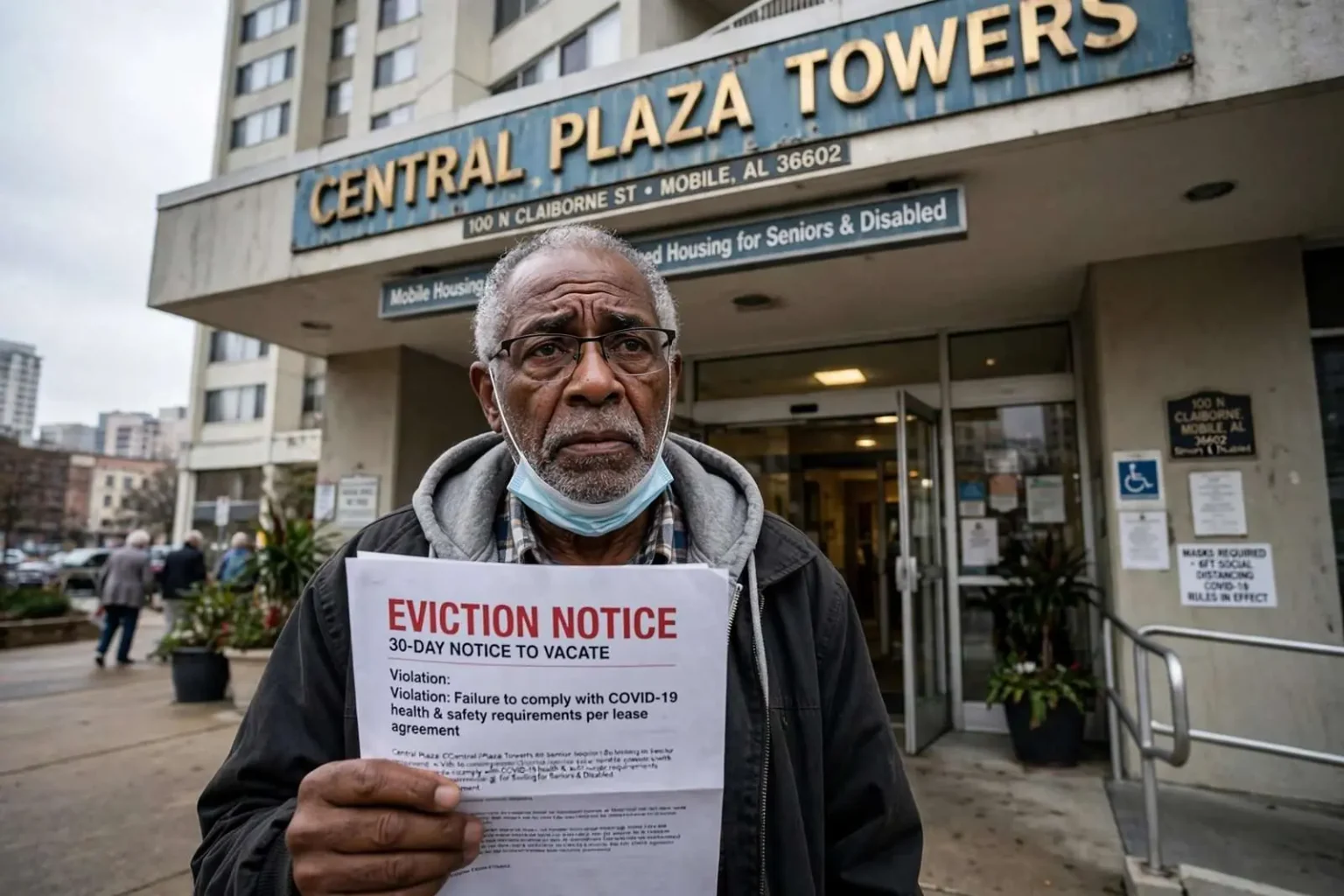
MOBILE, Ala. — A downtown Mobile senior housing center has taken the unusual step of issuing eviction notices to residents accused of ignoring coronavirus health rules — a move that has frightened tenants and drawn a response from city council leaders.
Keith Labeaud was the first resident of Central Plaza Towers to receive a notice alleging he violated his lease by not following health guidelines set by the housing board. He says the accusation doesn’t match reality for him or his neighbors. “We comply, we stay six feet apart and wear our masks,” Labeaud said. “I’m scared. If I get evicted today I don’t have anywhere to go.”
He added that the ordeal has made other residents afraid to even leave their apartments — a fear with its own health consequences in a building where isolation already weighed heavily on residents during the pandemic.
Board: ‘A Last Resort’
Mobile Housing Board Executive Director Michael Pierce said frightening residents was never the intent, and defended the notices as targeting people who were endangering their neighbors. “This was a last resort effort to try and save people’s lives,” Pierce said.
The board acted after the towers recorded one COVID-19 death and four other cases — a serious threat in a building full of seniors especially susceptible to the virus.
The numbers explain the board’s urgency. Central Plaza Towers houses elderly and disabled residents in a high-rise setting with shared elevators, hallways, laundry rooms and common areas — an environment public health officials identified early in the pandemic as among the most dangerous for viral spread. One death and four cases in such a setting, board officials argued, justified extraordinary measures.
The eviction notices, in the board’s framing, were aimed not at wholesale removal but at compliance: Residents who received notices have 30 days to vacate, but Pierce stressed that anyone now following the rules won’t have to leave at all. “After getting their attention and they are now complying … we would love to have them stay,” he said.
In practice, the notices function as a 30-day deadline that dissolves if the behavior changes. Residents who begin following the masking and distancing guidelines — and stop violating them — remain in their homes, and the board treats the notice as having served its purpose.
The legal and human stakes
Using lease enforcement against pandemic rule violations puts the housing board on unsettled legal ground, even in a public housing context where leases carry extensive conduct requirements. Federal, state and local eviction moratoria enacted during the pandemic generally targeted evictions for nonpayment, and housing advocates questioned whether a public housing authority could treat health-rule violations as grounds for termination while those protections were in force.
For the tenants on the receiving end, the practical reality is fear regardless of the legal questions. Labeaud’s account — no place to go if evicted — describes the situation of many seniors in subsidized housing, for whom an eviction is not a relocation inconvenience but the loss of the only housing they can afford, in a rental market and pandemic economy where options for low-income elderly renters are vanishingly thin.
Senior advocates note that the population most at risk from the virus is also the population most damaged by eviction stress: displacement disrupts medical care, breaks support networks of neighbors and staff, and for residents with mobility or cognitive limitations, the prospect of finding and moving into new housing in 30 days is functionally impossible without family intervention.
City Hall responds
The notices also drew scrutiny from City Hall: Council President Levon Manzie, Councilmember Fred Richardson and Council Vice President C.J. Small released a joint letter responding to the evictions Tuesday afternoon.
The joint letter put three of the council’s most senior voices on record in the same dispute, a notable alignment in a body whose members frequently split on housing policy. Council members hold no direct authority over the Housing Board’s operations — the board is a distinct entity from the city government — but the council controls appointments, zoning and the political climate in which the authority operates, and public letters of this kind carry weight with an agency dependent on city cooperation.
The council’s involvement also reflected the constituent pressure behind the dispute. Residents of the towers and their families had been contacting elected officials as the notices went out, and the letter represented the council’s first formal answer to a situation that had made tenants afraid to leave their apartments.
Public housing and the pandemic
Central Plaza Towers is part of the portfolio operated by the Mobile Housing Board, the public housing authority serving the city since the 1930s. The authority’s high-rise buildings for seniors and disabled residents present a management challenge that conventional family public housing does not: populations with high medical vulnerability, living at density, dependent on shared systems for daily life.
When the coronavirus reached those buildings, authorities across the country scrambled to adapt. Common responses included restricted building access, suspended gatherings and visitor policies, increased cleaning of high-touch surfaces, meal deliveries to limit elevator trips, and constant messaging on masking and distancing. Enforcing those guidelines against residents — who live in their own apartments and cannot be confined — proved to be the hardest part, and most authorities relied on education and persuasion rather than lease enforcement.
That context frames the Mobile board’s choice of tools. A notice threatening eviction is the bluntest instrument available to a housing authority, and its use against pandemic rule violations — rather than the nonpayment, criminal activity or lease violations that typically trigger it — is what made the Central Plaza Towers approach unusual enough to draw both city council attention and resident alarm.
The balance the board says it struck
Pierce’s public message attempted to hold two ideas at once: the notices were serious enough to change behavior, and no one who changed behavior would actually be evicted. The 30-day window, in this reading, was a compliance device calibrated to a life-threatening situation — a way to force attention in a building where the virus had already killed one resident.
Residents’ accounts describe a different experience: fear, confusion and a sense that their homes were suddenly conditional on rules enforced unevenly. Whether the board’s approach saved lives, terrorized tenants or accomplished both is the question the dispute left hanging — and the question the council’s joint letter put before the public.
What residents faced
For the tenants of the towers, the dispute was experienced floor by floor. Residents described watching neighbors receive notices, comparing the accusations against them with what they had actually seen in the hallways and elevators, and wondering whether their own conduct had been reported, misreported or observed at all. The notices named lease violations, but the underlying facts — who wore a mask where, who kept six feet of distance — turned on observations made in the ordinary traffic of a high-rise lobby.
Labeaud’s own description of life in the building — compliance with distancing and masking — captured the gap between the board’s enforcement narrative and the residents’ experience of it. Tenants who believed they had followed every guideline suddenly held 30-day notices, and the fear spread faster than the notice list itself: if the first recipient could be Labeaud, no one felt certain of their standing.
The pandemic had already reshaped daily life in the towers before the notices arrived. Common rooms closed, family visits curtailed, church services and building gatherings suspended — the social fabric that makes a senior high-rise livable thinned to hallway waves and phone calls. Adding the threat of eviction to that isolation deepened the anxiety in ways residents said made them less willing to come out of their apartments at all.
Housing authority governance and oversight
The Mobile Housing Board answers to its own board of commissioners and to the U.S. Department of Housing and Urban Development, which funds and regulates public housing nationwide. That structure places lease enforcement decisions within the authority’s discretion, but it also subjects those decisions to federal fair housing requirements, grievance procedures for tenants and the oversight mechanisms that apply to all public housing authorities.
Tenants facing lease termination in public housing are entitled to notice and an opportunity for a hearing, a process that gives residents a formal channel to contest the allegations in their notices. Whether the Central Plaza Towers cases would be resolved through those hearings, through the compliance the board said it sought, or through intervention by the city’s elected officials remained the open question as the 30-day windows ran.
The council members’ letter added political accountability to the procedural kind. Manzie, Richardson and Small represented districts and at-large constituencies that included public housing residents, and their joint response signaled that the authority’s pandemic enforcement would be examined at City Hall, not only in grievance hearings.
A dispute with lessons beyond one building
The Central Plaza Towers controversy echoed disputes in senior housing across the country, where authorities and landlords weighed pandemic enforcement against residents’ security of tenure. Public health guidance gave property managers a mandate — protect vulnerable populations from a deadly virus — but offered no clear answer to the enforcement question, and the tools available ranged from education to fines to the eviction notices Mobile chose.
What happened at the towers became a local case study in that dilemma: a building with a death and four cases, a board that reached for its sharpest legal instrument, residents who said the instrument frightened the compliant along with the violators, and a city council stepping into a dispute that its charter gave it no formal power to resolve.
For the residents holding notices, the outcome turned on the board’s own promise — that those now following the rules would stay. For the city watching, the episode left a standing question about how senior housing should balance safety enforcement against the security of the people it exists to house, a question the coronavirus era forced everywhere but answered nowhere.