
Mobile Shipyard Christens Future USS Canberra, the Only U.S. Ship Named for a Foreign Ally’s Capital
Austal USA christened LCS 30, the future USS Canberra — the only U.S. Navy ship named for the capital of a foreign ally. The 15th LCS built in Mobile.
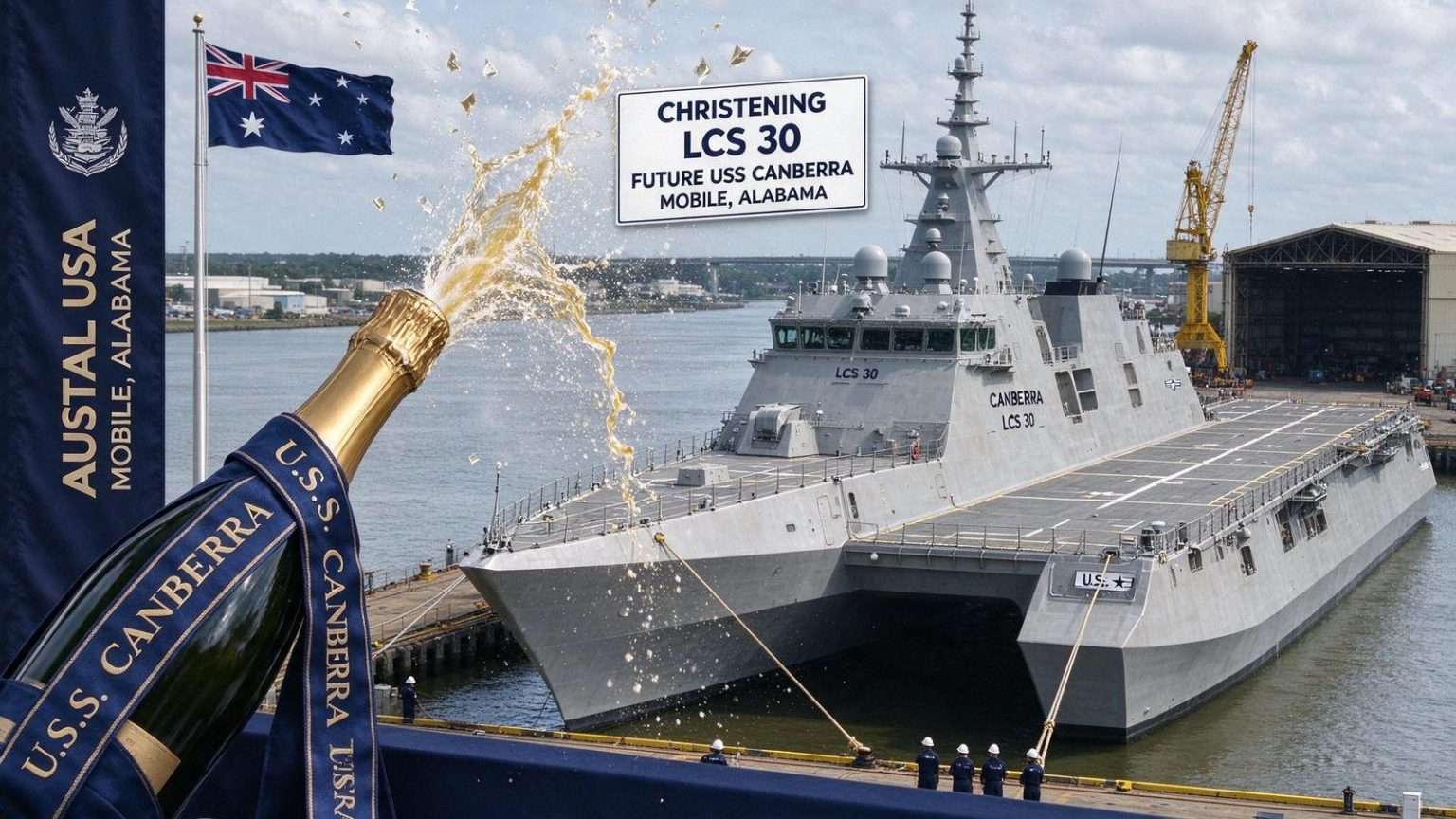
Mobile’s Austal USA shipyard staged one of the most symbolically loaded ceremonies in its history, swinging a ceremonial champagne bottle against the hull of the Navy’s newest littoral combat ship and giving it a name no other American warship carries: Canberra, after the capital city of Australia. The christening of LCS 30 at the Mobile River facility marked the first time the U.S. Navy has named a ship for the capital of a foreign ally, a distinction that flows directly from the yard’s Australian parentage and the deepening defense relationship between Washington and Canberra. For a shipyard that has built more than a dozen ships of the same class without comparable fanfare, the naming turned a routine industrial milestone into a diplomatic event.
A Name With Two Wars Behind It
The name carries historical weight beyond its novelty. Canberra is only the second ship in American naval history to bear it. The first was a Baltimore-class heavy cruiser commissioned during World War II and named to honor the Australian heavy cruiser HMAS Canberra, which was lost in the early months of the war during the Battle of Savo Island in the Solomon Islands. That original gesture of commemoration made the cruiser a floating emblem of the alliance, and the new littoral combat ship inherits the same role. Navy officials have pointed out that naming a warship for a foreign capital is an expression of trust reserved for the closest of partners, and Australia has fought alongside American forces in every major conflict since World War I, from the trenches of the Western Front to the deserts of Iraq and Afghanistan.
The original USS Canberra herself embodied that bond in an unusual way. Damaged in the same battle that sank her Australian namesake, the American cruiser was repaired and returned to service, and she later served as a centerpiece of allied naval operations in the Pacific. Sailors from both navies have marked the connection ever since, and the christening in Mobile revived that lineage for a new generation. Naval historians note that ship names are deliberately chosen to carry stories forward, and few names in the fleet arrive with as much shared history attached as this one.
Rear Adm. Casey Moton, speaking at the ceremony, framed the name as a reflection of how tightly the two navies now operate together. The cooperation runs through joint planning and engineering, shared shipbuilding concepts, and sailors from both nations serving side by side at sea. Australian and American crews regularly exchange personnel and train together in the Pacific, where both navies have emphasized distributed operations and high-end surface warfare. The ship’s name, in that light, is less a courtesy than a statement about the future shape of allied naval operations in a region where both countries have made freedom of navigation and partnership exercises central to their strategy.
A Delayed but Determined Ceremony
One planned piece of pageantry was missing. The christening had been arranged around the Australian ambassador and his wife, who were slated to serve as the ship’s sponsors in the traditional role of breaking the champagne across the bow. Flight delays kept the couple from reaching Mobile in time for the Saturday ceremony, a logistical wrinkle that disappointed organizers but did little to dull the occasion. Shipyard workers, Navy officials, and local dignitaries filled the riverside facility for an event that doubled as a showcase for the city’s shipbuilding industry. In naval tradition, sponsors maintain a lifelong relationship with a ship and its crew, and the ambassador’s connection to LCS 30 will continue even though the christening itself went forward without them.
Christenings along the Mobile River have become familiar civic theater in Mobile, drawing crowds of workers’ families, veterans, and school groups to the waterfront. Each ceremony marks years of work by thousands of hands — the welders, electricians, painters, and outfitters who assemble aluminum hull modules in fabrication halls before they are joined on the ways and launched into the river. The champagne bottle strike is the moment the vessel stops being a construction project and becomes a ship with an identity, a crew to come, and a destination on the other side of the world.
Built on the Mobile River
Austal USA’s yard on the Mobile River has been the sole production line for the Independence-variant littoral combat ship, the aluminum-hulled trimaran class designed for speed, shallow draft, and modular mission packages. Canberra is the 15th littoral combat ship built at the Mobile River facility, part of a construction program that has run continuously since the yard opened on the waterfront and became one of the largest industrial employers in the region. The class has drawn periodic criticism over survivability questions and early hull cracking, but the ships have matured into a workhorse for deployments, and the Navy has extended the service lives of the class while shifting future construction toward larger frigates.
The trimaran design gives the Independence variant a wide flight deck and a large internal volume for mission modules — surface warfare packages, mine countermeasures gear, or anti-submarine equipment that can be swapped as missions change. That modularity has made the class a frequent choice for forward deployments to Southeast Asia and the Persian Gulf, where shallow draft and aviation capacity are at a premium. Canberra will carry the same capabilities, along with whatever upgrades the Navy has folded into the later hulls of the production run.
From the Mobile River to the Pacific Fleet
Following the christening, the ship’s path runs through outfitting and sea trials on the Gulf of Mexico before delivery to the Navy and eventual commissioning. Like its predecessors, Canberra is expected to spend its service life with the Pacific fleet, where its range and speed suit the long transit distances of the Indo-Pacific theater. The ship joins a growing fleet assembled across the river from downtown Mobile, a skyline fixture that has made the city a recurring stop for Navy christenings and commissionings. Crew members assigned to the new hull typically begin arriving months before commissioning, training at the yard and aboard sister ships to learn systems they will operate at sea.
For Mobile, the ceremony reinforced a decade-long identity as a Navy shipbuilding city. Austal’s continued workload, including additional littoral combat ships and new auxiliary and support vessel programs, sustains thousands of direct jobs and a supplier network across the Gulf Coast. The christening of a ship named for an allied capital, delivered from an American yard owned by an Australian company, compresses that story into a single hull: a warship built on the Mobile River whose very name is a diplomatic instrument, carrying the alliance it honors from Alabama’s waterfront into the Pacific.
The alliance the ship celebrates is not merely ceremonial. Australia is one of a handful of nations the United States treats as a top-tier defense partner, with intelligence sharing, joint basing arrangements, and combined exercises that few countries enjoy. Australian companies participate directly in American defense supply chains, and Austal itself is the most visible example — an Australian shipbuilder whose American subsidiary delivers warships to the U.S. Navy from Alabama soil. The flow runs both ways: American submarines and surface ships call at Australian ports under rotational force posture initiatives, and the two militaries co-develop technologies ranging from hypersonics to undersea systems under frameworks like AUKUS.
What the LCS Class Does
For residents wondering what the newest visitor to the waterfront actually does, the littoral combat ship concept was born from post-Cold War naval thinking: a fast, flexible hull that could operate close to shore, where aircraft carriers and destroyers are ill-suited to loiter. The Independence variant’s aluminum trimaran hull, built at Austal’s Alabama yard, was derived in part from a high-speed ferry design the parent company had commercialized in Australia. Ships of the class have hunted smugglers in the Caribbean and Eastern Pacific, trained with allies across Southeast Asia, and tested new concepts for unmanned systems and over-the-horizon missiles.
The class has also been a lesson in acquisition debate. Early cost growth, mission module delays, and a Navy decision to retire some early hulls made the LCS program a recurring subject of congressional hearings. Shipbuilders and Navy leaders have countered that later flights of the class, like Canberra, incorporate more than a decade of lessons, with improved machinery, better corrosion control, and more capable combat systems. Whatever the argument, the ships keep deploying, and their crews have become among the most experienced small-ship sailors in the fleet.
Canberra’s delivery will add to a run of Mobile-built hulls that now serve across the Pacific and the Gulf of Guinea, and the ship’s name will travel with her wherever she goes. In port calls abroad, a warship named for a foreign capital draws attention that a hull number alone does not — an ambassadorial role performed at every pier. Navy officials have made the point explicitly at recent christenings: names are a form of signaling, and LCS 30 signals that the United States intends to build its most advanced ships alongside, and in honor of, its closest allies. For Mobile’s shipyard workers, the champagne bottle striking aluminum was the familiar sound of another hull going down the ways; for the alliance it honors, it was a rare public statement cast in steel — well, aluminum — and seawater.


