
Mobile Tattoo Artist Sues City Council to Settle Deadlocked Presidency Vote
L.A. Body Art owner Chassity Ebbole sued to break Mobile's City Council deadlock, seeking to seat Fred Richardson as president on a 4-3 vote.
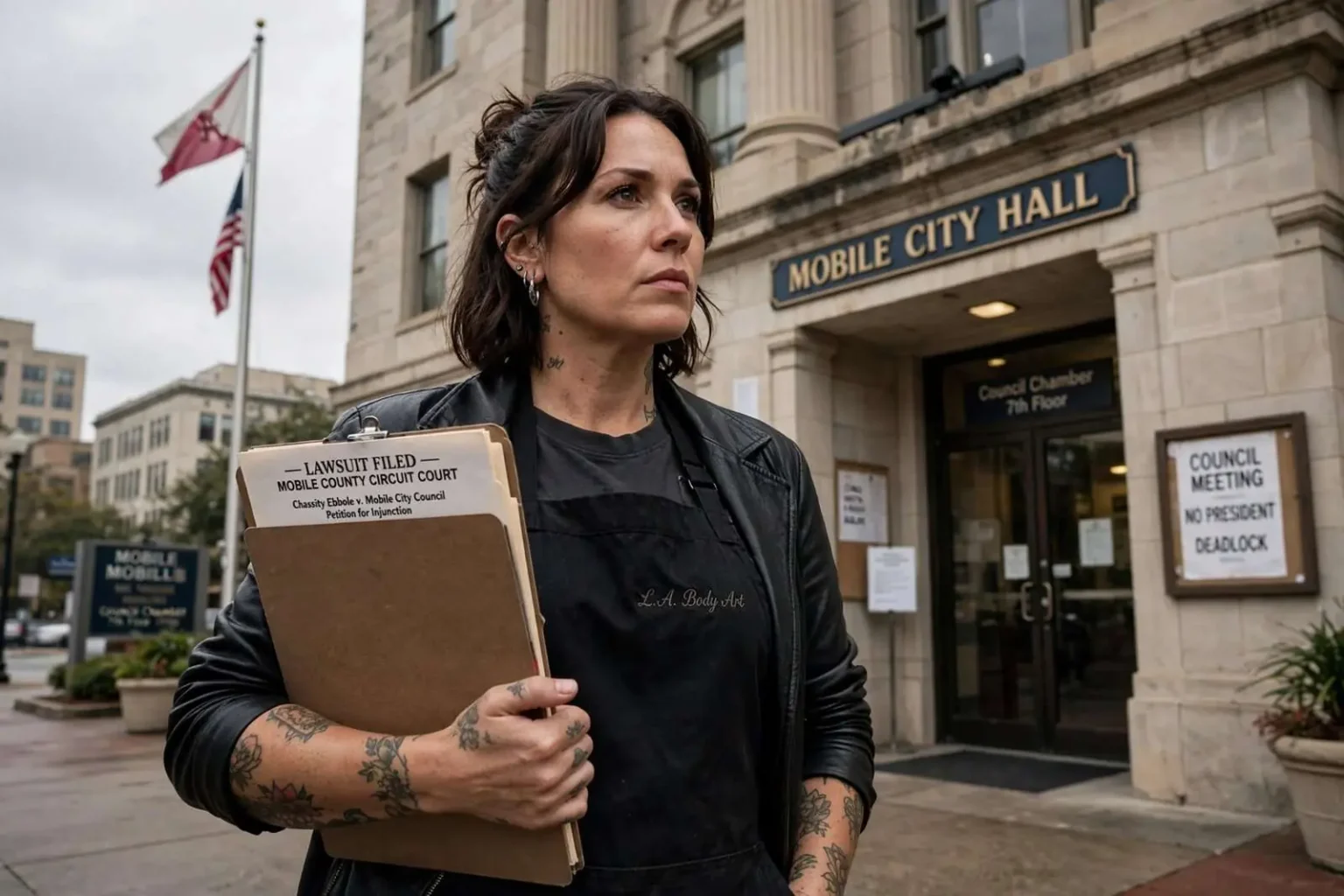
A Mobile business owner has filed a lawsuit in Mobile County Circuit Court seeking to force the City Council to resolve its long-stalled election of a council president — a fight that has left the body without a leader or standing committees for months and turned an internal dispute into the city’s most conspicuous governance problem.
The suit was filed by Chassity Ebbole, owner of L.A. Body Art and a friend of Councilman Fred Richardson. It argues the council should honor historical precedent and seat Richardson, who received four votes to Councilwoman Gina Gregory’s three when members informally cast their picks ahead of the organizational meeting — a tally that, under the council’s long practice, would have made him president.
The deadlock has instead persisted for months, leaving the seven-member council operating without a president, without its standing committee structure and without the normal machinery through which business moves from introduction to vote. What began as a procedural disagreement over one office has become a structural problem that touches nearly everything the council does.
Supermajority Rule at the Center
Under the Zoghby Act — the state law establishing Mobile’s current form of government — electing a council president requires votes from five of the seven members, a supermajority. The requirement, rarely a practical obstacle in past councils that organized quickly and unanimously, has become the immovable object in the current standoff, because neither Richardson’s four votes nor Gregory’s three can climb to five without someone crossing over.
Ebbole calls that an “old, dead law that had never been enforced” and argues the council’s sudden reliance on it to block Richardson is “arbitrary and capricious.” Her legal theory is straightforward: decades of practice treated a simple majority of the members’ votes as sufficient, and the council cannot retroactively impose a stricter reading to change the outcome.
“For more than 30 years it worked,” Ebbole said. “The system was not broken. It’s a joke.” Her complaint asks for an injunction preventing the council from changing its traditional selection method and claims the deadlock has caused “chronic and significant problems” governing the city.
The lawsuit puts a court in the position of referee for an internal legislative dispute — territory judges generally enter reluctantly, but which Mobile’s months of paralysis have made harder to avoid. If the court accepts Ebbole’s precedent-based argument, the council would be ordered to seat its president under the historical rule; if it accepts the city’s position, the Zoghby Act’s supermajority stands and the votes will have to come from somewhere.
What the Deadlock Has Cost
With no president seated, the city clerk has chaired meetings in the absence of Vice President Levon Manzie, who has been out recovering from a knee injury, and ad hoc committees have replaced the board’s standing committees. The arrangement keeps meetings functioning, but it inverts the ordinary structure of the council: committees are where ordinances get debated, budgets get examined and residents get heard before items reach the full body.
Standing committees in Mobile carry real power. They set agendas, shape legislation before it reaches the floor and provide the public process — hearings, department reviews, budget markups — that a city of Mobile’s size requires. Ad hoc substitutes, appointed case by case, operate without the continuity and precedent that standing structures accumulate, and watchdogs of municipal government have long warned that committee breakdowns are where legislative accountability first erodes.
The clerk’s service as chair, likewise, is a stopgap with limits. A city clerk administers meetings but is not a member of the body, cannot vote and does not participate in debate, which means Mobile’s meetings have been chaired in recent months by someone with a procedural role but no elected mandate. Combined with the vacancy in the president’s chair, the council has effectively been operating with six working votes and no elected leadership.
The Councilors Split
Richardson says he hopes the court can break the impasse: “There is no path in the city of Mobile among the council to selecting a president… if we had a path we’d have a president by now.” His position rests on the four votes he assembled — a majority of the members — and on the decades of practice under which such a majority was enough.
Councilman John Williams, who voted against Richardson, stood firm. “The law is the law,” Williams said. “It’s very simple, it takes a super majority.” His reading takes the Zoghby Act at its word: whatever past councils did, the statute on the books requires five votes, and no court fight changes arithmetic.
Council attorney Wanda Cochran and Manzie both declined comment, leaving the legal fight to unfold between Ebbole’s lawyers and whatever position the city takes in court. The silence from the council’s own legal office has been notable, since any court ruling will almost certainly address the city’s institutional practices rather than merely the two candidates’ claims.
The Person Behind the Suit
Ebbole acknowledged her 20-year friendship with Richardson but said there has never been anything improper in her advocacy, framing the lawsuit as a resident’s objection to a broken process rather than a favor for a friend. The acknowledgment, made proactively, signals awareness that the suit will be scrutinized for personal motive — a scrutiny she deflects to the substance of the claim: that the council’s method of electing a president changed midstream, after the votes were counted, and that the change served no purpose except the outcome.
As the owner of L.A. Body Art, a longtime Mobile small business, Ebbole is an unusual plaintiff in a governance lawsuit — not a council candidate, not a political operative, but a business owner whose public role grew out of frustration. Small-business plaintiffs in municipal governance fights bring a practical perspective: the council’s paralysis translates into delayed permits, postponed zoning decisions and a government whose committees cannot move commerce along.
Why the Council Presidency Matters
The president of the Mobile City Council is more than a presiding officer. The office controls meeting agendas, appoints committees, and stands first in the line of succession to the mayor — a constitutional fact that gives every fight over the gavel a stakes level residents can feel even when the procedural details are obscure. Whoever holds the presidency shapes what reaches the floor and in what order, which is why the seven members have treated the selection as worth a months-long standoff.
The Zoghby Act, passed in the 1980s, created Mobile’s current mayor-council structure with a seven-member council elected by district, and its drafters built supermajority requirements into the body’s internal elections to force consensus across districts. The design assumed council members would bargain and compromise; it did not anticipate a council so evenly split that no coalition reaches five.
That is the bind a court is now being asked to unwind. If the judge sides with Ebbole and orders the council to follow its historical practice, Richardson takes the gavel with four votes and the body finally organizes. If the court upholds the supermajority, the impasse continues until someone changes a vote — or until the next election reshuffles the board entirely. Either way, Mobile’s residents have learned more about the mechanics of their city charter than any election campaign ever taught them, and the council’s standing committees — the machinery of everyday governance — remain in ad hoc suspension while the lawyers argue.
How the Deadlock Began
The fight traces to the organizational meeting that follows every council election, when members informally cast their picks for president ahead of the formal vote. Richardson’s four votes to Gregory’s three would, under the council’s historical method, have ended the matter on the spot. Instead, the supermajority requirement surfaced, the informal tally failed to convert into a formal election, and the council has been stuck ever since — four members behind Richardson, three behind Gregory, and nobody prepared to move.
The strategic reality beneath the standoff is simple arithmetic. Four votes control nothing under the Zoghby Act’s five-vote rule, and three votes control less. Each side believes the other should blink: Richardson’s camp argues the majority of members spoke, while Gregory’s camp argues the statute requires more than a majority and that no amount of historical practice can rewrite it. Months of negotiation have produced exactly what the numbers predicted — nothing.
Into that vacuum stepped the courts. Ebbole’s complaint recasts the impasse as a legal question rather than a political one, asking a judge to decide whether the council’s 30 years of practice or the text of the Zoghby Act governs. Municipal law scholars generally give the statute’s text the stronger hand, but courts have also been reluctant to let a legislative body rely on a rule it ignored for decades, particularly when the sudden enforcement conveniently changes an outcome.
What Residents Are Watching
For Mobile residents, the saga has become a civics lesson conducted in public. Council meetings chaired by the city clerk, agendas assembled without a president, committee work done by ad hoc appointments — each stopgap has been visible, and each has underlined how much the body’s ordinary structure does before any ordinance reaches a final vote.
Business owners and neighborhood advocates have been the most directly affected, since the committees that review zoning changes, developments and budget items are the stage where their concerns get a hearing. A city of Mobile’s size cannot run its land-use and budget functions indefinitely without standing committees, and the months of ad hoc arrangements have stretched the point past what anyone considers healthy.
The lawsuit’s outcome will not end the underlying politics — four against three remains four against three, whatever a judge says about method. But it will decide whether the council’s paralysis has a legal exit or must wait for the members themselves to break it. Until then, Mobile’s city government continues operating on improvisation, its presidency vacant, its committees makeshift, and its seven members locked in the arithmetic that started it all.


