Mobile therapeutic recreation specialist devotes career to people with special needs
Mobile Parks and Recreation therapeutic specialist Ella Mooney devotes her career to inclusive programs that serve people with special needs across the.
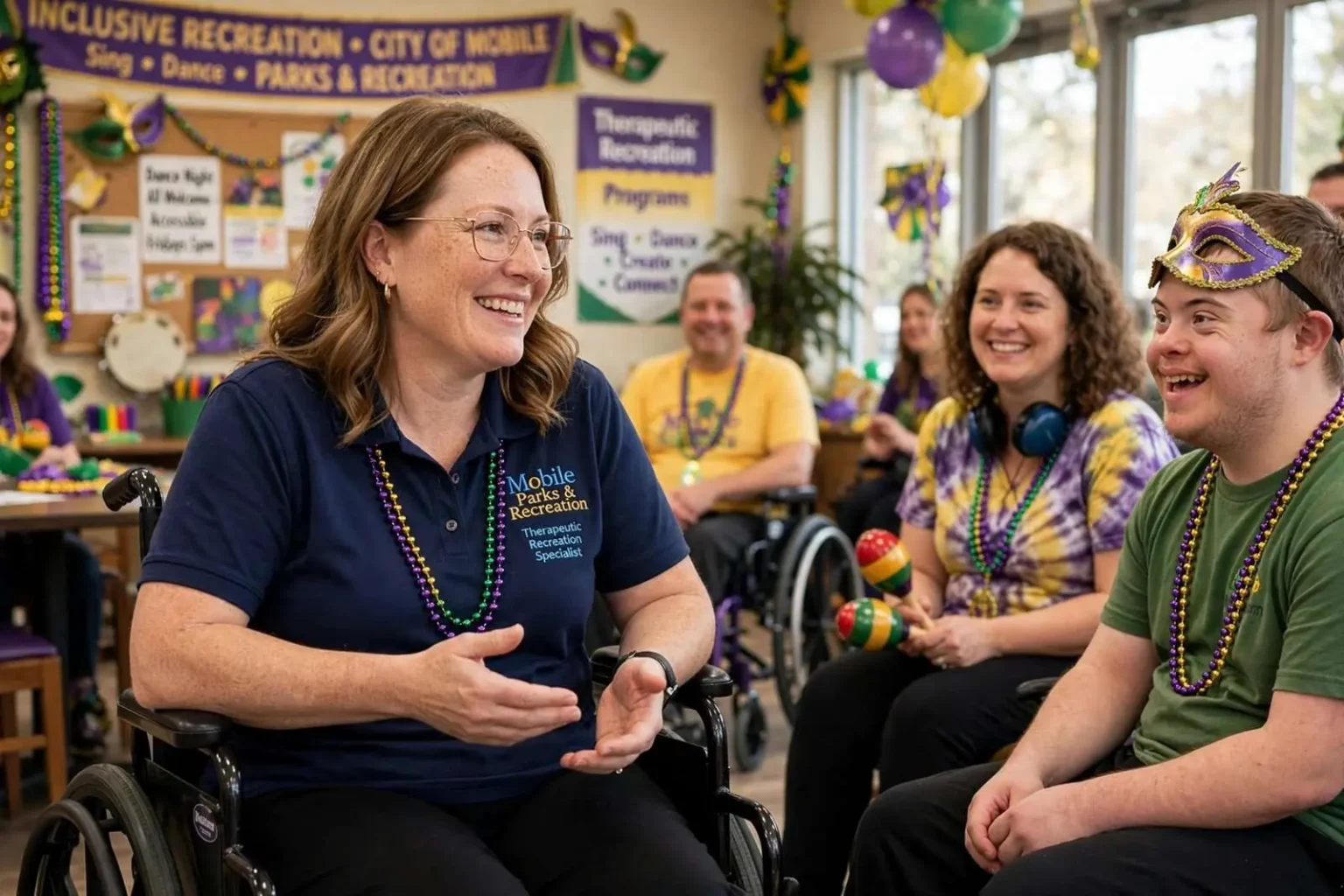
As a therapeutic specialist with the city of Mobile’s Parks and Recreation Department, Ella Mooney supervises inclusive and therapeutic programs that serve people with special needs. For her, the work reaches far beyond a job title. “It’s my ministry, it’s my passion. I just love it,” Mooney said.
After facing obstacles of her own in childhood, Mooney went on to college and earned multiple degrees with an emphasis on special needs. She used that training to help develop programs and services for families affected by developmental disabilities, building offerings within the city’s recreation system that give participants opportunities for recreation, social connection and community life that many take for granted.
Her path to the work was shaped by personal trials. She survived a traumatic, life-threatening car crash and lives with health challenges that keep her from walking. Rather than slow her down, she says, those experiences gave her a unique ability to relate to the people she serves — an understanding of barriers, access and perseverance that no textbook could provide. In her programs, that empathy is the operating principle, not a slogan.
Programs built on inclusion
Mooney organizes events where participants sing, dance and enjoy Mardi Gras parades together. The offerings mirror the rhythms of Mobile’s civic life — the city’s famous festival season chief among them — adapted so that people with physical and developmental disabilities can take part fully rather than watch from the sidelines. Inclusive recreation of this kind serves a purpose that goes well beyond entertainment: it builds social skills, physical confidence and community belonging for participants, and it gives families respite and support.
Therapeutic recreation is a recognized discipline within parks and recreation nationwide, grounded in the idea that play, movement and creative expression are part of health for everyone. Programs typically include adaptive sports, arts and music activities, social clubs, holiday dances and outings to community events, all designed with accessibility at the center. In Mobile, the city’s investment in such programming has made the department a lifeline for families who often find few options elsewhere for their adult children with disabilities.
“They have a right to be loved. They have a right to have fun. They have a right to be happy like we are,” Mooney said. The conviction animates everything from the planning of a dance to the handling of a participant’s daily needs, and families who rely on the programs say it shows.
Mooney, who does not have biological children, considers the adults in her programs to be her family. One of them, whom she calls her son, has lived with her since he was a teenager — a bond that grew out of program participation and became a permanent household. The arrangement reflects the depth of connection the programs create, and the way her professional vocation and personal life have merged into a single calling.
A reciprocal relationship
For all she gives, Mooney insists the exchange runs both ways. “They encourage me as much as I hopefully encourage them,” she said. “They make me realize the simple things in life and what really matters.” Colleagues and participants describe the programs as a place where joy is the default setting — where a birthday is celebrated with full ceremony, a song is sung loudly regardless of ability, and every Mardi Gras season brings a calendar of adapted parades and parties.
The reciprocal bond she describes is common in therapeutic recreation, where long-term participation turns programs into communities. Adults who have attended for years mark their own milestones together, look out for one another and develop friendships that extend outside scheduled activities. For parents aging alongside their adult children with disabilities, knowing those relationships exist provides security that few other services offer.
Mooney’s own story gives her leadership in this field particular weight. Having overcome childhood obstacles, survived a devastating crash and adapted to life with health challenges that limit her mobility, she models for participants what she teaches: that a full life is built on relationships, purpose and celebration, not on the absence of limitation.
Why therapeutic recreation matters in Mobile
The city’s therapeutic and inclusive programming exists within a broader landscape of services for people with disabilities in south Alabama. Families in the region navigate a patchwork of school-based support, state developmental disability services, nonprofit organizations and private providers, and municipal recreation programs fill a distinct niche within that system — the everyday, community-based activities that make a life feel ordinary in the best sense. Without them, many adults with disabilities would spend their days at home with limited social contact.
Mobile’s Parks and Recreation Department has historically been among the municipal systems in the region to maintain dedicated therapeutic programming, and the events Mooney organizes — from dances to parades — are fixtures on the calendars of the families who depend on them. The Mardi Gras connection is especially resonant in Mobile, the home of America’s original Carnival celebration. Making sure that people with special needs can ride in, dance at and fully experience the season that defines the city is, in Mooney’s framing, simply a matter of their rights: to be loved, to have fun, to be happy.
Her career demonstrates what a single committed professional can build within a municipal system. The programs she supervises, developed over years with families and participants, have become a model of what inclusion looks like when it is designed with — not merely for — people with disabilities. And the family she has gathered around her, biological or not, testifies to the reach of a ministry practiced through a city job title but carried out, in her words, as a passion she simply loves.
The daily texture of the programs
The inclusive programs Mooney supervises operate on a calendar that stretches through the year, with events timed to the seasons and celebrations of Mobile life. Mardi Gras — the city’s signature season — brings adapted parade experiences where participants catch throws, wear costumes and take part in the festivities that dominate the city each winter. Throughout the rest of the year, the calendar includes dances, holiday parties, talent shows and social gatherings where singing and dancing are standard features, not exceptions.
The design of each activity reflects the therapeutic discipline behind it. Adaptive approaches ensure that participants with mobility devices, communication differences or behavioral needs are included in the same event rather than segregated into parallel offerings. Staff and volunteers learn each participant’s abilities and preferences, and families are treated as partners in the planning. That attention to detail is what turns an ordinary dance into an event where a wheelchair user is the first on the floor rather than an observer at the wall.
The benefits accrue on both sides of the room. Participants gain social connection, physical activity and the confidence that comes from belonging; volunteers and community members who attend inclusive events routinely describe the experience as perspective-changing. Mooney’s philosophy — that participants have a right to be loved, to have fun and to be happy like anyone else — challenges the broader community to see ability rather than disability first.
Overcoming her own obstacles
Mooney’s qualifications for the work run deeper than her degrees. Facing obstacles in her own childhood taught her early what it means to be underestimated, and she carried that insight into a college career that produced multiple degrees with an emphasis on special needs. Education gave her the professional toolkit; experience gave her the empathy.
Her survival of a traumatic, life-threatening car crash added another dimension. Recovering from serious injury and adapting to health challenges that keep her from walking reshaped her understanding of independence, accessibility and the daily ingenuity that people with disabilities bring to ordinary tasks. When she tells participants that limitations do not define a life, she speaks from a practice of that belief, not a theory of it.
That authenticity explains the extraordinary bonds her programs create. The young man she calls her son, who has lived with her since his teenage years, began as a participant whose family connection with Mooney deepened into a permanent relationship — an adoption in every practical sense, though she frames it simply as family. Her household, like her programs, is organized around the conviction that everyone belongs to somebody.
Colleagues within the Parks and Recreation Department describe her as the heart of the therapeutic division, and families describe her as indispensable. She, in turn, redirects every compliment toward the participants themselves, insisting they give her more than she gives them — encouragement, joy and a daily reminder of what really matters. It is the language of a calling, which is exactly how she describes it: a ministry, a passion, and work she simply loves.