
Mobile to Boot Vehicles of Drivers With Unpaid Parking Fines
Starting June 1, Mobile will boot vehicles with five or more unpaid parking fines. May serves as a warning period for drivers to settle outstanding tickets.
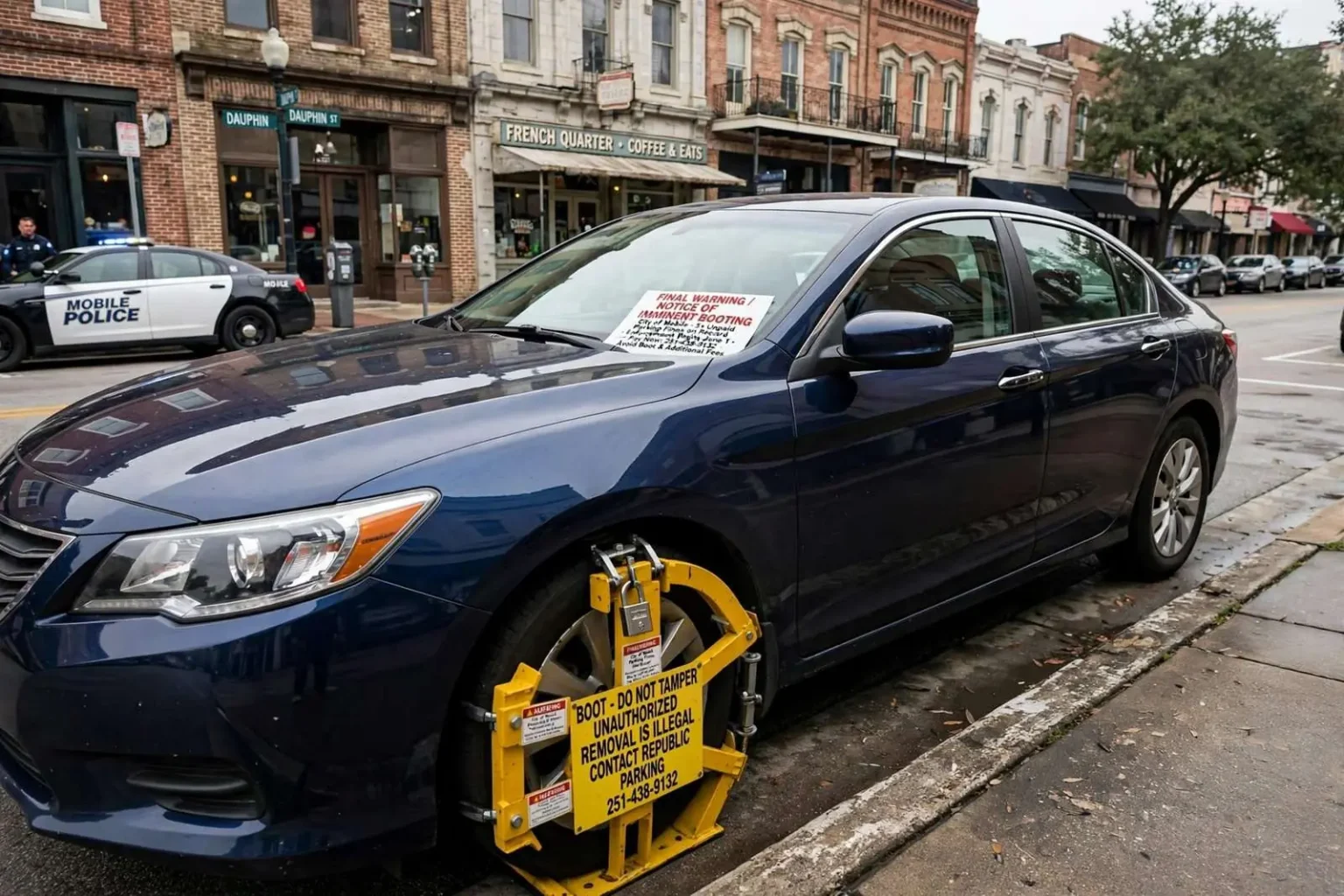
Drivers in Mobile with a stack of unpaid parking tickets could soon find their vehicles immobilized. City officials announced that, beginning June 1, the city’s parking management contractor will team up with the Mobile Police Department to place boots on vehicles whose owners have five or more outstanding parking fines.
Before enforcement begins, city team members will spend the remainder of May handing out warnings to drivers who have racked up more than five unpaid tickets. The grace period is meant, according to the city, to “create awareness and provide ample time” for drivers to settle what they owe before booting starts. Anyone with outstanding tickets from the City of Mobile can pay by contacting Republic Parking at 251-438-9132.
The crackdown is the latest step in the city’s long-running effort to bring order and revenue to a parking system that has struggled for years with unpaid citations, expired meters and the sheer seasonal pressure that comes with being a port city that throws the nation’s oldest Mardi Gras celebration every winter.
How the Booting Program Will Work
Under the plan, once enforcement begins June 1, any vehicle whose owner has five or more outstanding parking fines becomes eligible for a boot — a device clamped over a wheel that renders the car immobile until the fines are paid and the boot is removed by the contractor. The Mobile Police Department’s involvement adds weight to the program: a booted vehicle left in place can block spaces and traffic flow, and officers can assist when a driver disputes a boot or refuses to comply with removal procedures.
The five-ticket threshold is the key number for drivers to understand. A motorist with one, two or even four unpaid citations will not see a boot under this policy, though the fines themselves remain due and can still carry late fees. The threshold is designed to concentrate enforcement on the chronic offenders — vehicles that amass ticket after ticket while their owners ignore the accumulating balance — rather than on the driver who misjudged a meter once.
City officials have framed the program as fairness as much as revenue. Drivers who pay their tickets on time, the argument runs, should not be subsidizing those who simply ignore citations. When unpaid fines pile up without consequence, the city says, it encourages a culture of nonpayment that undermines the entire parking system, leaving honest parkers effectively paying for the spaces that scofflaws use for free.
Why the Warning Month Matters
The May warning period gives chronic offenders a genuine off-ramp. Anyone who receives a warning has the better part of a month to contact Republic Parking, confirm what they owe, and clear the balance before the boot crews hit the street. The city’s message is straightforward: the debt does not disappear, and it will only get more expensive and more inconvenient to deal with after June 1.
Payment, in this program, is by phone. Drivers call Republic Parking at 251-438-9132 to settle outstanding tickets owed to the City of Mobile. Contractors handling municipal parking enforcement commonly accept payment through multiple channels, but the city’s announcement pointed drivers to that number as the way to resolve what they owe, and it is the number to have on hand if a boot appears on a vehicle after enforcement begins.
Warnings also serve the city’s legal and public-relations interests. Booting a car is a dramatic, highly visible enforcement action, and municipalities that deploy it without a notice period routinely face complaints from drivers who claim they never knew they owed anything. A month of door-to-door or windshield-based warnings builds a paper trail showing that every affected driver had ample notice, which protects the city against disputes over individual boots and against the broader criticism that the program is a revenue trap aimed at unsuspecting motorists.
The Context: Parking in Downtown Mobile
Mobile’s parking challenges are shaped by the city’s layout and its calendar. The downtown core — the area around Dauphin, Government and Royal streets, the historic districts and the waterfront — is dense with restaurants, bars, offices and event venues, and its on-street spaces are metered and enforced. Demand for those spaces spikes dramatically during special events, and none more so than Mardi Gras, when weeks of parades and balls draw enormous crowds into areas where parking is already tight.
Into that environment come parking citations, issued by the enforcement staff who patrol metered spaces, residential permit zones, and restricted areas around parks and government buildings. Citations that go unpaid are not merely an administrative annoyance. Municipal parking systems depend on turnover — metered spaces exist so that short-term visitors can circulate, and chronic nonpayment combined with long-term occupation of spaces chokes off that turnover, hurting the businesses that depend on customer access.
Republic Parking, the contractor named in the announcement, is part of a national parking management company that operates municipal systems, garages and enforcement programs across the country. Cities typically turn over citation processing, collections and enforcement actions to such contractors so that the tools of enforcement — records of outstanding fines, payment processing, and physical measures like booting — are handled by a specialist operation working under contract, with the police department available for situations that exceed civilian enforcement authority.
What Happens to Drivers Who Ignore the Warning
For a driver whose vehicle gets booted after June 1, the resolution is the same as in the warning period: pay what is owed, plus any additional boot-related fees the program imposes. Most municipal booting programs charge a removal fee on top of the outstanding fines, and many place time limits on how long a booted vehicle may remain before it is subject to towing. A boot left unaddressed can escalate into a towed and impounded vehicle, which multiplies the cost dramatically with storage charges that accrue daily.
Drivers who believe a citation was issued in error retain the standard avenues for contesting tickets — typically a written dispute or an administrative hearing process established by the city. But contesting a ticket generally does not suspend the booting clock once a vehicle crosses the fine threshold, which is one more reason the May warning period matters: anyone with a legitimate dispute should raise it before the enforcement date, not after a boot is clamped on a wheel.
The program also serves as a reminder that parking fines follow the vehicle. Cars registered to owners with unpaid citations can accumulate liability regardless of who is driving when a ticket is issued, and in many jurisdictions unresolved fines can eventually affect vehicle registration renewal. Cities rarely forgive that debt quietly, and Mobile’s move from passive collections to active enforcement signals that the era of ignoring the stack of tickets on the dashboard is ending.
There is also a practical argument for the boot over other collection tools. Towing is more disruptive and more expensive for everyone involved, mailing late notices repeatedly costs money with mixed results, and court actions over small fines are rarely worth the effort. A boot sits at the middle of that spectrum: inexpensive to deploy, impossible to overlook, and resolved in a single phone call that the driver, not the city, has to make.
The Broader Effort to Tighten Enforcement
Booting programs have become common in mid-sized cities across the South and the nation because they work where mailbox notices do not. A letter from a collections office is easy to ignore; a wheel boot in a downtown space is not. The physical immediacy of the boot creates a direct, same-day consequence for years of nonpayment, and cities that have adopted similar programs generally report meaningful recoveries of outstanding revenue and improved compliance with meters and time limits.
The partnership between the contractor and the Mobile Police Department also reflects a division of labor that keeps the program on solid footing. Civilian contractors handle the boots and the payment process, while sworn officers remain available for the situations where enforcement becomes a public safety matter — a confrontation at a booted vehicle, a driver who attempts to move a car with a boot attached, or questions about a vehicle’s registration or ownership.
For the vast majority of Mobile drivers, the program will pass without incident. Pay tickets promptly or contest them properly, and a boot will never appear. For the smaller group of chronic nonpayers, the math of the announcement is hard to misread: five or more outstanding fines as of June 1 means a very public reckoning with a very small device on a very large wheel — and a month’s warning, by phone or by windshield, to avoid it entirely.
Whether the program ultimately changes behavior will show up in the numbers the city tracks: outstanding balances collected, tickets paid on time, and repeat offenders reduced to zero. Booting is a blunt instrument, but it is a visible one, and the month of warnings ahead of it means no driver in Mobile can claim they did not see it coming.