Mobile to Host Free Household Hazardous Waste Collection Event in October
Mobile residents can drop off household hazardous waste for free on Oct. 22 from 9 a.m. to 1 p.m. at James Seales Jr. Park. Registration is required.
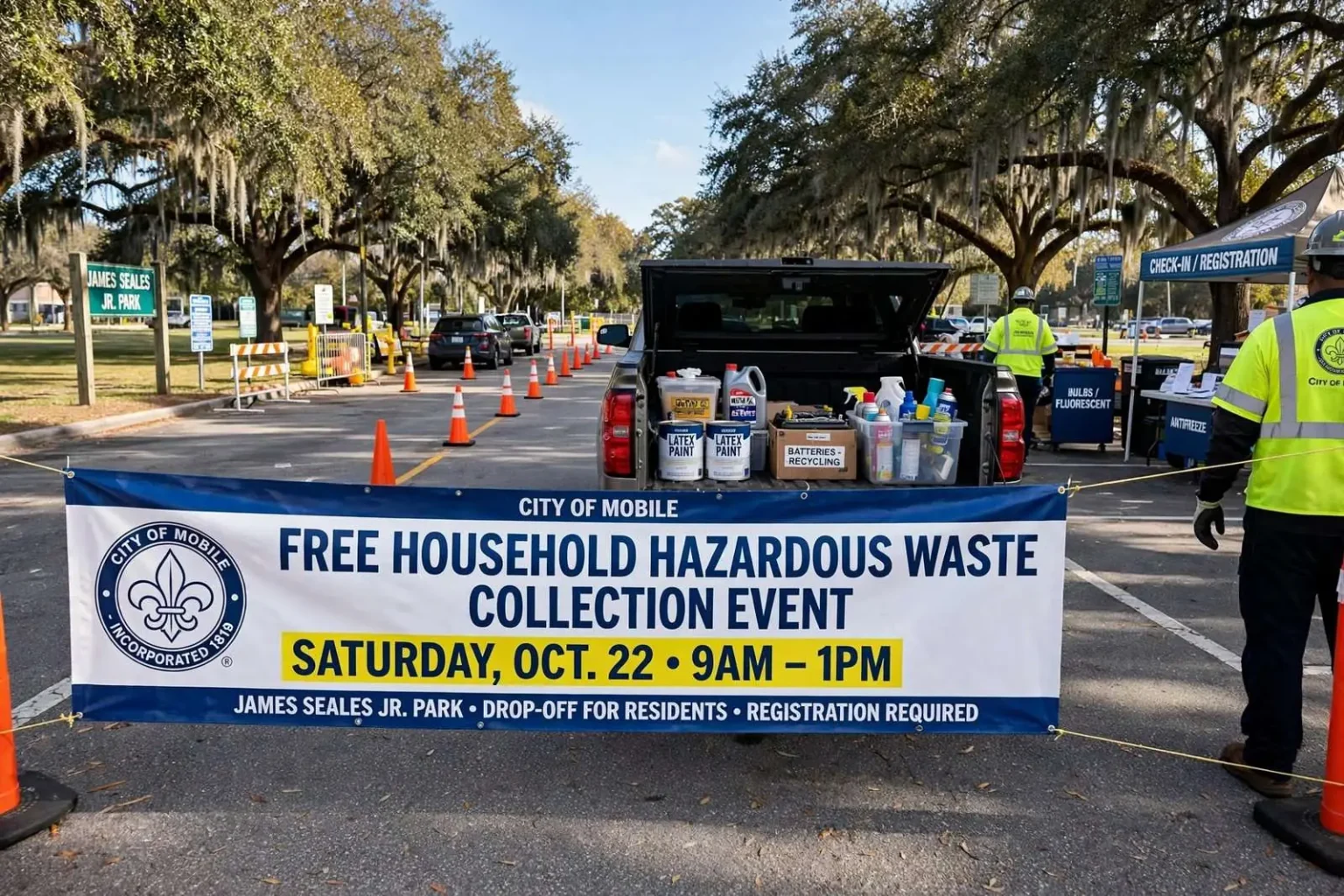
MOBILE, Ala. — Mobile residents will get a chance to clear out hazardous household materials safely this fall. The city is hosting a free Household Hazardous Waste Collection event on Saturday, Oct. 22, from 9 a.m. to 1 p.m. at James Seales Jr. Park. The event gives residents a way to discard items that cannot go out with regular trash, keeping potentially dangerous materials out of the landfill and Mobile Bay’s waterways. City officials urge anyone holding old paint cans, solvents, automotive fluids, pesticides or pool chemicals in a garage or shed to take advantage of the single-day drop-off.
Who can participate
The collection is open only to individuals, and participants must register before the event. Businesses, contractors, non-profits and other organizations are not permitted to drop off materials, a restriction that helps the city keep the event within its capacity and its disposal contracts. Registration typically asks for a name, address and a general idea of what will be brought, which allows organizers to plan staffing and container space. Residents who miss the registration window are usually encouraged to watch for announcements about future collections rather than showing up unregistered.
Household hazardous waste is a broad category, and it covers far more than many residents realize. Common accepted items include latex and oil-based paints, thinners and strikers, drain openers, degreasers, batteries of various chemistries, fluorescent bulbs and tubes, motor oil, antifreeze, brake fluid, gasoline, lawn and garden chemicals, fertilizers with pesticide content, pool treatment chemicals, and aerosol cans with product still inside. Electronics, tires and medical sharps are often handled through separate programs and may not be accepted at a hazardous waste event, so residents should confirm the accepted list before loading up.
Why it matters for Mobile
Port City households generate a steady stream of these materials every year, and when they are thrown out with regular garbage they can break open in collection trucks, ignite at the landfill or leach into the soil and groundwater. Storm runoff in Mobile carries whatever is on the street directly into Three Mile Creek, the Mobile River and eventually Mobile Bay, making improper disposal an environmental problem as well as a safety hazard for sanitation workers. Paint poured into a storm drain, for example, travels to the waterway untreated, and chemicals stored in a shed that floods during hurricane season can spread contamination across an entire neighborhood.
Gulf Coast weather gives the issue extra urgency. Mobile’s frequent thunderstorms, tropical systems and high water table mean that half-full containers left outdoors are regularly knocked over, rusted through or floated away. Holding a hazardous waste collection in the fall, before the heart of the late-season storm window, allows residents to clear out accumulated materials while conditions are calm.
How to handle materials before drop-off
Organizers advise residents to keep products in their original containers whenever possible, since labels tell handlers what is inside and how to sort it. Lids should be tightened, leaking containers should be placed inside a larger bucket or plastic bin, and chemicals should never be mixed, because combining products such as bleach and ammonia or bleach and acids can create toxic gases. Gasoline and other fuels should travel in approved containers, and cylinders such as propane tanks should be transported upright and secured so valves cannot be knocked open.
Residents should also pack their vehicle so that everything can be unloaded quickly from the trunk or bed, since drive-through collection events move fastest when workers can lift boxes directly from the vehicle without climbing over cargo. Participants should follow the signs at the park, stay in their cars, and let event staff remove the materials, which keeps the line moving and reduces handling risks for everyone.
James Seales Jr. Park, the event site, provides the open paved space and separate ingress and egress lanes that a drive-through collection requires. Events like this one are generally staffed by city public works employees and trained contractors who segregate materials for recycling, treatment or licensed disposal. Many items collected — motor oil, lead-acid batteries, antifreeze and latex paint among them — can be recycled or reprocessed, which reduces the volume that must be landfilled and recovers value from materials that would otherwise be wasted.
The bigger picture
Mobile has worked in recent years to expand its environmental services, and periodic hazardous waste collections are one of the most visible pieces of that effort. Communities across the Gulf Coast hold similar events, often funded through a mix of municipal budgets and state programs, because the cost of cleaning up improper disposal far exceeds the cost of collecting materials properly in the first place. For residents, the city’s October event is a free and straightforward way to close out a long-deferred cleanup project, protect sanitation crews, and keep Mobile’s creeks, rivers and bay a little cleaner.
What happens to the collected waste
Once materials leave a resident’s vehicle at an event like this, they begin a carefully tracked journey. Contractors working under contract with the municipality sort everything into broad streams: flammable liquids, corrosives, oxidizers, poisons, batteries, bulbs and recyclable metals. Each stream is packed into drums or containers that meet federal Department of Transportation standards, labeled, and manifested — a shipping paper that follows the waste from the collection site to its final destination. That manifest system, required under federal and state hazardous waste rules, creates a chain of custody so that every gallon of solvent or pound of pesticide can be traced from a Mobile driveway to a licensed treatment, recycling or disposal facility.
A surprising share of what comes in can be recycled. Used motor oil is often re-refined into lubricant or burned as industrial fuel in permitted equipment. Lead-acid car batteries are almost entirely recycled, with the lead, plastic cases and acid all recovered. Latex paint that is still usable can be reblended and resold or given away through local paint reuse programs. Even fluorescent tubes, which contain a small amount of mercury vapor, can be processed by specialized recyclers who recover the mercury for reuse rather than releasing it to the environment.
The materials that cannot be recycled are stabilized and landfilled in cells designed to isolate them from groundwater, or treated chemically to neutralize their hazards. That disposal path is expensive — costs are typically measured in dollars per pound, far beyond what a household could pay on its own — which is exactly why municipal collection events matter. By aggregating a whole city’s worth of household hazardous waste into one event, the city can negotiate better rates and spread the cost across the whole community rather than leaving individual residents to guess at safe disposal options.
Other disposal options in the Mobile area
Between scheduled events, Mobile County residents have a few alternatives for specific items. Many auto parts retailers accept used motor oil and car batteries at no charge year-round. Some battery and electronics stores take rechargeable batteries and old cell phones, which keeps lithium-ion packs out of the garbage where they have been known to start fires in collection trucks and landfills. Paint that has fully hardened in the can, per local guidance, can often be disposed of with regular trash once the lid is off, while liquid paint should be saved for a hazardous waste event or dried out with an absorbent such as cat litter.
Residents who are unsure about a specific product can usually call the city’s public works department or check the event announcement for a list of accepted and excluded items. Showing up with material that cannot be accepted creates delays for everyone in line, so a few minutes of checking ahead pays off. The city typically publicizes its collection events through its website, social media channels and local news outlets, and registration details are included in those announcements.
A simpler cleanup than most people expect
For many households, the hardest part of a hazardous waste cleanup is simply getting started. Boxes of half-empty cans and forgotten chemicals accumulate over years, and the worry about how to get rid of them keeps the project perpetually deferred. A free, local, registration-based event removes most of the friction: residents gather what they have, register online or by phone, drive to the park on the appointed Saturday morning, and leave with an empty trunk and a cleaner garage.
City officials frame events like the Oct. 22 collection as both a service and a form of prevention. Every container of pesticide that comes in through the proper channel is one that will not leak into a storm drain during the next heavy rain, and every gasoline can turned in is one that will not feed a garage fire. For a coastal city that lives with intense weather and a famously rich estuary at its doorstep, those are outcomes worth a Saturday morning.