
Mobile Weighed $3 Million Commitment as Deadline Loomed to Bring Amtrak Back to the City
Mobile's Finance Committee weighed a $3 million commitment to restore twice-daily Amtrak service to New Orleans before a year-end deadline.
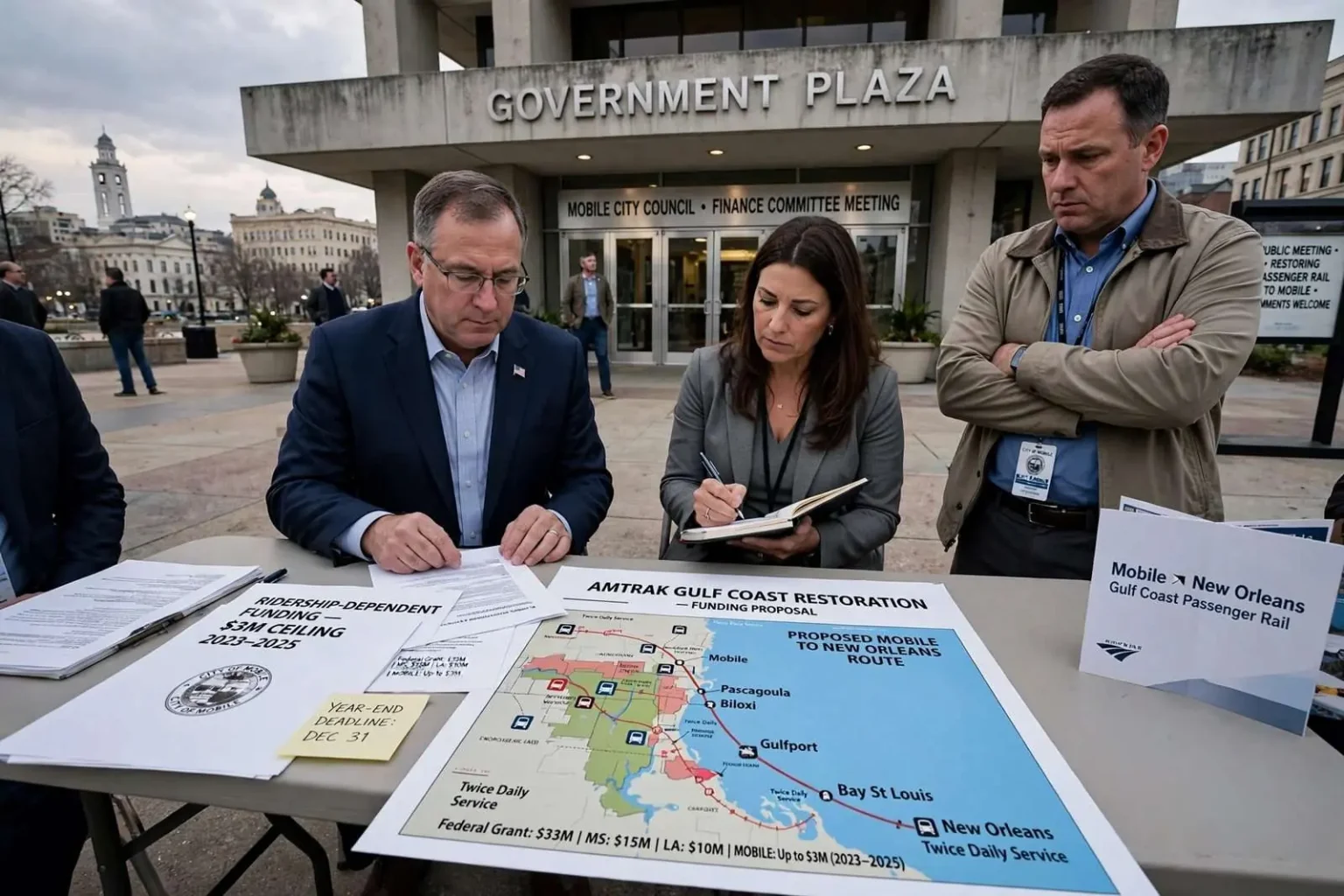
With a year-end deadline bearing down, Mobile’s city leaders debated how much they were willing to pay to restore passenger train service that Hurricane Katrina swept away more than a decade earlier. The Mobile City Council’s Finance Committee met at Government Plaza to discuss a multi-million dollar commitment to return Amtrak to the city, and the city faced an end-of-year decision on whether it wanted the service back.
Amtrak service to Mobile halted in 2005 after Katrina damaged tracks along the Gulf Coast, ending a rail link that had connected Mobile directly to the cities of the Mississippi Gulf Coast and New Orleans. In the years since, restoring the route has been the subject of repeated studies, negotiations and funding proposals, and the conversation had finally reached the point where the money on the table was real and the deadline for committing to it was close.
The proposed route would run from Mobile to New Orleans twice daily, with stops in Pascagoula, Biloxi, Gulfport and Bay St. Louis. Those cities once formed the backbone of the Gulf Coast rail corridor, and each has pushed for the service’s return because of what it would mean for tourism, commuting and connection to the region’s largest city. For Mobile, the route would restore a direct passenger link to New Orleans for the first time since the storm.
Where the money stands
The funding picture that emerged from years of negotiation put most of the burden outside Alabama. Mississippi had already committed $15 million and Louisiana $10 million, with another $33 million coming from a federal Consolidated Rail Infrastructure and Safety Improvements grant. That left Mobile and the State of Alabama as the only entities without a financial stake in the restoration.
Under the proposal discussed at Government Plaza, Mobile would be asked to commit up to $3 million from 2023 through 2025 depending on ridership, with the state and Mobile County potentially on the hook as well. The tiered structure meant the city’s actual cost would rise or fall with how many passengers used the service, an arrangement supporters saw as a fair test of demand and opponents saw as an open-ended obligation.
Gov. Kay Ivey had shown little interest in funding Amtrak previously, which left the city weighing whether to move without a clear state partner. That question shaped the Finance Committee debate, because a city-level commitment of several million dollars over three years is significant money for any municipality, and council members wanted to know what the state’s position would be before signing on.
The terminal question
The city would also need a terminal. Passenger service requires a station capable of handling boarding, ticketing and waiting passengers, and Mobile’s options carried different price tags and different strategic implications. A downtown site near the Convention Center was considered preferable for tourists, putting arriving visitors within reach of hotels, restaurants and the riverfront without needing a car.
Mayor Sandy Stimpson hoped to eventually relocate passenger air service to the Brookley Aeroplex, offering an alternative location that would tie the rail line into a broader transportation vision for the south of the city. Brookley, the former Air Force base now home to aerospace and industrial employers, has been a centerpiece of the city’s economic development strategy, and connecting intercity rail to it would have served commuters and workers as much as tourists.
The terminal debate reflected a larger question about what the train is for. A downtown station treats the service as a tourism and downtown revitalization asset; a Brookley-area station treats it as part of a multi-modal employment and logistics hub. Council members weighing a multi-million dollar commitment had to weigh not only whether to fund the service but where it should land when it arrived.
Opposition from the Port
Not everyone welcomed the trains’ return: officials at the State Docks worried that passenger service would interfere with freight traffic moving to and from the Port of Mobile. The port is one of the busiest on the Gulf of Mexico and a core economic engine for the region, and its rail volumes have grown alongside its container business. Every passenger train added to the corridor is a slot that freight trains cannot use at the same time, and scheduling conflicts can ripple through an entire day of cargo movements.
Rail operations between Mobile and the Mississippi line are shared infrastructure, and the freight railroads that own and dispatch the tracks have their own priorities and obligations. A twice-daily passenger schedule has to fit within that reality, which is why port officials wanted assurance that passenger service would not slow the freight business that pays the bills along the corridor.
Those concerns did not kill the proposal, but they added a stakeholder whose sign-off mattered. Any restoration plan that works on paper but chokes freight access through the port risks harming the very economy the service is meant to support, a tension the Finance Committee had to weigh alongside the dollar figures.
What the service would mean for riders
For travelers, the restored route would recreate a trip that has required a car or a bus since 2005. Mobile to New Orleans by train is roughly a two-and-a-half-hour ride along the coast, and the intermediate stops put the Mississippi casinos, beaches and coastal towns within rail reach of Alabama’s third-largest city. A twice-daily schedule, with a morning departure and an afternoon or evening return, is shaped for day trips and weekend travel rather than long-haul connectivity.
Before Katrina, Gulf Coast passenger service was a quiet fixture of the region, used by commuters, retirees, casino visitors and students. Its loss was one of the storm’s less-mentioned but longest-lasting civic changes, and every year it stayed gone, a generation of Gulf Coast residents grew up without ever seeing a passenger train serve their hometown. Restoration advocates argued that rebuilding the habit would take time but that demand existed along the whole corridor.
The ridership-dependent funding formula acknowledged the uncertainty. If the trains drew strong numbers in their first years, Mobile’s share of the operating support would rise toward the $3 million ceiling; if the service struggled, the city’s obligation would fall. That design shifted some of the risk from the city’s budget to the service’s performance.
The deadline and the decision
The end-of-year deadline was not arbitrary. Federal grant money and the interstate funding agreement had a window, and if Mobile declined to join before it closed, the route’s supporters would have to rebuild the coalition from scratch. That dynamic put pressure on a city that had spent more than a decade supporting the idea of the service in principle while hesitating at the price.
The Finance Committee session at Government Plaza was part of the standard path any such commitment must take: discussion in committee, followed by consideration by the full City Council. Council members asked about the ridership projections, the terminal site, the state’s posture and the port’s objections, the same questions that had surrounded the route’s restoration in every earlier iteration.
What distinguished this round from those before it was specificity. The route, the frequency, the stops, the grant total and the city’s potential share were all on the table in concrete figures, and the choice in front of Mobile was no longer whether the service was a good idea but whether it was worth up to $3 million over three years.
The broader push for Gulf Coast rail
Mobile’s deliberation took place inside a larger, multi-state effort to bring passenger rail back to the Gulf Coast. The Southern Rapid Rail Transit Commission and local officials in Mississippi and Louisiana had spent years making the case that the corridor could support scheduled service, and the federal Consolidated Rail Infrastructure and Safety Improvements grant program exists precisely to fund projects of this kind, where capital costs overwhelm what local governments can raise on their own.
The corridor itself remains in place. The tracks between Mobile and New Orleans carry freight today, and restoring passenger service means adding capacity, signals and agreements rather than rebuilding from nothing. That is what made the restoration plan achievable at the funding scale discussed: the heavy infrastructure of the route already exists, and the money being debated covers the service, the station arrangements and the operating support needed to start trains running again.
For Mobile, the stakes extend beyond the train itself. A connected city draws conventions, tourists and workers more easily than an isolated one, and the loss of the rail link after Katrina removed a strand of connectivity the city had relied on for generations. The Finance Committee’s debate was, in that sense, about how Mobile positions itself in the region as much as about a rail schedule.
What happens next
With the deadline approaching, the city’s options were to commit, to negotiate for a smaller share or a later start, or to let the year-end date pass and wait for the next opportunity. Each path carried consequences: committing put real money on the line in exchange for restored service; waiting preserved budget flexibility but risked watching the project launch without Mobile on the schedule.
The Finance Committee’s discussion moved the decision closer to the full City Council, where the final vote would happen. Between the committee room and that vote lay the practical questions members had raised, including confirmation of the state’s position and the port’s operational concerns, and any of them could reshape the terms before a commitment was signed.
However the decision landed, the meeting marked the closest the route had come to restoration in the years since Katrina. The funding partners outside Alabama had put their shares on the table, the federal grant was secured, and the twice-daily Mobile-to-New Orleans schedule existed as a working plan. What remained was for Mobile to decide what the return of passenger rail was worth to the city, in dollars and in its own place on the Gulf Coast map.