
Mobile’s Arts Scene Comes of Age: A 2010 Year in Review
From CLA leadership turmoil to new galleries and Arts Awards winners, a look back at how Mobile's arts scene came of age in 2010.
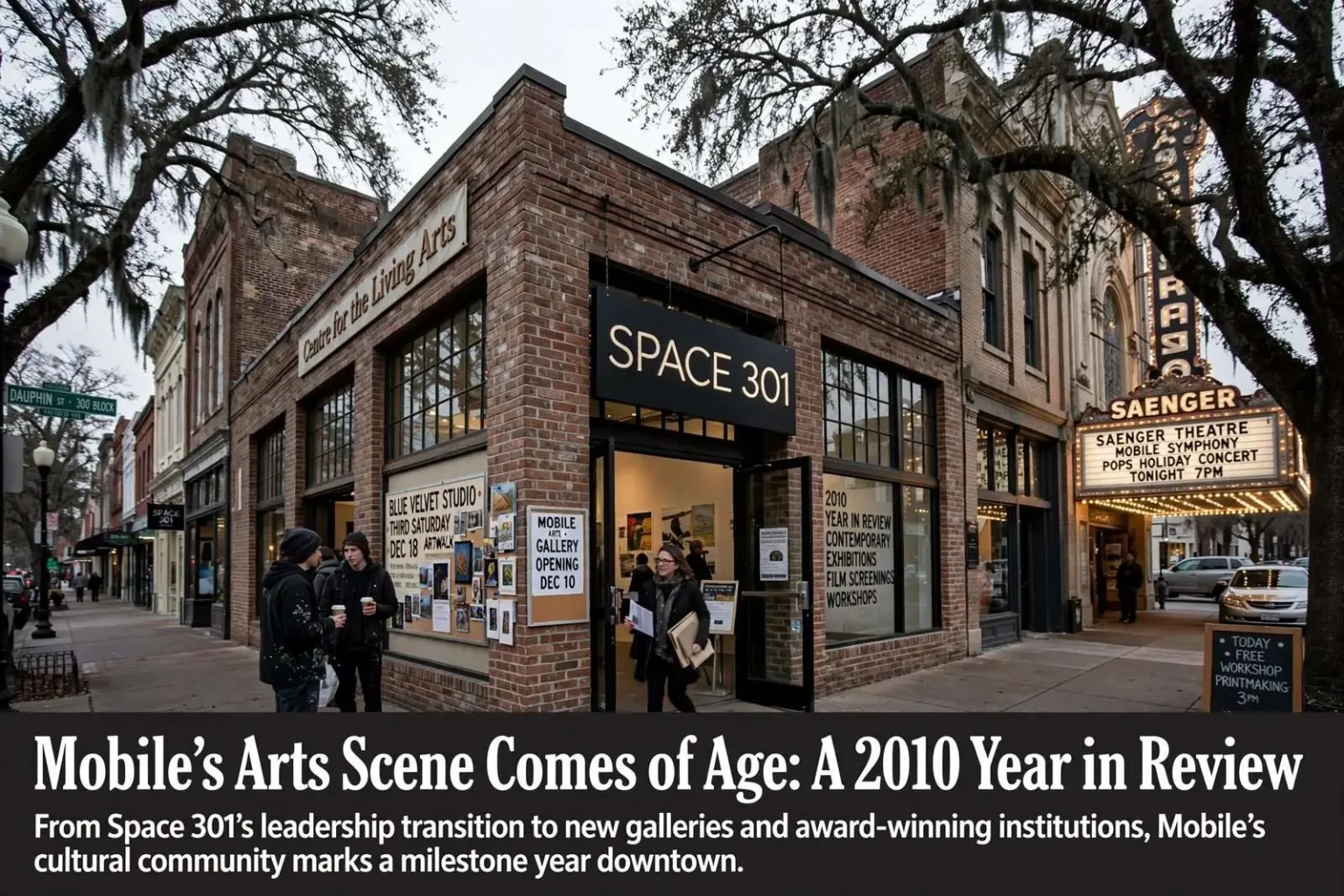
For a decade, talk of Mobile’s rising arts scene carried a note of hope as much as fact. By the close of 2010, the evidence had become hard to dispute — even as the city’s flagship arts institution weathered its most public upheaval in years.
Turmoil at the Centre for the Living Arts
The Centre for the Living Arts, formed by the Bedsole family in the late 1990s to run the Saenger Theatre before building the Space 301 arts center downtown, spent the year managing a leadership transition. CEO Carlos Parkman announced her retirement, then departed a few months ahead of schedule. In the fall, founder Ann Bedsole and board chair Carol Hunter stepped off the board after disagreeing with other members over the search for Parkman’s replacement.
Hunter acknowledged the stakes: with Bedsole philanthropy historically central to CLA’s funding, future requests to the family’s distribution committee could be viewed differently than in the past. That warning carried weight across the city’s nonprofit world, where the Bedsole name had been attached to a generation of cultural and civic projects, and where a family foundation’s confidence is often the difference between a plan and a building.
The friction played out in public enough that downtown’s arts community watched the boardroom as closely as the galleries. CLA’s task going into the new year was familiar to any founder-driven institution in transition: professionalize the operation without losing the founding family’s commitment, and prove to the city that Space 301’s programming could survive a change in leadership.
Space 301 itself, occupying the former Saenger furniture building on civic center plaza blocks, had by 2010 established itself as downtown’s premier contemporary gallery — a converted commercial space with the kind of rotating exhibitions, workshops and film screenings that a traditional museum rarely mounts. Its fate was, in practical terms, a referendum on whether Mobile would support edgier work at scale.
The Standbys Hold Steady
Elsewhere the established institutions kept building. Mobile Opera rolled out new educational programming while the Mobile Symphony worked to shed classical music’s formal image with more accessible events. The Mobile Museum of Art continued its string of strong exhibitions, and the Gulf Coast Exploreum — riding momentum since the record-setting Dead Sea Scrolls show of 2005 — kept its cycle of popular shows running.
The year’s turbulence at CLA also unfolded against a backdrop of civic ambition for downtown as a whole. City leaders had spent the decade betting on the entertainment district — restoring the Saenger, rebuilding the civic center plaza blocks, courting the cruise terminal — on the theory that a downtown alive after five o’clock would anchor everything from restaurant leases to museum memberships. The arts institutions were the bet’s load-bearing wall, which is why a leadership fight at one of them was civic news rather than mere gossip.
Each of the established institutions had spent the decade redefining its relationship with the city. The Mobile Symphony’s move into the restored Saenger Theatre gave it a first-rate home and a downtown address at the heart of the entertainment district, and its pops-style programming and school partnerships were explicitly aimed at families who might never buy a subscription. Mobile Opera’s educational push brought performers into classrooms across the county, building the audience the art form will need in twenty years.
The Exploreum’s blockbuster formula — Dead Sea Scrolls in 2005 drew record crowds and put the science center on the national tour circuit’s map — showed what a Gulf Coast city of Mobile’s size could attract when it committed to a show, and its annual slate of traveling exhibits became a fixture of the city’s convention-and-visitors pitch. The Mobile Museum of Art, in Langan Park, anchored the city’s west side with a collection and exhibition schedule that gave the scene institutional depth beyond downtown.
The gallery at the Alabama School of Mathematics at Ann and Dauphin streets flourished under Orren Kickliter’s direction, introducing new talent and thought-provoking exhibits to downtown. A working gallery inside a public charter high school is an unlikely arrangement anywhere, and Mobile’s version doubled as a teaching tool — students helped stage shows and met working artists at an age when most never set foot in a gallery.
And when a CLA exhibition revived the spirit of the shuttered GULF Art Space and its “Baldwin Bauhaus” artists, the work landed closer to mainstream Mobile taste than it had just a few years earlier — a sign of broadened horizons on both sides of the canvas. The Baldwin artists, working in the modernist shadow of the Fairhope single-tax colony’s long artistic history, had once been a hard sell downtown; by 2010 their revival was a programming strength.
Awards Signal a Broader Community
The Greater Mobile Arts Awards reflected the scene’s widening circle. Winners included patron Herndon Inge III, educator Jane Shaw and volunteer Laureen Lynn, alongside artist Wanda Sullivan, whose emotional acceptance speech moved former USA classmates in the crowd. The Gulf Coast Ethnic and Heritage Jazz Festival’s award marked another step in erasing old racial divisions — fitting for an art form that has long done exactly that.
The depth behind the standbys mattered for the scene’s economics as much as its reputation. Between them, the opera, symphony, museum and Exploreum employed orchestral players, stagehands, curators, educators and seasonal staff, rented downtown parking on show nights, and filled restaurants before curtain. A mid-sized city’s arts ecosystem is measured not just in exhibitions but in payrolls, and 2010’s steady institutions kept Mobile’s payroll growing even in a slow economy.
The awards also underscored the pipeline that keeps a scene alive: educators like Shaw, who taught the students who filled the youth programs; volunteers like Lynn, whose unpaid hours kept small organizations solvent; and patrons like Inge, whose giving bridged the gap between box-office revenue and real budgets. Every established arts city runs on that three-part foundation, and Mobile’s version — honored publicly rather than assumed quietly — suggested the community understood the dependency.
The awards ceremony itself has become the scene’s annual inventory — an evening when the city counts up its patrons, teachers, volunteers and working artists and notices, once a year, how many people the ecosystem now employs. The jazz festival’s recognition carried particular resonance in a city whose musical lineage runs from Hank Aaron’s neighborhood juke joints to the Preservation Hall pipeline, and whose festival had spent a decade building audiences across lines the city once enforced by ordinance.
New Blood Behind New Doors
Two venues captured the year’s energy at opposite ends of the entertainment district. The Blind Mule, a block behind the Mobile Arts Council offices, became a showcase for young DIY talent — never more visibly than during the debate over a commissioned graffiti wall that got the city talking about art in public space.
That debate was a small controversy with a long tail. Public art fights are how most American cities work through questions about vandalism, property and taste, and Mobile’s version pulled the conversation out of the galleries and into the pages of the daily paper — free publicity, of a sort, for the idea that the city’s walls and alleys could carry art as well as advertising. For the young painters and musicians who gravitated to the Mule, the argument itself was the arrival: their work was taken seriously enough to argue about.
Nearby, newcomer Karen Cassidy turned her living space into Blue Velvet Studio, bringing prominence to the western end of Dauphin Street and helping launch “Third Saturday” events that complement the monthly LoDa ArtWalk.
The western stretch of Dauphin had long been the quiet end of the district, and Blue Velvet’s transformation of a residence into a working studio gave it a destination. The Third Saturday rhythm extended the gallery-crawl habit the LoDa ArtWalk had built on Friday nights into a second weekend each month, giving collectors and the curious twice the reasons to walk the street — and giving artists without gallery representation a route to an audience.
By year’s end, covering every downtown gallery opening within a single ArtWalk evening had become impossible — the surest sign yet that Mobile was closer than ever to being an arts town. A decade earlier, that sentence would have required the hopeful tone; by the end of 2010 it required only a schedule conflict, and a promise to catch the rest of the shows next month.
What the year ultimately demonstrated was the difference between a scene and a season. A city can host a good festival and call itself cultural; a scene requires the rest — the schools teaching it, the patrons funding it, the dive bars booking it, the galleries arguing over it, and the institutions surviving their own transitions. Mobile closed 2010 with every one of those pieces visibly in place, at scales large and small, from a boardroom in need of a new director to a living-room studio on the west end of Dauphin Street.


