Mobile’s Household Hazardous Waste Program Gives Residents a Safe Disposal Option
The City of Mobile's Household Hazardous Waste Collection program, run since 2022, offers residents a free way to dispose of paint, chemicals, batteries and other items regular trash service won't take.
Mobile residents looking for a safe way to get rid of items that can’t go out with the regular trash have an ongoing resource in the city’s Household Hazardous Waste Collection program, which the City of Mobile has offered since 2022. The program gives residents a convenient, no-cost outlet for disposing of materials that routine curbside garbage and trash service is not equipped to handle safely. For households that have spent years storing old paint cans, half-full gasoline containers and chemicals in a garage or shed because there was nowhere to take them, the program exists precisely for that inventory.
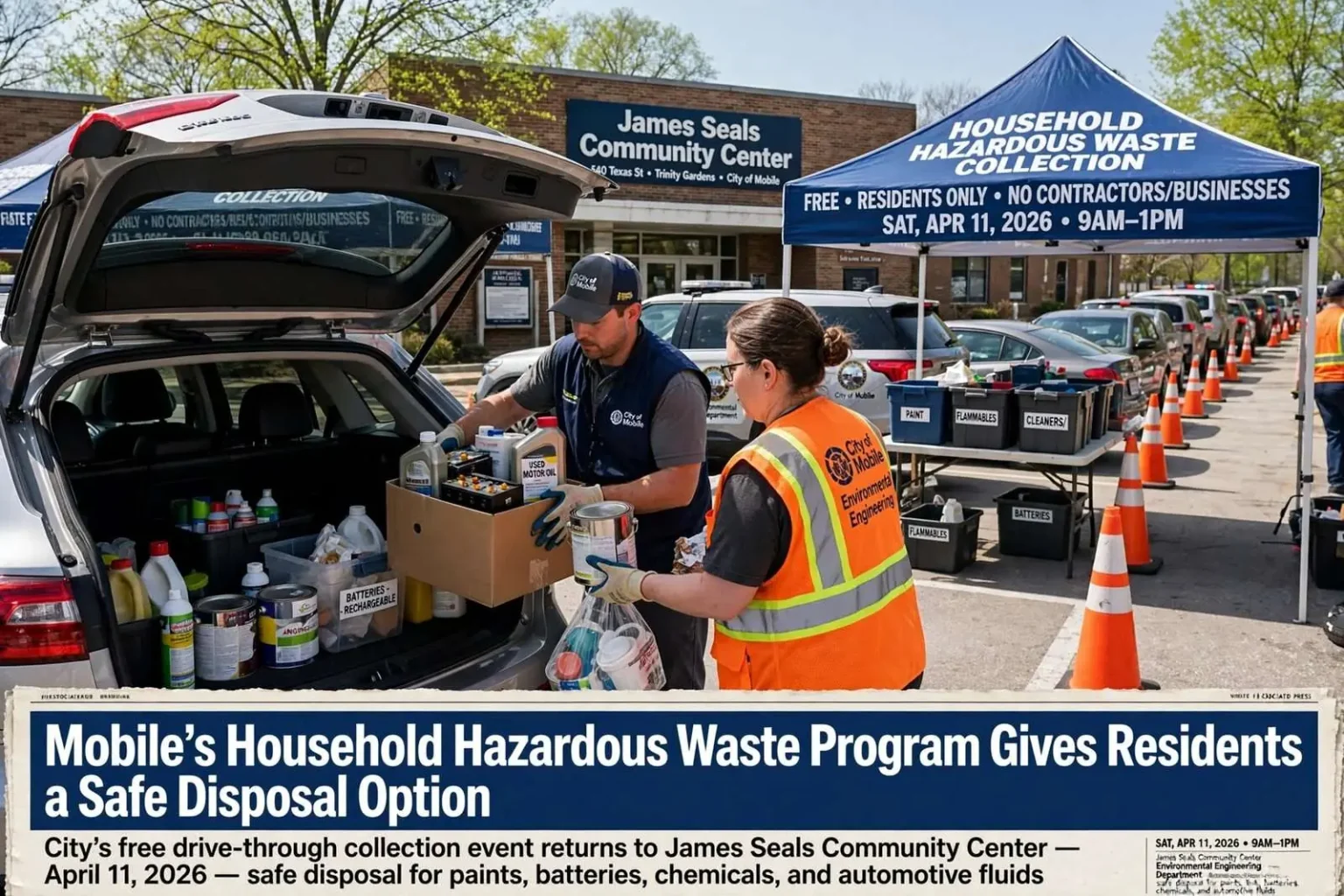
The program is organized by the City of Mobile Environmental Engineering Department and is built around periodic collection events held throughout the year. The most recent event took place this spring, on Saturday, April 11, 2026, running from 9 a.m. to 1 p.m. at the James Seals Community Center, located at 540 Texas St. in Mobile. As with previous events, it was free to attend, required no advance registration, and was limited to Mobile residents and individuals — contractors and businesses were not permitted to drop off materials.
The residency restriction is not arbitrary. Commercial waste falls under a different regulatory scheme, and a contractor dumping a trailer-load of construction chemicals through a residential event would quickly overwhelm the collection capacity and shift disposal costs onto the city. Homeowners with a garage full of household leftovers are the intended customers, and the drive-through format of these events — residents stay in their vehicles while workers unload — keeps lines moving even when hundreds of cars show up.
Why the program exists
Many common household products contain chemicals or materials that can be dangerous if they end up in a landfill, are poured down a drain, or are mixed in with regular household trash. Items such as automotive fluids, pesticides, paint and batteries can pose risks to sanitation workers, contaminate soil and water, or create fire hazards when disposed of improperly. Used motor oil poured into a storm drain travels directly to Mobile Bay; a lithium battery crushed in a garbage truck compactor can ignite a load of refuse; pesticides leaching from a landfill can find their way into groundwater.
The risks are not theoretical. Waste handlers across the country have reported growing numbers of fires at recycling and disposal facilities traced to batteries and volatile chemicals mixed into ordinary waste streams, and sanitation departments routinely see injuries from containers that burst or leak. By giving residents a dedicated, supervised drop-off option, the city aims to keep those materials out of the regular waste stream and ensure they are handled and disposed of correctly.
There is an environmental dimension as well. Mobile’s storm drains empty into the Mobile-Tensaw Delta and Mobile Bay, the receiving waters for much of south Alabama’s runoff, and the city’s neighborhoods sit atop a water table that supplies drinking wells in parts of Mobile County. Every gallon of paint or antifreeze that enters the collection program instead of a ditch is a small amount of contamination that never reaches those systems. Household hazardous waste collection is one of the least expensive environmental protections a city can offer, which is why programs like Mobile’s have become standard practice in municipalities across the country.
What the program accepts
The Household Hazardous Waste Collection program is designed to take a wide range of items that routine trash pickup won’t. Accepted materials include automotive fluids such as motor oil, antifreeze, brake and transmission fluid, gasoline and oil filters, along with aerosols and both automotive and household batteries, including rechargeable batteries. The automotive category is typically the largest at household collection events, since nearly every home that maintains a car accumulates oil, coolant and old fuel in one form or another.
The program also accepts fluorescent tubes and light bulbs, oil and latex paint up to a limit of 15 gallons, household cleaners, pesticides, herbicides and fertilizers, pool chemicals, drain cleaners, fire extinguishers, flammable materials like fuels, lighter fluid and kerosene, solvents, varnishes and epoxies, mercury and mercury-containing devices, and small camp-style or barbecue propane cylinders. The paint limit is generous by the standards of municipal programs — many cities cap household paint at five or ten gallons per visit — and reflects the reality that leftover paint is the single most common hazardous material in American garages.
Some categories deserve a note for residents planning a drop-off. Fluorescent tubes contain mercury vapor and must not be broken into ordinary trash. Mercury thermostats and thermometers, common in older Mobile homes, are handled as a distinct stream because even small amounts of elemental mercury are toxic and persistent. Propane cylinders, even small camping sizes, are pressurized vessels that explode if compacted, which is why they are accepted only at supervised events. Each of these items is legal to own but hazardous to throw away, which is the definition of the material this program was created for.
What the program does not accept
Not every hazardous or hard-to-dispose-of item qualifies for the program. Residents should note that the collection events will not accept tires, explosives such as ammunition or flares, firearms or other weapons, pharmaceuticals, biohazard materials including medical waste and needles, or large appliances such as refrigerators, freezers, air conditioners, washers and dryers.
Asbestos, unidentified materials or containers, lawn equipment such as mowers, weed eaters and blowers, electronics, and other non-hazardous items are also excluded, as are compressed gas cylinders containing acetylene, oxygen, carbon dioxide, refrigerant or helium, and any radioactive materials. The exclusions fall into two broad groups. The first is items that are dangerous but handled by specialized systems — pharmaceuticals take-back programs, medical sharps disposal, scrap metal recyclers for appliances, and hazardous-materials contractors for asbestos or unknown chemicals. The second is items that are bulky rather than chemically hazardous, such as lawn equipment and electronics, which belong in the city’s bulk trash and electronics recycling channels instead.
Residents with items that fall outside the program’s scope, such as electronics, appliances or pharmaceuticals, will need to look to separate disposal or recycling programs to handle those materials safely, since the Household Hazardous Waste Collection events are specifically designed around the categories listed above. A little preparation prevents a wasted trip: label what you can, leave unknown chemicals in their original containers when possible, and call the Environmental Engineering Department before transporting asbestos or unidentified drums anywhere.
How the events work in practice
Residents attending a collection event for the first time should expect a straightforward process. Materials are transported in the trunk or truck bed, and when the vehicle reaches the unloading zone, trained handlers remove the items while the driver remains in place. Workers sort the materials on site into their separate streams — flammables, corrosives, batteries, paints, propane — because each category travels to a different licensed treatment or disposal facility. Some materials are recycled rather than destroyed: used motor oil can be re-refined, lead-acid batteries are almost entirely recyclable, and latex paint can be reground and reused in some markets.
The periodic, event-based format is a deliberate choice. A permanent year-round drop-off facility is expensive to staff and secure, while scheduled events concentrate volume, allow the city to contract for the right disposal capacity, and create predictable dates residents can plan around. The trade-off is storage: between events, households hang onto their hazardous items, which is why officials encourage residents to gather materials in advance of an announced date rather than starting to sort the garage that morning.
The April event at the James Seals Community Center followed the pattern of previous collections. The center, a longtime city facility in the Trinity Gardens area, offers the parking and drive-through layout a collection event requires, and holding events at neighborhood centers rather than a single remote site spreads access across the city. Residents who missed the spring event have simply had to hold their materials a little longer — safely stored, out of reach of children, and away from heat sources — until the next date is announced.
Looking ahead
Since launching in 2022, the Household Hazardous Waste Collection program has given Mobile residents a recurring opportunity, offered at no charge, to responsibly dispose of the kinds of household chemicals and materials that can otherwise be difficult or unsafe to throw away. The program has become part of the city’s broader waste-management portfolio, alongside curbside garbage, trash and recycling service, filling the niche that regular collection was never designed to serve.
The no-cost structure is itself significant. Commercial hazardous waste disposal is expensive — facilities charge by the pound or by the container — and without a municipal program, the practical alternative for many households is the ditch, the storm drain or the trash can. Covering the cost through the city budget internalizes an expense that would otherwise be passed to the environment, the sanitation crews and the landfill operators downstream.
Residents interested in taking part in a future collection event are encouraged to watch for the City of Mobile Environmental Engineering Department’s announcements of upcoming dates and locations. Announcements typically circulate through the city’s website and social media channels ahead of each event, and the department can answer questions about specific items before a resident makes the trip. For the growing number of Mobile households cleaning out garages, estates and rental properties, the program turns a nagging disposal problem into a Saturday-morning errand — and keeps a steady stream of paint, fuel and chemicals out of the ground, the bay and the back of the garbage truck.