Mod Mobilian TV Debuts on JagTV With Locally Made Music and Variety Programming
Locally made music and variety series Mod Mobilian TV debuts on the University of South Alabama's JagTV, with new episodes Wednesdays at 9 p.m.
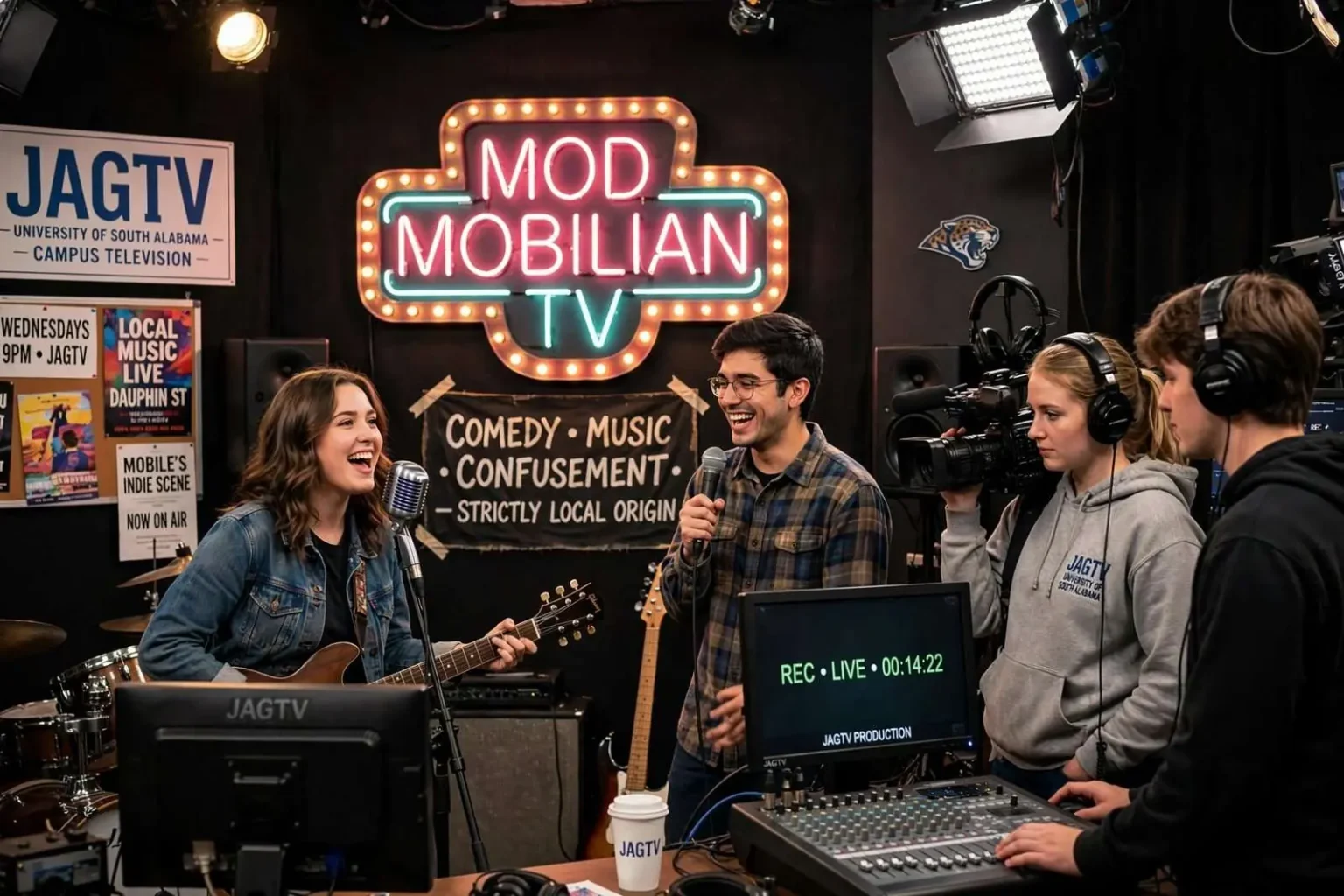
A new locally produced music and variety series, Mod Mobilian TV, has debuted on JagTV, the University of South Alabama’s campus television station, adding a fresh outlet for Mobile’s homegrown performers. The program brings the city’s indie arts scene to the airwaves, pairing sketch comedy with live musical performances in a format rarely seen on local television in recent years.
The show promises what its producers call comedy, music and confusement of strictly local origin — a mix of sketch comedy and performances from area musicians packaged in a variety-show format. The tongue-in-cheek description signals the program’s approach: a loose, playful hour that spotlights the people already making music and comedy in Mobile rather than importing talent from outside the region. Every act on the show comes from the city and its surrounding communities.
New episodes air every Wednesday at 9 p.m. on JagTV, putting student-produced equipment and airtime behind the city’s indie arts scene. The weekly slot gives the series a consistent home on the station’s schedule, and it hands student crews regular, deadline-driven production work — camera operation, audio mixing, lighting, and editing — that mirrors the demands of professional broadcast.
A home for Mobile’s performers
The debut marks an expansion for the Mod Mobilian brand, which has covered Mobile’s music, art and culture as an online publication, and gives local bands and comedians a recurring televised stage. For performers who have long relied on bar stages, coffeehouse open mics, and festival slots to reach an audience, a weekly television program offers something new: a broadcast platform that puts their work in front of viewers who might never set foot in the venues where those acts usually play.
Mobile’s music scene has deep roots, from the R&B and soul heritage that made the city famous among record collectors to the active circuit of singer-songwriters, punk and indie bands, and jazz players working the clubs along Dauphin Street and beyond today. What the scene has often lacked, organizers of such efforts point out, is consistent media exposure — coverage that treats local music as news rather than novelty. The Mod Mobilian brand has spent years documenting that culture online, and the television series extends that mission into a new medium.
Sketch comedy rounds out the lineup, giving Mobile’s comedians and writers a laboratory for material that might otherwise live only in live sets. Variety programming of this kind has a long regional tradition, recalling the era when Gulf Coast television stations routinely produced locally hosted music and comedy programs before syndication and network consolidation pushed them off the air.
How JagTV fits the University of South Alabama
JagTV operates as the student television station at the University of South Alabama, where students in communication and media programs learn broadcast production by doing it for real audiences. Campus stations of this kind have historically served as proving grounds: alumni of student TV operations go on to work at commercial stations across the Gulf Coast, and the equipment, studio space, and airtime the university maintains become community resources in the process.
By opening that infrastructure to a program like Mod Mobilian TV, the university strengthens its ties to the city’s cultural life. Students gain hands-on experience producing a show with real contributors and real stakes, while Mobile’s artists gain access to a professional studio environment that would be prohibitively expensive for a small publication to build on its own. The arrangement reflects a broader pattern in which campus media outlets partner with community organizations to fill gaps left by commercial broadcasters.
The weekly production rhythm also benefits the acts themselves. Musicians who appear on the show receive recorded performances they can use for promotion, and comedians can test material before a broadcast audience. Each Wednesday episode becomes an archive of the city’s scene at a particular moment — a record that grows more valuable to local music fans as the seasons accumulate.
Watching in person and online
Viewers can also follow the series online between broadcasts, extending each episode’s reach beyond the Wednesday night airing. The dual approach — linear broadcast plus online distribution — matches how audiences actually watch in the streaming era, letting fans catch performances they missed on air and share them with friends outside the immediate broadcast area.
For the producers, the online component also serves the publication’s existing readership. Mod Mobilian’s audience already follows the brand’s coverage of Mobile music, art and culture on the web, and the show’s online presence gives those readers a direct path to the video content while drawing television viewers back to the publication’s written coverage.
The variety format keeps the barrier to entry low for performers. A band needs only a working set; a comedian needs a few minutes of material. Producers have structured the show to accommodate that range, mixing comedy segments between musical performances to keep each episode moving and to give viewers several distinct acts per broadcast.
Local arts advocates have long argued that Mobile’s creative community supports the kind of programming this series represents — original, locally sourced, and reflective of the city’s own voice. The debut of Mod Mobilian TV puts that argument to the test with real airtime, real equipment, and a weekly deadline, and its producers have committed to keeping the content, as they put it, of strictly local origin.
What the series means for Mobile’s arts scene
The launch lands at a moment when Mobile’s cultural identity is increasingly tied to its independent artists. The city’s galleries along Dauphin Street, its independent venues, and its growing roster of locally brewed festivals all point to an arts economy that runs on grassroots energy rather than outside investment. A televised showcase adds an institutional anchor to that ecosystem, one with the backing of a university and the visibility of a broadcast schedule.
For young performers in particular, the show provides something the scene has historically lacked: proof that a career in music or comedy can begin in Mobile without immediately moving to New Orleans, Atlanta, or Nashville. Seeing hometown acts on a weekly broadcast — produced by students barely older than the artists themselves — makes the local path legible in a way that scattered bar bookings never could.
The partnership model matters as well. Rather than waiting for a commercial station to take a chance on local variety programming, the Mod Mobilian team built the series through a campus outlet that already existed, demonstrating how community producers can work within university media to get original programming made. That template could extend to other formats in the years ahead: talk shows, documentary shorts, or live event coverage, all produced locally and aired by the station.
New episodes of Mod Mobilian TV air Wednesdays at 9 p.m. on JagTV, and the series remains available online between broadcasts. For Mobile’s musicians, comedians, and the students producing the show, the Wednesday slot is both an ending and a beginning: the culmination of a collaboration between a homegrown publication and a campus station, and the start of a weekly stage the city has not had in decades.
The variety format, then and now
Variety programming occupies a special place in Southern television history. For decades, Gulf Coast stations produced locally hosted shows that blended music, comedy, and conversation, and those programs introduced generations of viewers to regional performers who never received national attention. The format faded as syndicated content filled local schedules, leaving fewer and fewer places where a hometown band could appear on television without a record deal or a manager in another city.
Mod Mobilian TV consciously revives that tradition with a modern sensibility. The comedy, music and confusement of strictly local origin that the producers promise is the same promise local television made fifty years ago — the difference is who controls the production. Today the students at JagTV and the writers behind the Mod Mobilian publication hold the cameras, the edit bays, and the schedule, which means the programming decisions stay in Mobile rather than moving to a corporate programming office somewhere else.
That local control shapes what viewers see. Instead of chasing broad national appeal, the show can book a singer-songwriter who plays Tuesday nights on Dauphin Street, build a sketch around a joke about Mobile traffic, or give airtime to a performer who has never appeared on camera before. The result is programming that could not exist anywhere else, which is precisely the point its producers make when they describe the content as strictly local in origin.
The weekly Wednesday schedule also builds a habit. Viewers who tune in at 9 p.m. know they will see something new each time, and performers know exactly when their appearance will reach an audience. That predictability — rare in the streaming era, where everything arrives on demand and disappears into algorithms — gives the series a communal quality that local observers have compared to the appointment viewing of earlier decades.
Whether the series continues for seasons or serves as a one-year experiment, its debut has already changed the calculus for Mobile’s independent artists. There is now a television stage in the city, staffed by students, backed by a university, and open to performers of strictly local origin. Anyone who has ever finished a late set and wondered whether the music could reach a bigger audience has an answer waiting on Wednesday nights on JagTV — and another one waiting online the next morning.