Monroe County Deputies Cleared After Reports Of Guns Drawn At Manack Bridge
The Monroe County Sheriff's Office says two deputies never interacted with the public at Manack Bridge and calls claims that guns were drawn on a group.
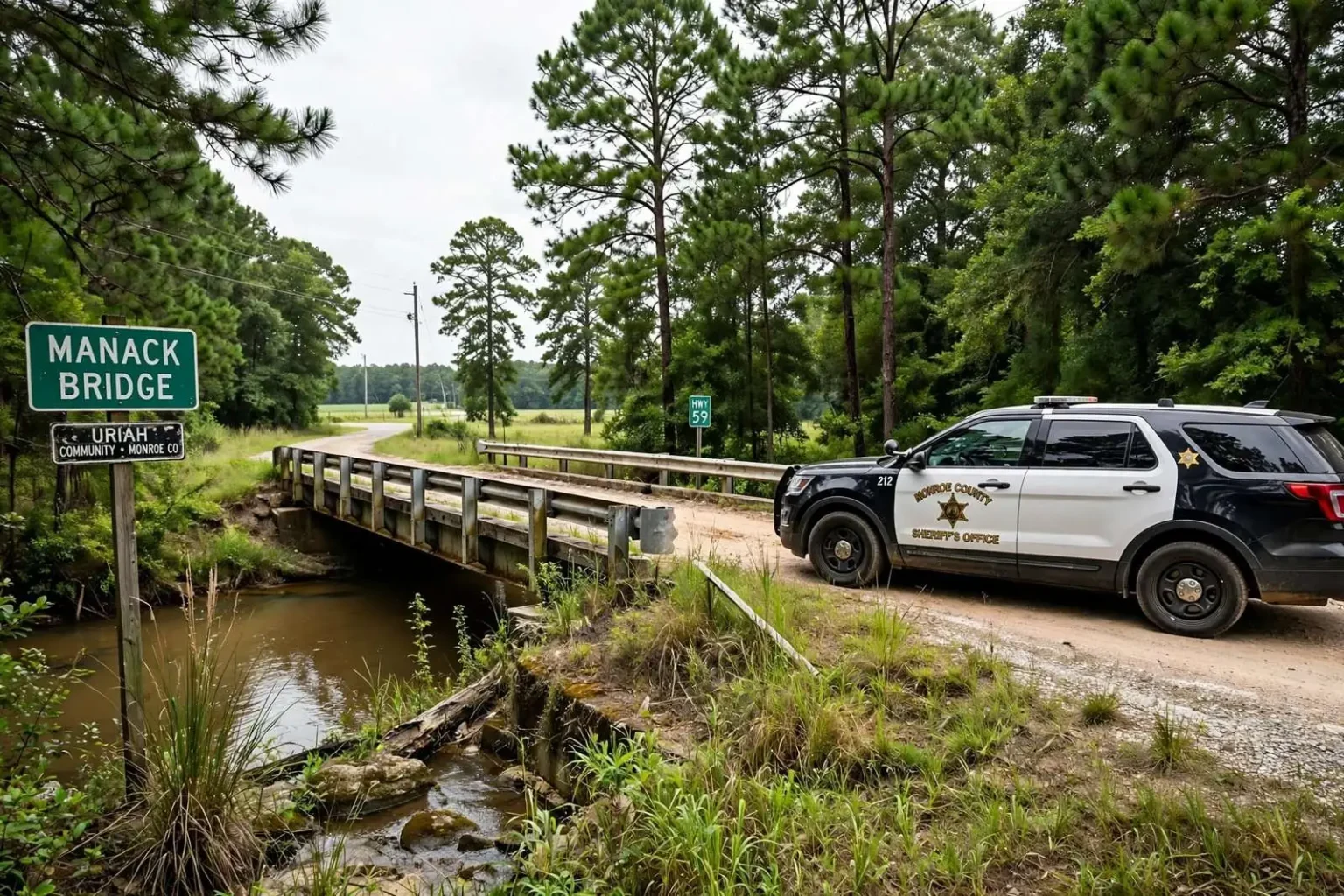
MONROE COUNTY, Ala. — The Monroe County Sheriff’s Office says an internal review has cleared two deputies of wrongdoing after social media posts accused them of pointing firearms at a group of people gathered near Manack Bridge in the Uriah community. The allegations spread quickly once they appeared online, and the sheriff’s office treated the dispute over the deputies’ conduct as serious enough to warrant a formal accounting. The episode shows how fast a routine call can turn into a public controversy in a small county.
Sheriff Tom Boatwright released an account of the July 11 call after the agency fielded several complaints from residents and became aware of posts circulating on Facebook. In a county where news travels by word of mouth as much as by newsfeed, the posts had reached a wide audience by the time the office responded. Boatwright’s decision to publish a detailed timeline reflected an effort to correct the record before the allegations hardened into accepted fact.
Monroe County, best known nationally as the home of Monroeville and the literary legacy of Harper Lee, is a sparsely populated stretch of south Alabama where the sheriff’s office operates with a small complement of deputies covering hundreds of square miles. Response times are measured in tens of minutes rather than minutes, and mutual reliance among the sheriff’s office, municipal departments in Monroeville and Beatrice, and state troopers is a working necessity rather than a courtesy.
The Uriah community sits in the western part of the county, an unincorporated area where the school, churches and the creek crossing serve as the focal points of local life. For residents there, the sheriff’s office is often the only law enforcement presence they see, which is why an allegation against local deputies carries weight that it might not in a larger jurisdiction. Boatwright’s office serves at the pleasure of county voters, and his response to the posts reflected that accountability.
What the Sheriff’s Office Says Happened
According to the sheriff’s office, Monroe County E-911 dispatch was notified that Alabama Law Enforcement Agency troopers had received a complaint about a large group of ATVs riding on the roadway of Manack Bridge Road. Complaints about all-terrain vehicles on public roads are among the most common calls in rural Alabama counties, where four-wheelers and side-by-sides routinely travel between homes, fields and creek access points even though riding on roadways is generally prohibited.
Because troopers were farther out, the ALEA post asked Monroe County deputies to respond, expecting a shorter arrival time. The handoff between state and county units is standard practice in rural districts, where the nearest available officer is often the local deputy rather than the state trooper assigned to a wide multi-county zone. Dispatch routed the call accordingly and the two deputies began moving toward the bridge.
While two deputies were en route, turning onto Highway 59 from Highway 21 South, an immediate backup signal was broadcast reporting that a confrontation had broken out among people at the creek bank and that firearms had been produced by those involved, the agency said. Emergency assistance signals override normal call priority and draw every available unit, which explains why the deputies accelerated their response. The radio traffic from that moment became central evidence in the later review.
The deputies encountered several ATVs traveling roadside in the opposite direction, away from the Manack Creek area, as they approached. The departing riders suggested the group had already begun to scatter before law enforcement arrived, consistent with the account that officers found the situation winding down. The deputies continued toward the bridge to link up with the other units on scene.
Once at the bridge, the sheriff’s office said, ALEA troopers and other officers already on scene told the deputies that the dispute had been verbal, that no firearms had been seen by officers, and that law enforcement was standing by while the riders left. By the time the county units arrived, the confrontation had dissolved without violence, and the on-scene officers’ accounts matched what dispatch had relayed only in part. The deputies’ role, according to the office, was limited to arriving and assisting as the group dispersed.
The Agency Disputes the Allegations
The sheriff’s office said Monroe County dispatch never spoke to the original complainant and worked only from information relayed through another agency’s dispatch. That relay structure is a known weak point in multi-agency responses, since each transfer of information risks distortion. Boatwright’s office pointed to it as the likely source of the gap between what deputies believed they were responding to and what the social media posts later claimed.
It also said the two responding deputies never interacted with members of the public at Manack Bridge, and that neither deputy had been issued an AR-15 or any other rifle. The equipment detail went to the heart of the viral claim, since the allegation centered on a rifle being pointed at civilians. An agency statement confirming the assigned weapons of the two deputies on the call was an unusual but direct way of rebutting it.
Boatwright’s office described the allegation that a Monroe County deputy pointed a firearm at the public at the bridge as false. The sheriff’s decision to label the claim flatly false, rather than simply unproven, reflected the confidence the review reached in its findings. Officials said the deputies’ conduct was consistent with policy at every point in the response.
Sheriff’s offices in Alabama have few formal external review mechanisms, which places the burden of investigating their own personnel on internal processes. That structure draws criticism when findings go the agency’s way, which is one reason the Monroe County review leaned on records outside the office’s own control: radio logs shared with other agencies, ALEA trooper accounts and witness interviews conducted with civilians who were at the bridge.
After reviewing radio logs, interviewing witnesses and speaking with the other agencies on scene, the sheriff’s office said both deputies were cleared of any wrongdoing. The radio logs gave investigators a second-by-second record of what was broadcast and when, which is the most objective evidence available in disputes over what happened during a call. Witness interviews filled in the picture from the civilian side of the gathering.
Social Media and Small-Town Law Enforcement
The episode is a case study in how quickly claims can outrun facts in rural communities wired together by Facebook groups. Posts about the incident reached thousands of viewers within days, while the underlying records — radio traffic, dispatch logs and witness accounts — took longer to assemble. By the time the sheriff’s office finished its review, the allegation had been shared and repeated far beyond Monroe County’s borders.
Law enforcement agencies across Alabama have faced similar dynamics in recent years, as bystander video and secondhand accounts circulate before any official account exists. Departments have responded in different ways, from silence to rapid public statements, and the Monroe County review represents the more transparent end of that spectrum. Publishing a timeline, the office calculated, was the only way to compete with the version already circulating.
Manack Bridge itself is a recognizable landmark for residents of the Uriah community, a crossing over Manack Creek that draws swimmers, fishermen and families on summer weekends, particularly around holiday periods. Creek crossings in south Alabama routinely draw large informal gatherings in warm months, and with them the traffic, noise and occasional disputes that generate complaints to state and county authorities.
ATV complaints put rural deputies in a recurring bind. Riders often see the machines as ordinary transportation on low-traffic roads, while state law generally restricts them from public roadways, and neighbors bothered by noise or safety file the complaints that trigger enforcement. Calls like the July 11 one are common enough that deputies route them daily, and most end without incident.
Multi-Agency Responses and Their Risks
The call also illustrates the coordination chain that governs rural Alabama policing. ALEA troopers cover wide territories, county deputies fill the local gaps, and volunteer fire departments or municipal police sometimes join when a call escalates. Each agency runs its own dispatch or shares a regional center, and information moves between systems by phone and radio rather than through a single unified feed.
Emergency assistance broadcasts, like the one that sped the deputies toward the bridge, are designed to err on the side of officer safety, which means units often arrive to find the reported danger already resolved. That gap between what the radio reports and what awaits on scene is a familiar feature of rural policing, and it is precisely the space where misunderstandings about conduct are most likely to form.
The Monroe County Sheriff’s Office said its internal review is complete, and officials have encouraged anyone with questions about the account to contact the agency directly rather than rely on social media posts. The two deputies remain on regular duty, according to the office’s account, and the agency considers the matter closed pending any new information.
Community relations specialists note that the aftermath of such incidents is shaped by how agencies communicate. Silence lets the online version stand; a detailed rebuttal, like the one Monroe County issued, at least gives residents a documented alternative. Whether the explanation changes minds in the Uriah community is a separate question, but the office’s account is now part of the public record for anyone weighing the competing versions.
For Uriah residents, the episode leaves a familiar residue: conflicting narratives about a July afternoon at the creek, an official account that disputes the viral one, and a community deciding whom to believe. What is documented, at least, is now public — the dispatch records, the timeline and the findings of a review that cleared the two deputies of the accusations that followed them home.