Monroeville Man Dies In Single-Vehicle Crash On Monroe County 5 Near Repton
ALEA says a 34-year-old Monroeville man died when his pickup left Monroe County 5 near Repton and hit a tree Saturday evening. Troopers are investigating.
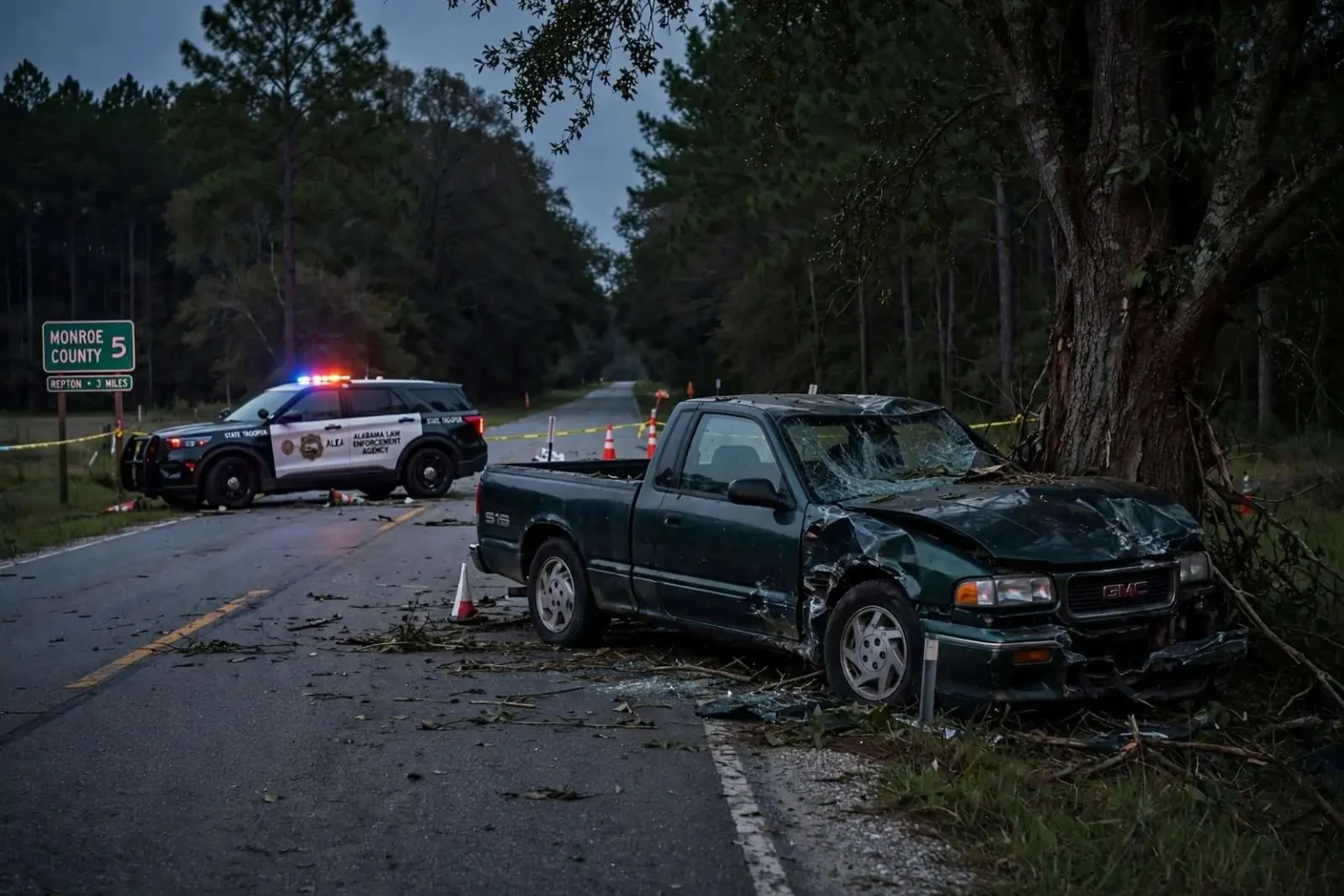
MONROE COUNTY, Ala. — A 34-year-old Monroeville man was killed Saturday evening when the pickup he was driving ran off a county road near Repton and struck a tree, the Alabama Law Enforcement Agency said. Troopers identified the driver as Kenneth Naki Lee. He was pronounced dead at the scene.
According to ALEA, Lee was behind the wheel of a 1990 GMC S15 that left the roadway before hitting the tree. Investigators said he was not wearing a seat belt at the time of the wreck. The agency said the single-vehicle crash happened at about 6:30 p.m. on Saturday, Nov. 4, along Monroe County 5. No other vehicles were reported to be involved.
Troopers with the ALEA Highway Patrol Division are continuing to investigate and have not released a determination on what caused the vehicle to leave the road. Rural two-lane routes account for a substantial share of Alabama’s traffic deaths each year, and state troopers routinely note seat belt use among the factors examined in fatal single-vehicle wrecks.
The road and the setting
Monroe County 5 is a rural two-lane county road in the southwestern part of the county, running through the lightly populated countryside between Repton and neighboring communities. Roads of this type — narrow lanes, soft shoulders, mature trees close to the right of way — define the driving environment across Monroe County, and they are where a disproportionate share of Alabama’s fatal crashes occur each year.
Repton itself is a small Conecuh-border town of a few hundred residents, and the roads around it carry a mix of local traffic and drivers moving between Monroeville, Evergreen and the communities along U.S. 84. Evening drives on county roads in this part of the state present conditions that highway engineers consistently flag: limited lighting, curves that appear quickly, and deer and other wildlife crossings that peak around dusk — the very hours when this crash occurred at about 6:30 p.m.
The vehicle involved, a 1990 GMC S15, is a compact pickup from an era when trucks of that class carried fewer standard safety features than modern vehicles. Older pickups lack the side-impact protection, stability control and airbag coverage found in current models, and their behavior when leaving a roadway at speed differs measurably. Vehicle age alone does not cause crashes, but it is a factor troopers document in reconstructing fatal wrecks, and it shapes survivability when a truck strikes a fixed object such as a tree.
Seat belts and single-vehicle fatalities
Investigators’ finding that Lee was not wearing a seat belt places this crash within Alabama’s most persistent highway safety problem. State data has shown for years that a majority of vehicle occupants killed in Alabama crashes were unrestrained, and that single-vehicle run-off-road crashes — where a driver loses the road and strikes a tree, ditch or embankment — are a leading scenario in those deaths.
Alabama’s seat belt law requires drivers and front-seat passengers to buckle up, and the state’s standard enforcement allows troopers and officers to stop a vehicle for that violation alone. But enforcement reaches only so far on rural county roads at night, where traffic is thin and patrol coverage is stretched across dozens of miles of two-lane asphalt. That is why rural fatality counts in counties like Monroe, Conecuh and Escambia remain stubbornly high relative to their small populations.
The physics of an unbelted crash into a fixed object are unforgiving. A pickup leaving a two-lane road typically strikes a tree with one portion of its front end, concentrating the impact; an unrestrained driver continues moving at the vehicle’s speed until stopped by the steering wheel, windshield or interior structure. Seat belts cannot prevent every fatality, but in run-off-road crashes they remain the single most effective factor in whether a person walks away.
Troopers have not determined what caused the 1990 GMC S15 to leave Monroe County 5, and the Highway Patrol Division’s investigation continues. In crashes of this type, investigators work through a standard checklist: roadway conditions at the scene, the vehicle’s mechanical condition, visibility, speed, and any evidence of driver impairment or distraction. The results of that work determine whether the crash record notes a contributing factor — or remains, as many do, undetermined.
Monroeville, Lee’s hometown, is the Monroe County seat and the largest community in the region, and county roads like Route 5 are the daily arteries connecting it to the smaller towns around it. The evening timing of the crash — about 6:30 p.m. on a Saturday in early November — falls after sunset in early November, when darkness arrives before 6 p.m. in south Alabama, adding darkness to the list of conditions troopers examine.
How fatal crash investigations proceed
When a crash involves a fatality, the response is different from an ordinary wreck. ALEA troopers close the roadway while an on-call crash reconstructionist documents the scene, and the county coroner responds to make the pronouncement and handle next-of-kin notification. Only after the scene is fully photographed and measured is the road reopened — a process that in rural areas can take several hours.
The investigation that follows can take weeks. Investigators review the vehicle’s damage pattern, download any data available from the truck’s systems, interview anyone who saw the vehicle before the crash, and await toxicology results before closing the file. ALEA’s public statements at the scene typically confirm only the identities, the vehicle, the location and the restraint status — the facts released in this case — with further findings waiting on the completed report.
For families, the sequence includes support services that ALEA coordinates alongside local coroners. Fatal crash notifications are made in person where possible, and troopers ask anyone who may have witnessed the crash or the vehicle beforehand to come forward, since even a brief sighting of the GMC S15 on Monroe County 5 can help establish the moments before the wreck.
The larger toll on rural roads
Lee’s death is one entry in a statewide pattern that safety officials describe in familiar terms every year. Alabama’s rural roads carry a fraction of the traffic of its interstates but account for the majority of its traffic deaths, a ratio driven by higher speeds relative to road design, longer emergency response times, lower seat belt use, and the proximity of trees and other fixed objects to the roadway edge.
Monroe County’s roads are part of the state’s legacy two-lane infrastructure, much of it built decades ago for lighter traffic than it now carries. County commissions across the Black Belt and south Alabama shoulder the cost of maintaining those routes — resurfacing, clearing brush from sight lines, and replacing fading signs — with budgets that rarely keep pace with the need. Safety improvements as simple as widened shoulders and clear recovery zones are known to reduce run-off-road fatalities, but they arrive slowly in rural counties.
In the meantime, the factors troopers cite in wrecks like this one — restraint use, speed appropriate to a dark rural road, and sobriety — remain the ones individual drivers control. A 34-year-old Monroeville man driving home on a Saturday evening did not survive the moment his truck left Monroe County 5, and the investigation into why it left the road continues without him.
Emergency response times on rural Monroe County roads also shape crash outcomes. The nearest emergency medical services to the crash scene on Monroe County 5 would have come from volunteer departments and county units based in Repton, Frisco City or Monroeville, and even a prompt response means a drive measured in miles of two-lane road. In crashes involving severe trauma, the interval between impact and advanced medical care is a decisive variable — one reason rural fatality rates per mile traveled far exceed urban rates across Alabama.
What investigators look for next
In the coming weeks, ALEA’s file on the crash will come together piece by piece. Troopers will complete their examination of the GMC S15, looking at tires, brakes and steering components for any mechanical condition that might have contributed to the vehicle leaving the roadway. They will chart the vehicle’s path from where it first left the pavement to the tree it struck, using that geometry to estimate speed at the point of departure. Toxicology results, when they return, either rule out or establish impairment as a factor.
None of that analysis changes the outcome for Lee’s family, but it matters for the record and for the road itself. When a particular curve or stretch of county road appears repeatedly in fatal crash reports, county engineers and the Alabama Department of Transportation’s local programs take notice, and low-cost fixes — signage, reflectors, cleared sight lines — often follow. The completed investigation is what puts a crash like this one into that data stream.
For now, the facts stand as ALEA released them: Kenneth Naki Lee, 34, of Monroeville, driving a 1990 GMC S15 on Monroe County 5 near Repton at about 6:30 p.m. on Saturday, Nov. 4; the truck left the roadway and struck a tree; he was not wearing a seat belt; he was pronounced dead at the scene; and no other vehicles were involved. Troopers with the Highway Patrol Division continue to investigate what caused the vehicle to run off the road, and their findings will close the record on a Saturday evening crash that took the life of a 34-year-old man on a rural Alabama county road.