Monroeville Pastor Charged With Two Counts Of Second-Degree Sodomy After Grand Jury Indictment
The Monroe County Sheriff's Office says a 47-year-old Monroeville pastor was arrested on two counts of second-degree sodomy after a grand jury indictment.
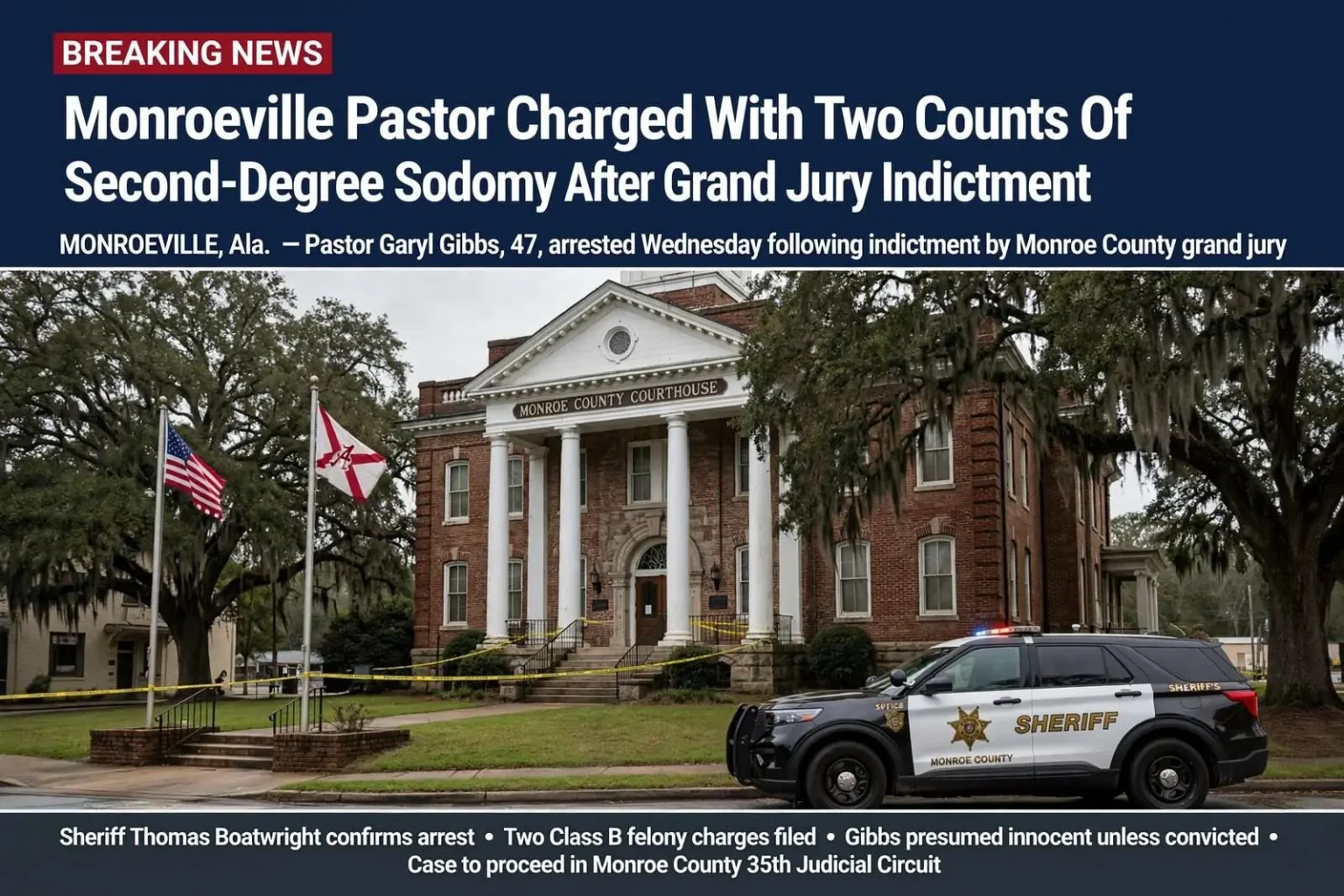
MONROEVILLE, Ala. — A Monroeville pastor was arrested Wednesday on two counts of second-degree sodomy, according to the Monroe County Sheriff’s Office. Sheriff Thomas Boatwright identified the man as Garyl Gibbs, 47. The sheriff said a grand jury returned an indictment against Gibbs the previous week and that Monroeville Police carried out the arrest.
Under Alabama law, sodomy in the second degree is a Class B felony that generally involves allegations of sexual conduct with a person under 16 or a person unable to give legal consent. Each of the two counts stands as a separate felony charge, meaning the penalties, if convictions are obtained, can be stacked by a judge at sentencing.
The sheriff’s office released a booking photo of Gibbs but did not detail the allegations underlying the indictment, and did not say when the conduct at issue is alleged to have occurred. Charges filed by way of a grand jury indictment reflect a finding of probable cause to proceed, not a determination of guilt. Gibbs is presumed innocent unless convicted in court.
Additional information about the arrest was expected from Monroeville Police, which handled the booking. Until then, officials have released only the basic facts: two counts, one indictment and an arrest carried out Wednesday in the Monroe County seat.
How the case came together
The path that led to Gibbs’ arrest ran through Alabama’s grand jury system, which operates differently from the more familiar process of an arrest followed by a preliminary hearing. Rather than a district judge weighing probable cause in open court, a grand jury — a panel of citizens drawn from the county — hears evidence presented by prosecutors behind closed doors and decides whether there is probable cause to charge.
Sheriff Boatwright said the grand jury returned the indictment the previous week, meaning the panel had already reviewed the evidence and found sufficient cause to move the case forward before Wednesday’s arrest. That timing matters: an indictment-first prosecution signals that prosecutors believed the evidence was ready to present to the citizen panel from the outset, rather than building the case after an arrest.
Grand jury proceedings in Alabama are secret by design. Witnesses testify without the defendant or defense counsel present, and the record of what was said is not released. That secrecy is why the sheriff’s office could confirm the indictment while offering no details of what was alleged — the underlying evidence remains sealed unless and until it surfaces in court filings or at trial.
The law behind the charges
Alabama’s sodomy statutes divide offenses into first and second degree, in parallel with the state’s rape laws. Second-degree sodomy, a Class B felony, generally applies when the complainant is under 16 years old and the defendant is older, or when the person involved is deemed unable to give legal consent because of mental defect, incapacitation or similar circumstances.
A Class B felony in Alabama carries a sentence of up to 20 years in prison upon conviction. With two counts pending, the potential exposure doubles if a judge chooses to run sentences consecutively. Felony convictions in Alabama also carry long-term consequences beyond prison time, including registration requirements that apply to certain sex offenses under the state’s community notification laws.
An arrest and a small town
For a pastor, an arrest of this kind reverberates beyond the individual. Congregations in rural Alabama often function as extended family, and news of criminal charges against a church leader spreads quickly through both the membership and the wider community. Churches and denominational bodies generally have their own internal processes for handling allegations against clergy — suspension of duties, revocation of credentials, review boards — separate from the criminal courts, though none of those steps substitute for the criminal process itself.
That principle carries particular weight in small towns like Monroeville, where a charge alone can damage a reputation long before any evidence is tested in public. Monroeville, the seat of Monroe County, is a community of roughly 6,000 people best known as the hometown of Harper Lee and the setting that inspired the courtroom scenes of To Kill a Mockingbird. Its residents know well how accusations, fair or not, can mark a person and a family in a small Southern town.
The division of labor behind the arrest is common in Alabama counties between the sheriff’s office and municipal police departments. The Monroe County Sheriff’s Office, led by Sheriff Thomas Boatwright, announced the arrest and identified the defendant, while Monroeville Police — the municipal department covering the city itself — carried out the arrest and handled the booking.
Sheriff’s offices in Alabama counties typically serve as the primary law enforcement agency for unincorporated areas, operate the county jail and handle court security and civil papers. Municipal departments like Monroeville Police handle enforcement within city limits. When an indictment is returned, warrant service frequently falls to the agency covering the defendant’s location, which in this case was the city police force.
What happens next in a felony case
After booking, an Alabama felony case follows a well-established path. The defendant appears before a district or circuit judge for an initial appearance, where the charges are read and bond is set or confirmed. Defense counsel is either retained or, for defendants who cannot afford an attorney, appointed. The arraignment follows, where the defendant enters a plea to the indictment’s counts.
From there, the case enters the discovery phase, in which prosecutors must turn over the evidence they intend to use — witness statements, reports and other materials — to the defense. Pretrial motions can challenge the indictment, the evidence or the law applied. Many felony cases are resolved by plea agreement before trial; others proceed to a jury trial in circuit court, where the prosecution must prove every element of each count beyond a reasonable doubt.
If Gibbs is convicted on any count, sentencing would follow, with a judge weighing the offense grade, the defendant’s history and the facts proven at trial or admitted in a plea. If he is acquitted, or if the case is dismissed at some stage, the charges end there — though, as residents of small towns understand, public attention rarely disappears as quickly as the case files close.
A community watching
Monroeville’s residents have followed the case with the attention that any allegation against a local religious leader draws. The city, long known for its literary heritage and its courthouse square, is a place where institutions — churches, schools, courts — are tightly woven into daily life, and where news of an indictment travels by word of mouth faster than any press release.
Officials said additional information about the arrest was expected from Monroeville Police. Until that information is released, the public record remains limited to the indictment’s existence, the two Class B felony counts and the facts of Wednesday’s arrest — a starting point, not a conclusion, in a case that will be decided not by rumor or booking photos, but by evidence tested in a Monroe County courtroom.
Resources and reporting
When charges involving minors or vulnerable persons surface in a community, advocacy organizations typically remind residents of the reporting channels available: local law enforcement, the Alabama Department of Human Resources’ child abuse hotline, and school counselors, who are mandated reporters under state law. Early reporting, officials say, is often what allows investigators to build the record that grand juries later review.
What comes next in this case rests with the courts of Monroe County’s 35th Judicial Circuit: an initial appearance, an arraignment, motions and, eventually, either a plea or a trial. Until then, the indictment stands as the grand jury’s finding of probable cause — and nothing more.
Gibbs, 47, remains charged with two counts of second-degree sodomy and is presumed innocent unless convicted in court. The Monroe County Sheriff’s Office and Monroeville Police have not indicated when the next public development in the case is expected, and residents seeking reliable updates will find them in official statements and court records rather than in the rumor mill that inevitably follows an arrest of this kind in a small Alabama city.
The case also serves as a reminder of how Alabama’s grand jury system functions for citizens watching from outside the courthouse. Grand juries in the state hear evidence in felony matters and return either true bills — indictments — or no bills, declining to charge. Their deliberations are ex parte and confidential, and the strong-measure standard they apply is probable cause, a far lower bar than the proof required at trial.
Defense attorneys often scrutinize indictments for defects in form or in the instructions given to the grand jury, and pretrial motions can attack an indictment on those grounds. In practice, however, indictments stand in the overwhelming majority of cases, and the real contest occurs later, at suppression hearings, trial or plea negotiations.
Second-degree sodomy under Alabama law in detail
The second-degree classification exists to distinguish circumstances involving minors or vulnerable individuals from other charges. The statute’s reach is defined by age and consent capacity rather than by the specifics of any single incident, and prosecutors charging under it must prove the elements laid out in the code — the nature of the conduct, the ages of the parties and the consent capacity at issue — to a jury’s satisfaction.
Because each count is charged separately, a jury would be asked to return verdicts on each count independently. That structure matters for sentencing and for appellate review, since convictions on different counts can be affirmed, reversed or vacated individually.
Alabama’s sentencing framework gives judges discretion within statutory ranges, subject to guidelines that apply to many non-capital felonies. Prior record, aggravating facts and victim-impact evidence all inform the outcome at a sentencing hearing.
Support resources and next steps for the public
When charges involving minors or vulnerable persons surface in a community, advocacy organizations typically remind residents of the reporting channels available: local law enforcement, the Alabama Department of Human Resources’ child abuse hotline, and school counselors, who are mandated reporters under state law. Early reporting, officials say, is often what allows investigators to build the record that grand juries later review.
For congregations processing the news, denominational offices and regional bodies can provide guidance on interim leadership and on their internal review procedures. Counselors in the Monroeville area likewise emphasize that members, especially young ones, should be given space to ask questions and be heard.
What comes next in this case rests with the courts of Monroe County’s 35th Judicial Circuit: an initial appearance, an arraignment, motions and, eventually, either a plea or a trial. Until then, the indictment stands as the grand jury’s finding of probable cause — and nothing more.
The sheriff’s office has committed to releasing further details as they become available, and any additional public information is expected from Monroeville Police, the booking agency. Residents seeking reliable updates will find them in official statements and court records rather than in the rumor mill that inevitably follows an arrest of this kind in a small Alabama city.
Gibbs, 47, remains charged with two counts of second-degree sodomy and is presumed innocent unless convicted in court. The Monroe County Sheriff’s Office and Monroeville Police have not indicated when the next public development in the case is expected.