Moon Honey Talks New Name, Debut Album, and Upcoming Show at Alabama Music Box
Moon Honey discusses their name change from Twin Killers, debut album Hand-Painted Dream Photographs, and upcoming show at the Alabama Music Box.
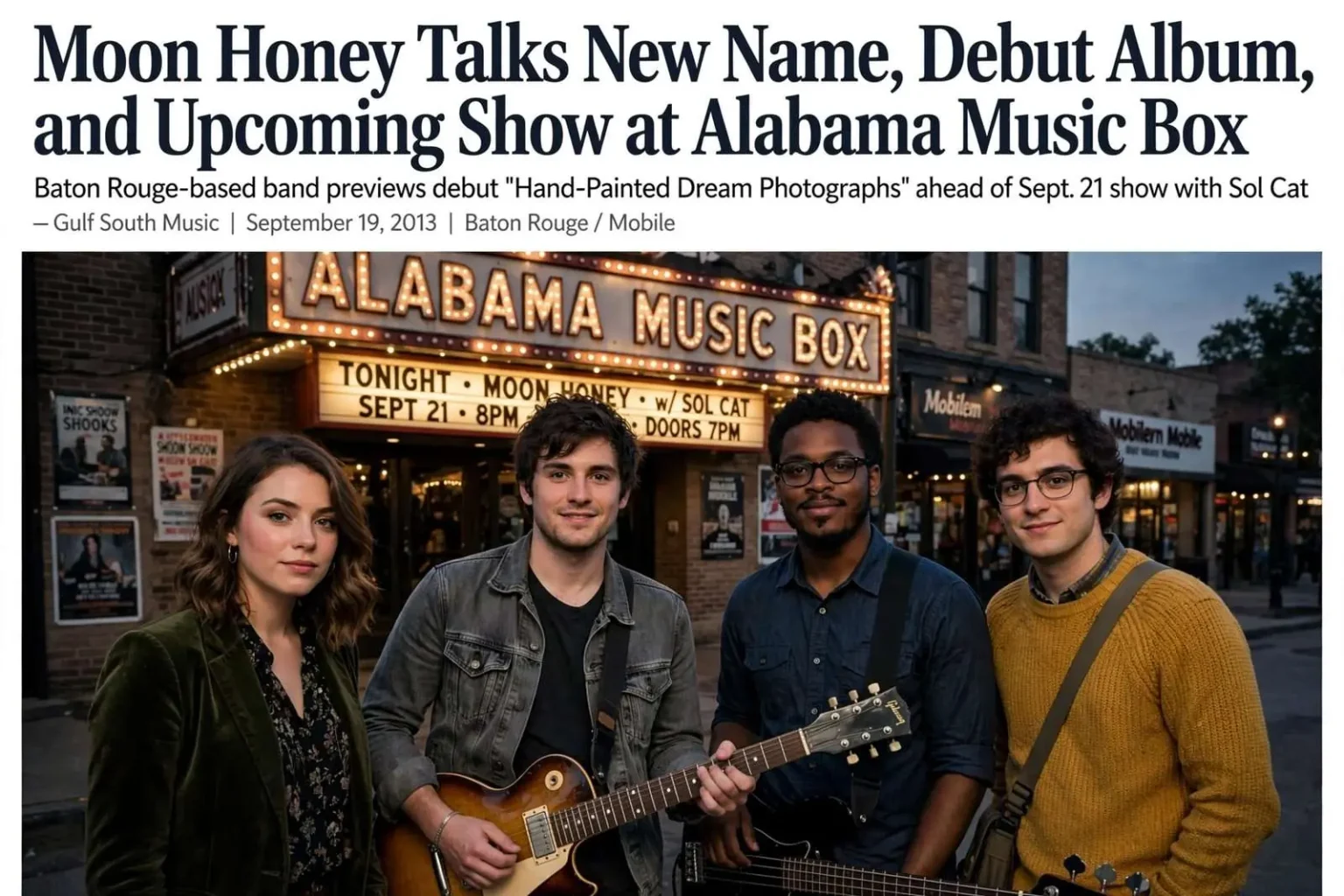
Baton Rouge-based band Moon Honey, formerly known as Twin Killers, sat down ahead of their September 21, 2013 show at the Alabama Music Box in Mobile, where they were set to share the stage with Sol Cat. Vocalist Jessica Ramsey discussed the band’s origins, their name change, and the highly anticipated release of their debut full-length album.
The stop in Mobile fit a band on the way up. The Alabama Music Box, a fixture of the downtown music scene, has long served as a proving ground for touring indie acts working their way across the Gulf South, and September dates through Louisiana, Alabama and Tennessee are the traditional plumbing of a young band’s first album cycle. Sharing a bill with Sol Cat gave Moon Honey a co-headliner’s audience and a chance to test new material before the record’s official arrival.
From Twin Killers to Moon Honey
The band’s formation traced back to guitarist Andrew Martin, who moved from the Cayman Islands at age 14 to pursue music. After stints in pop punk and hardcore projects, Martin teamed up with bassist Jermaine Butler to write ambitious, progressive compositions. The duo struggled to find a vocalist until Butler recruited Ramsey, who initially turned them down due to her lack of experience. She eventually joined, and keyboardist Jeffrey rounded out the lineup just one week before their first tour.
That scramble-for-a-singer origin story is more common in band lore than anyone admits, but in Moon Honey’s case it produced an unusual division of labor: a rhythm section writing complex, genre-hopping arrangements around a self-taught vocalist who arrived without the habits that formal training can impose. The band’s sound came to lean on that tension — theatrical, rhythmic and unpredictable, with Ramsey’s voice as the through-line.
The name change from Twin Killers to Moon Honey came with a sense of purpose. Ramsey explained that “Twin Killers” had been chosen hastily when the band first formed and carried a harsh connotation that no longer fit their evolving sound. The new name was inspired by a visit to the Stax Museum in Tennessee, where they encountered an exhibited artist whose last name was Honeymoon but who went by “Moon Honey.”
“I don’t want a drop of evil to be in the name of that which I love most in my life,” Ramsey said. “There is a lot of beauty, wonder, mystery and darkness inside of the music. It speaks for the tide, the worker bees, and the discharge of heaven.”
The Stax connection roots the band’s reinvention in one of American music’s sacred places. The Memphis museum, built on the site of the legendary soul label, houses the artifacts of Otis Redding, Isaac Hayes and the other architects of Southern soul — a pilgrimage stop for any band that cares about where its music comes from. That the group found its new identity in a piece of visual art there says something about how deliberately they were rethinking the project.
Debut Album on the Horizon
Moon Honey’s debut full-length album, “Hand-Painted Dream Photographs,” was set for an official December 3, 2013 release. The album was mixed by Greg Saunier, drummer of the influential experimental rock band Deerhoof, and mastered by Steve Fallone of Sterling Sound, whose credits included work with The Strokes and TV on the Radio.
The recording featured contributions from several guest musicians, giving the album a texture beyond what the four band members could stage on their own. For a debut, the personnel represented a striking vote of confidence: Saunier’s involvement in particular carried weight among listeners of experimental rock, since Deerhoof has spent two decades influencing a generation of bands who want to be adventurous without losing the hook.
Mastering at Sterling Sound placed the record in an elite pipeline. The New York studio has put the final polish on some of the most recognizable records of the past two decades, and Fallone’s credits alongside The Strokes and TV on the Radio signaled that Moon Honey intended their debut to compete sonically with national releases rather than sound like a regional demo. For a young band from Louisiana’s capital, that attention to the final product was a statement of ambition.
The Road Through the Gulf South
The September 21 date at the Alabama Music Box anchored a stretch of touring that took the band through the small clubs and listening rooms where debut albums are actually built. Mobile has historically rewarded bands that work the circuit honestly — the venue’s stage has hosted countless acts on their first pass through the region, some of whom returned years later playing much larger rooms.
For local audiences, shows like this one offered a chance to see a band before the record arrives. The material the group was performing in the fall of 2013 comprised the songs that would become “Hand-Painted Dream Photographs” in December, played with the rough energy of arrangements still settling. Bands often say the album captures a moment; the tour before the album is where that moment breathes.
By the time the December 3 release date arrived, the plan was for the band to have spent the fall turning curious showgoers into record buyers, an old-fashioned strategy that still works in an era when albums leak months in advance. Independent artists live or die on the strength of the live show and the mailing list, and Moon Honey’s itinerary through Baton Rouge, Mobile and the surrounding region was exactly that grind.
What to Listen For
Based on the band’s description, listeners could expect a record that lives up to its literary title — songs interested in beauty, mystery and darkness in equal measure, delivered with the instrumental ambition of a group that came together around progressive compositions rather than garage riffs. Ramsey’s poetry about tides, worker bees and the “discharge of heaven” suggested lyrics that reach for imagery rather than confession.
The pairing with Sol Cat on the Mobile date also fit the moment. Both bands occupied the space where indie rock meets something stranger — psychedelic touches, rhythmic experiments, hooks buried inside odd structures — and audiences at the Alabama Music Box that September night got an early look at two acts building followings the honest way: city by city, room by room, one show at a time.
For a Baton Rouge band with a new name, a December record, a Deerhoof drummer behind the mixing board and a growing Gulf South circuit, the fall of 2013 was the hinge. Mobile’s date was one night in the middle of it — and the kind of night that, in retrospect, is where bands like this one are made.
Baton Rouge’s Place in the Story
The band’s home base matters to the sound. Baton Rouge sits in the long shadow of New Orleans’ music scene, and bands that come up there tend to develop without the ready-made industry infrastructure their bigger-city peers enjoy. That distance breeds self-sufficiency — booking their own tours, cutting their own records, finding their own audiences — and it often produces acts that sound like nowhere else, since they are drawing on Louisiana’s dense musical culture without being assigned a genre by their surroundings.
The city’s university population also supplies a reliable audience for adventurous music, and venues around the capital routinely book national indie touring acts passing between New Orleans and Houston. A band that can hold that crowd at home can take the show on the road, which is precisely what the fall 2013 itinerary represented.
Membership in that scene also explains the guest musicians on the album. Regional bands trade players freely — a horn part here, a vocal there — and the credits on “Hand-Painted Dream Photographs” reflected a community rather than a closed unit. It is a working method as old as Southern music itself.
The Album Cycle Ahead
With the record scheduled for December 3, the band’s calendar for the remainder of the year followed the classic sequence: tour in the fall, release in early winter, then a longer run of dates behind the finished album once critics and college radio had their copies. Mastering finished, artwork ready and physical copies on order, a debut record’s arrival is the moment a band stops being a promise and becomes a catalog.
The involvement of Saunier and Fallone also positioned the album for the kind of press attention a self-released debut rarely earns. Reviewers pay attention to names, and a record mixed by Deerhoof’s drummer arrives with a question attached — what does an experimental-rock lifer hear in this band? — that is worth a dozen cold emails.
For Mobile, the September 21 show was the local chapter of that story: a rising band, a packed room downtown and new songs played months before they were for sale. The Alabama Music Box has hosted that scene countless times, and on nights like this one it did what small venues do best — put an audience a few feet from a band that was about to get interesting.
Whether the record fulfilled the promise was, at press time, still ahead of the band. But the ingredients — a rebuilt identity, a serious studio team, a working region and a debut ready to ship — added up to one of the more intriguing albums of the coming winter from anywhere on the Gulf South circuit, and Mobile audiences could say they heard it first.