
More Than 3,000 Midtown Mobile Customers Lose Power as Crews Work Repairs
More than 3,000 Alabama Power customers in midtown Mobile lost power Tuesday morning. Crews cut the outage count to under 1,000 by mid-morning.
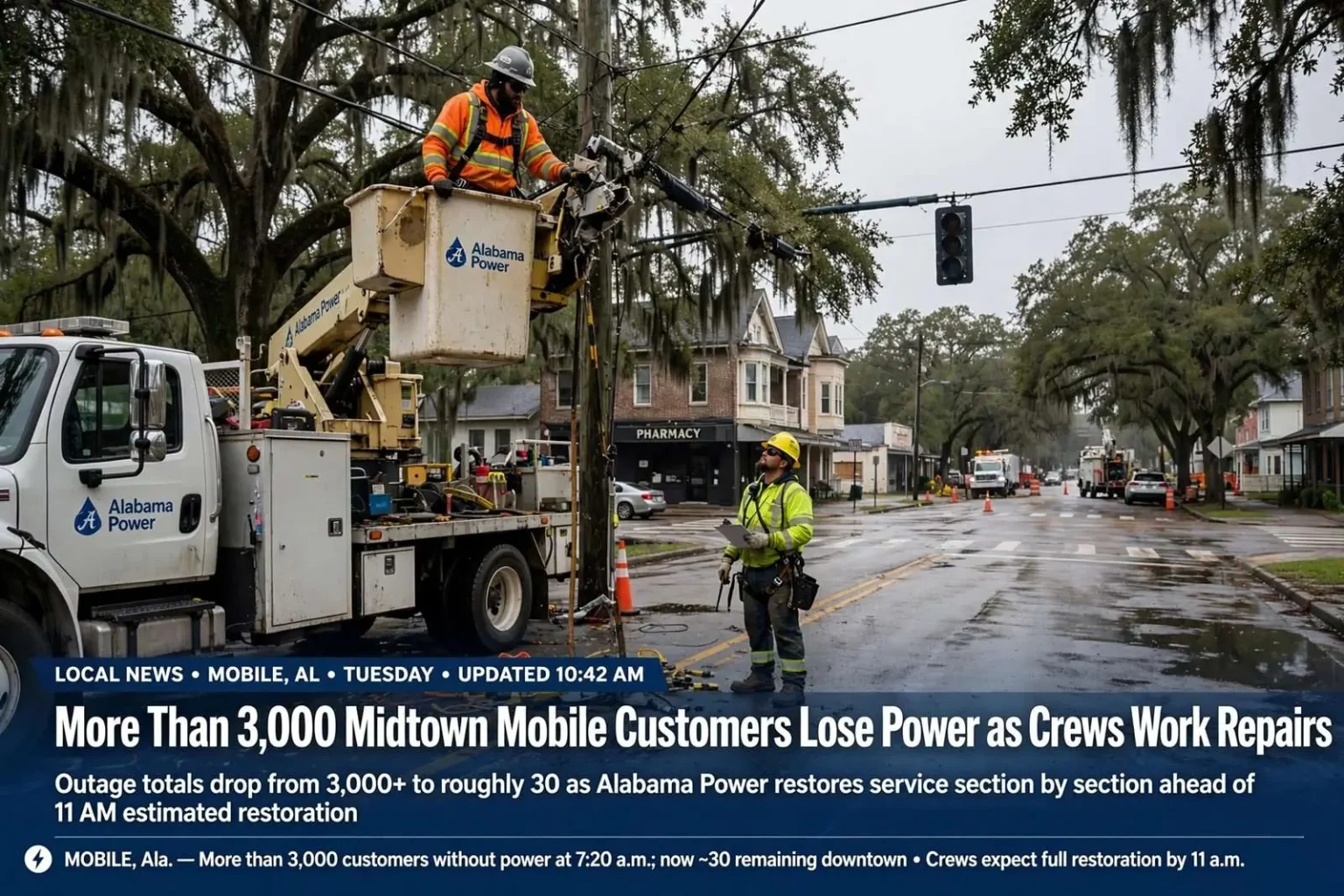
MOBILE, Ala. — More than 3,000 Alabama Power customers in midtown Mobile were without electricity Tuesday morning, according to the utility’s online outage map, which estimated that repairs would wrap up around 11 a.m. The interruption, concentrated in one of the city’s most densely populated residential corridors, briefly knocked out service to homes and businesses between downtown and the western neighborhoods, with stoplights, offices and morning routines all feeling the effect.
Crews worked through the morning to restore service. By mid-morning, Alabama Power reported the outage total had dropped to roughly 700 customers, and a later update put the number of affected customers — concentrated in the downtown area — at about 30. The steady shrinking of the outage total suggested crews were isolating and repairing the problem section by section, restoring neighborhoods progressively rather than waiting on a single systemwide fix before bringing customers back online.
Outage Total Fell Steadily Through the Morning
The utility’s outage map, which tracks interruptions in near real time, showed the bulk of the morning’s outages clustered in the midtown area of Mobile before the count fell steadily as repair work progressed. The map’s progression — from more than 3,000 customers at the morning’s start, to roughly 700 by mid-morning, to about 30 concentrated downtown in the final update — traced the repair work’s path in public, letting residents watch the restoration move through the affected zones hour by hour.
For residents, the morning’s disruption arrived at the least convenient hour. Power losses in midtown Mobile affect a broad stretch of the city’s everyday machinery: traffic signals at busy intersections along its principal east-west corridors, medical offices and pharmacies, school buildings and the small businesses that anchor the area’s commercial streets. Morning outages in dense residential districts also bring a familiar cascade — garage doors that will not open, alarm clocks that never sounded, and commuters rerouting around darkened intersections.
Alabama Power does not always announce a cause for short-duration outages of this kind; interruptions can stem from equipment failures, downed lines, vegetation contact or vehicle strikes on poles. The utility’s practice is to prioritize restoration and report the cause when it is determined to be significant, leaving many single-morning interruptions unexplained in public statements even after crews have found and fixed the fault.
How Restoration Works
The repair sequence behind a morning like Tuesday’s follows a standard utility playbook. When an interruption registers, grid operators first identify the affected circuits and the protective equipment that isolated the fault. Crews then patrol the line, often on foot and by truck, to find the point of failure — a blown fuse, a damaged transformer, a limb across a conductor, a pole knocked out of true. Once the fault is located and cleared, power returns in stages, with each step shrinking the outage map’s colored polygons as customers come back online.
The speed of Tuesday’s restoration — from a four-figure outage count to double digits inside a morning — reflects both the nature of the fault and the density of the affected grid. Midtown Mobile’s undergrounded and overhead infrastructure sits close together, with short feeders serving large numbers of customers, so a single repair can restore service to hundreds of households at once. The final holdouts in any outage tend to be the customers downstream of the most complicated damage, which is why the last few dozen usually take longer than the first few thousand.
Customers who remain without electricity after an estimated restoration window can report the outage through the utility’s alert channels. Alabama Power maintains text, phone and online reporting options, and the company uses customer reports to confirm the accuracy of its automated outage data — a system that occasionally misses individual service drops even when neighborhood-level totals look restored.
Outages in a Gulf Coast City
Short-duration outages are a recurring feature of life in Mobile, where an aging residential grid, abundant tree canopy and frequent Gulf weather combine to keep crews busy year-round. Summer thunderstorms topple limbs onto lines, and hurricane season adds the larger events that utilities plan for months in advance. But the most common interruptions are the small ones — a squirrel in a substation, a car-pole collision on a rain-slicked street, a component failure at the transformer level — that darken a few thousand homes for a few hours and end without public explanation.
Utilities weigh the tradeoff of cause disclosure carefully. Announcing a specific cause before the investigation is complete risks error, and many routine faults — wildlife contact, equipment wear — carry no actionable lesson for the public. What customers get instead is the restoration estimate, updated in near real time on the outage map, which has become the primary public communication channel for events of this size. Tuesday’s progression from estimate to restoration, visible online hour by hour, is the modern shape of a utility’s public notice.
The outage map itself has become an essential local tool. Mobile residents checking the map during an interruption can see whether their street’s cluster is recorded, how many neighbors share the outage, and what restoration time the system estimates — information that determines whether to wait, unplug sensitive electronics, or find somewhere else to work for the morning. Utilities refine those estimates continuously as crews report from the field, which is why estimated completion times shift during complex repairs.
What Customers Can Do
For households caught in a morning outage, utility guidance is consistent: keep freezers and refrigerators closed to preserve cold, unplugged sensitive electronics to protect them from the surge when power returns, and treat any downed line as energized no matter how it looks. Intersections with dark signals become four-way stops under Alabama traffic law, a rule that matters during just such an interruption when commuters meet at signalless corners across the affected area.
Businesses in the affected corridor face their own calculus. Restaurants lose refrigerated inventory if an outage stretches into hours; offices without power send employees home or to coffee shops with generators; medical facilities with critical equipment run on backup power and wait. Tuesday’s restoration pace spared the midtown area the worst of those scenarios, with the count falling to triple digits before the workday’s midpoint.
By the time the utility’s final update put the remaining count at about 30 customers concentrated downtown, the morning’s disruption was effectively over for the vast majority of those affected. The event joined the long ledger of brief Gulf Coast outages — thousands of customers, a few hours, crews on the line until the map went quiet — and a reminder of how quickly a modern city’s morning depends on the continuity of its wires.
Midtown Mobile’s grid profile helps explain both why the outage spread as far as it did and why it collapsed so quickly. The area’s housing stock — early-20th-century neighborhoods of oak-lined streets alongside mid-century subdivisions — sits on feeders that branch densely across the district, so a fault on a main line can darken thousands of households at once. The same density works in reverse during restoration: clearing one fault on a main brings whole swaths back together, which is how a four-figure outage count falls to three figures before lunch.
The morning’s timing also shaped its footprint. Outages during school and commute hours produce the most visible disruption — darkened classrooms waiting on emergency routines, intersections where police and utility flags redirect traffic, and a surge of calls to the utility’s contact center. Restoration targets of mid-morning, like the 11 a.m. estimate on the outage map, aim to compress the disruption into a single morning rather than allowing it to carry over into the afternoon’s heat, when a darkened neighborhood without air conditioning becomes a different category of problem.
For Alabama Power, events of this size are handled by local distribution crews rather than storm-response teams, and the utility’s after-action is routine: repair the fault, update the map, and move on without a public cause unless the failure reveals something systemic. Tuesday’s event fit that pattern — a morning interruption, thousands affected, a steady restoration clock, and by the end of the update cycle a remaining handful of customers downtown whose service was the last to return.
Residents who lose power in future mornings will find the same tools Tuesday’s customers used: the online map for status, text and phone channels for reporting, and the standing advice to report again if the estimated window passes without restoration. In a Gulf Coast city where brief outages are part of the calendar, knowing how to read the outage map — and when to report an outage the map seems to have missed — has become standard local knowledge alongside hurricane preparations and summer storm routines.