
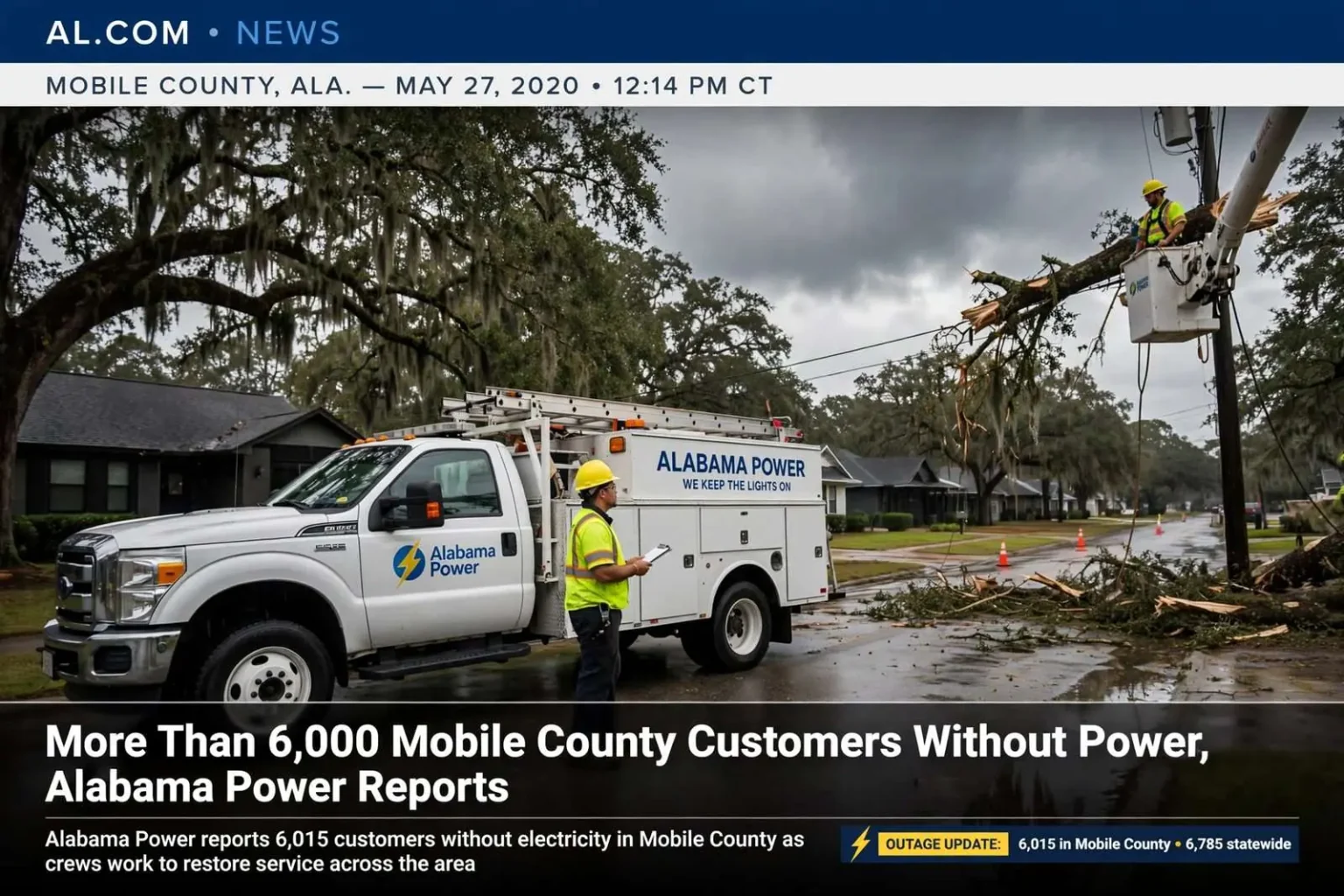
MOBILE COUNTY, Ala. — Alabama Power’s outage map showed more than 6,000 customers in Mobile County without electricity on Wednesday, May 27, 2020, as the utility worked to restore service across the area. The interruption, one of the larger single-day outages reported in the county that spring, left households and businesses across parts of the county waiting on repair crews through the middle of the day.
According to the company’s tracking system, 6,015 customers in Mobile County were experiencing outages as of midday. Systemwide, the utility reported 6,785 customers without power at the same time, indicating the vast majority of the disruption was concentrated in Mobile County. That pattern — nearly nine of every ten affected customers inside one county — pointed to a localized problem in the local distribution grid rather than a regional transmission failure or a storm system sweeping the whole service territory.
The county’s size and geography make such concentrated events significant when they occur. Mobile County stretches from the Mississippi line to Mobile Bay, taking in the city of Mobile, the Eastern Shore communities’ mainland side, and a broad rural expanse of communities north and west of the city. With hundreds of thousands of residents, an outage affecting 6,000 customers can mean an entire subdivision, several commercial corridors, or a cluster of neighborhoods sharing a single set of feeders.
Tracking Restoration in Real Time
Alabama Power encouraged customers to check the company’s online outage map for real-time updates on restoration progress and estimated times of service return. The map provides neighborhood-level detail on outage locations and the number of customers affected in each area. During an event like Wednesday’s, the map becomes the utility’s primary public communication: residents can see whether their block is recorded, how many neighbors are affected, and what restoration estimate the system is projecting as crews report from the field.
The tracking system works from automated signals — meters that stop reporting, protective devices that record a fault — supplemented by customer reports phoned or submitted online. Operators use the combined picture to dispatch crews to the most likely fault locations, and as repairs are completed the map’s clusters shrink and vanish. The neighborhood-level detail matters for individual households, because automated systems occasionally miss single service drops even when a wider outage is fully recorded, and a customer report is what triggers a check of an unlisted address.
The company did not immediately specify a cause for the outages. That silence is standard practice for events still under repair: utilities announce causes for significant or widespread interruptions once investigations are complete, but for a single-day event the priority is restoration, and the cause — whether equipment failure, vegetation contact, or damage to a specific structure — often goes unpublicized if the repair resolves it.
Late May on the Gulf Coast
Power outages in late May are not uncommon along the Gulf Coast, where the early weeks of hurricane season can bring severe thunderstorms, high winds and heavy rainfall capable of downing trees and power lines. The Atlantic hurricane season begins June 1, and the weeks surrounding it — including late May — are historically active for severe weather across south Alabama, as spring’s collision of warm Gulf air and passing frontal systems produces the region’s strongest thunderstorms outside of tropical events.
Mobile County’s exposure is amplified by its landscape. The city of Mobile is one of the rainiest in the United States, averaging more than 66 inches of precipitation a year, and its abundant tree canopy — a civic treasure most of the time — becomes a hazard in every strong windstorm. Saturated ground from spring rains loosens root systems, so a storm that would barely trouble a dry landscape can topple large hardwoods onto lines in wet weeks like late May.
Utilities prepare for this seasonality with year-round vegetation management, trimming growth along distribution corridors and removing hazard trees before the season’s peak. Crews stage for the June 1 start of hurricane season with mutual aid agreements in place across the Southeast, but ordinary spring and summer thunderstorms — not named storms — account for the vast majority of the region’s short-duration outages each year, which keeps local crews working storms like Wednesday’s without outside help.
What the Numbers Meant
The math of Wednesday’s outage — 6,015 of 6,785 systemwide customers inside Mobile County — illustrates how a modern utility reads its own map. Distribution grids are built around local feeders and substations, so when a single county holds nearly all of an outage, operators know the fault lies in local equipment rather than the high-voltage transmission backbone, which serves broad regions and fails far more dramatically. A transmission-level event would have spread customers across counties; a feeder-level event concentrates them, and that distinction drives both the dispatch of crews and the expected repair time.
For the affected households, the midday timing framed the disruption. An outage beginning in late morning catches schools and offices at full activity, halts cooling systems as outdoor temperatures climb toward afternoon, and threatens refrigerated inventories at the groceries, restaurants and pharmacies that serve the affected neighborhoods. Medical customers who rely on powered equipment are advised to register with the utility in advance so their addresses are flagged for priority awareness during restoration planning.
Restoration priorities follow a standard hierarchy: life-safety facilities first — hospitals, emergency operations, water and sewer plants — then the repairs that restore the largest number of customers, then the smaller pockets and individual service drops. That is why one neighborhood’s lights can return hours before a nearby street’s, and why utility guidance always includes a way to report an outage that the map may not show.
Advice for Customers
During any outage, the utility’s standing recommendations apply: stay away from downed lines and never assume one is dead, run generators outdoors and away from windows to prevent carbon monoxide buildup, keep refrigerator and freezer doors closed to preserve cold, and unplug sensitive electronics so the return of power does not surge through them. Those measures cost nothing and address the most common injuries and losses associated with interruption events.
Customers can report outages through Alabama Power’s phone, text and online channels, and the company recommends reporting even when neighbors have already done so, since reports confirm the extent of an outage and catch addresses the automated system missed. The outage map’s estimated restoration times are updated continuously, but utilities caution that estimates can shift as crews locate damage — a lesson Gulf Coast residents learn quickly during storm season, when initial estimates frequently extend as reconnaissance reveals more downed lines than first reported.
By day’s end, the count on the tracking system told the story of the repair effort: from more than 6,000 Mobile County customers at midday toward zero, neighborhood by neighborhood, as crews cleared the faults and the map’s clusters disappeared. Whatever the cause proved to be, the event fit the season — a late-May reminder, just ahead of June 1, that on the Gulf Coast the power grid and the weather are in a year-round negotiation, and that the first weeks of hurricane season arrive with storms already rehearsing.
The May 27 event also landed in a year already reshaping how utilities and customers interact with outage information. With more households working and schooling from home during the coronavirus pandemic, a daytime interruption in 2020 carried heavier stakes than in a typical year — home offices went dark, remote lessons paused, and the usual escape of spending the outage hours elsewhere was limited by public health restrictions. Utilities nationwide noticed the change, as residential daytime demand patterns shifted and customer sensitivity to even brief interruptions grew.
Mobile County’s grid serves a mix of urban core, suburban expansion and rural stretch that makes restoration logistics distinctive. Downtown Mobile’s towers and the historic districts around them run on networked underground infrastructure, midtown and west Mobile sit on dense overhead feeders threaded through the tree canopy, and the county’s rural north and west depend on long rural lines serving fewer customers per mile. A fault in any one of those environments produces a different outage signature — and the map’s neighborhood clusters let observers guess which environment the crews were working in.
Weather watchers in the county will recognize the date’s position in the calendar as well. The final week of May typically brings the region’s transition from spring storm patterns into the tropical season, and emergency management agencies use those same weeks to run their annual preparedness campaigns — urging residents to build kits, review generator safety and sign up for alerts before the season’s first named storm organizes in the Atlantic or Caribbean. An outage count above 6,000 in that week was, in a sense, the season’s opening argument.
For the customers affected, Wednesday’s disruption ended the way most Gulf Coast interruptions do: with the hum of air conditioners restarting across the county and a few hours of spoiled routines behind them. The utility’s advice for the next one — check the map, report if unlisted, stay clear of downed lines — remains the same standing instruction it has always been, on the cusp of another hurricane season along the northern Gulf.