More Than 650 Local Families to Audition for Family Feud in Atmore
More than 650 Gulf Coast families auditioned for the TV game show Family Feud during weekend casting calls at Wind Creek Hotel and Casino in Atmore.
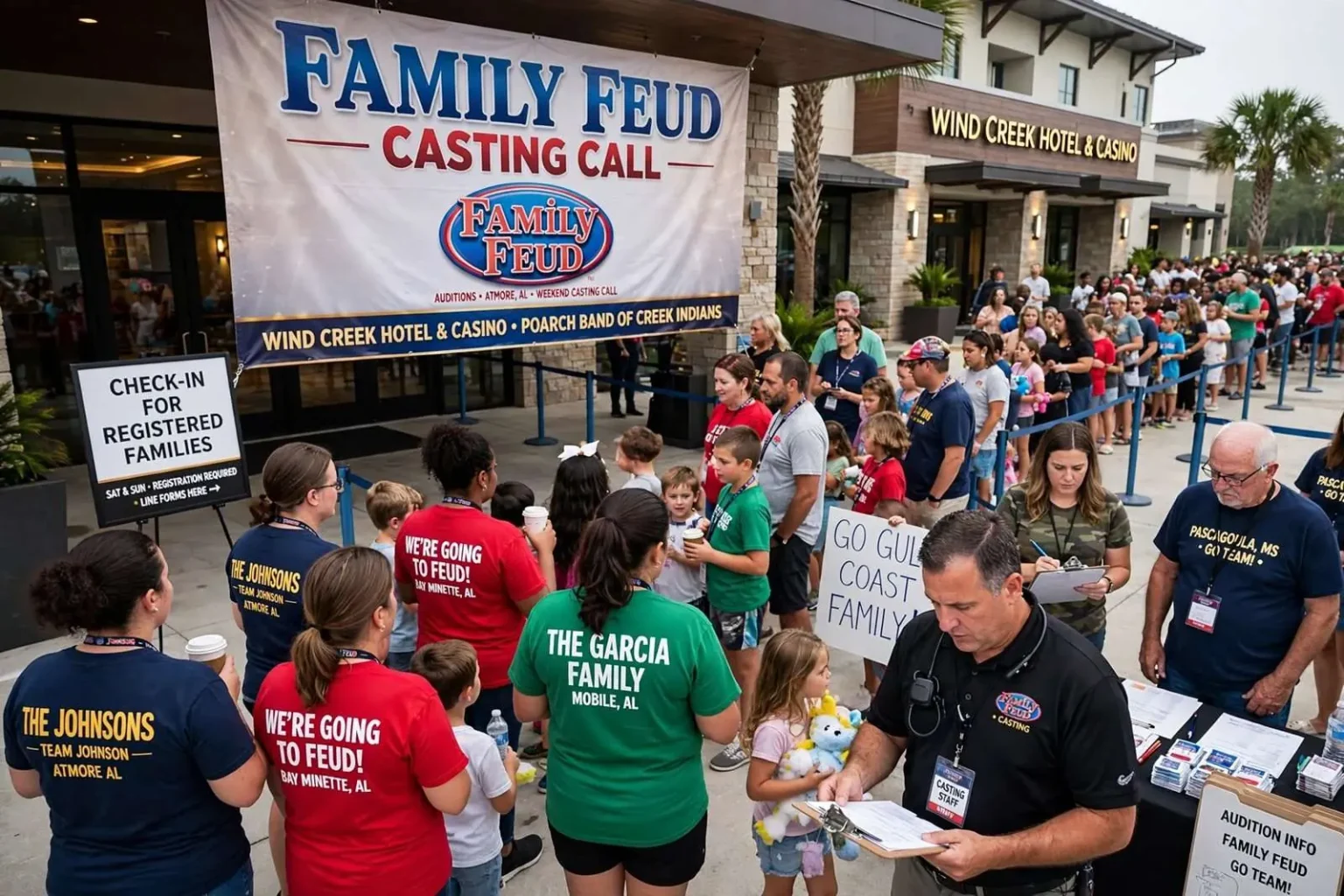
More than 650 families from across the Gulf Coast were set to audition for the television game show Family Feud during a weekend casting call at Wind Creek Hotel and Casino in Atmore. The auditions ran Saturday and Sunday, but only for families who registered in advance — a sign of just how much interest the show’s producers found in south Alabama.
Producers held the open call as part of the show’s search for energetic families to appear on the long-running program, which airs weekdays at 4 and 4:30 p.m. Local coverage planned to be on site Saturday to capture the fun and excitement of the audition rounds. Families who made the cut in Atmore would advance toward the possibility of appearing on the nationally televised program, where two families of five face off to name the most popular answers to survey questions posed to the public.
A Big Weekend for Local Families
The scale of the turnout said as much as the numbers themselves. More than 650 families — which, at five people apiece, meant several thousand would-be contestants — registered for a shot at a two-minute audition in front of the show’s casting team. Families came from across the Gulf Coast region, from Mobile and Baldwin County, from the Florida Panhandle, and from south Mississippi, converging on the resort at the Alabama-Florida line for a weekend built around a game show audition.
The Family Feud format has been a television staple for decades, and its revival-era success has made live casting calls a regular feature of the show’s production calendar. The current version of the program, long hosted by Steve Harvey, has built its popularity on family banter as much as on the survey answers themselves, and casting producers openly look for personality: teams that laugh together, play off each other, and can fill airtime with energy. That is what the casting directors in Atmore were sifting for as family after family took their turn.
The audition process at these events is famously fast. A registered family checks in, waits its turn, and then gets a brief window on camera with the producers — a quick round of imaginary fast-money style questions, a chance to introduce the team, and a read on how the group plays together. Producers typically follow up with callbacks for families that stand out, with no guarantee attached to any single audition. The sheer volume of registrants in Atmore underscored the math: hundreds of families competing for a handful of slots in the show’s national taping pipeline.
Why Atmore
Atmore, home of the Wind Creek resort operated by the Poarch Band of Creek Indians, has become a regular stop for major entertainment events along the Alabama-Florida line. The resort’s hotel, event space, and casino floor make it one of the largest entertainment venues between Mobile and Pensacola, and it has hosted concerts, comedy tours, and regional events that once would have had no home in the rural corner of Escambia County where the town sits.
The Poarch Band’s development of Wind Creek has transformed the economics of the area over the past two decades. The tribe, whose reservation sits just outside Atmore, has grown Wind Creek into the flagship of a hospitality enterprise that now operates gaming and resort properties across the country, and the home property remains a major employer in a part of south Alabama where manufacturing and agriculture have historically anchored the economy. Hosting a television casting call fits the venue’s strategy of drawing regional visitors for events that fill hotel rooms on weekends.
For the families, the weekend had the feel of a miniature vacation built around a long shot. The casino resort’s restaurants and amenities absorbed the crowds between audition blocks, and the atmosphere at these casting events tends toward the festive — matching team shirts, hand-made signs, and groups practicing their introductions in the hallways. Even families with no realistic expectation of a callback treated the trip as a shared experience, the kind of story a family tells for years afterward regardless of how the audition goes.
How the Show Works
Family Feud’s format explains why producers travel the country looking for teams rather than casting from a studio backlot. Two family teams compete to guess the most popular answers to survey questions that have been put to panels of everyday people — naming the top responses for everything from “the worst chore to do on a hot day” to “the last thing you’d want to find in your sandwich.” Points build through the rounds, the winning family advances to the fast money bonus round, and the show’s structure rewards teams that think the way the crowd thinks.
What makes the show castable is that the game is easy to simulate in an audition. Producers do not need real survey boards to see how a family plays: they ask mock questions, watch who steps forward, and listen for the quick, funny, unguarded exchanges that translate to television. At the Atmore call, that meant each registered family had its moment in front of the casting table, and the producers’ notebook of standouts was the real product of the weekend.
The show’s production cycle typically films its episodes in blocks in a studio in the Atlanta area, and families that survive casting are scheduled for tapings months down the line, with travel logistics handled by the production. The prize structure — cash for winning fast money — is supplemented for most families by the experience itself and the local pride of representing their community on a national broadcast.
Game Shows and Regional Casting
The Atmore event fits a broader pattern in which long-running game shows have decentralized their casting, taking auditions to mid-sized venues across the country rather than waiting for hopefuls to come to Los Angeles or Atlanta. The approach widens the demographic range of contestants — shows like Family Feud draw much of their appeal from appearing to be ordinary people, and nothing says ordinary like a church group from Pascagoula or a family of cousins from Bay Minette — and it turns each casting call into a local event worth covering in its own right.
Regional casting also serves the show’s ratings geography. Family Feud airs in the late afternoon in markets across the country, including Mobile and Pensacola, and episodes featuring recognizably Southern families play strongly in Gulf Coast households. Producers have long known that the program’s audience skews toward the same regions its casting calls visit, and the show’s hosting and format lean into that affinity rather than away from it.
For the 650-plus families registered in Atmore, the odds of any single group reaching the broadcast stage were long, but the casting-call structure is designed to move a steady stream of regional teams into the pipeline over time. Multiple families from a single call can ultimately be scheduled, and producers keep audition footage on file when a team shows promise without quite fitting a current need.
What Comes Next for the Families
After the weekend ended, the process moved behind the scenes. Casting teams review their notes and footage, callbacks go out by phone and email, and the families that advance face more detailed vetting — background checks, eligibility confirmations, and scheduling conversations — before any taping date is set. Producers offer no timeline and no feedback to the families who are not selected, which is part of why these events generate such anxious follow-up among participants.
For Atmore and Wind Creek, the weekend was another entry in the venue’s growing portfolio of non-gaming events. The resort has positioned itself as the region’s entertainment anchor, and a national television property choosing it as a casting stop reinforces that bid. For the families who turned out, the two days offered something simpler: a chance to stand up together, play the game they watch every afternoon, and find out — for better or worse — how they come across on camera.
A Weekend Economy Built on an Audition
The casting call also illustrated how large events ripple through a small town. Atmore’s regular population swells on big weekends as visitors fill the resort’s hotel rooms, its restaurants, and the gas stations and shops along Highway 21, and a two-day event drawing several thousand registrants and their guests produced exactly that pattern. Local eateries outside the resort saw the spillover, and the town’s position just north of Interstate 65 and a short drive from the Florida line makes it a natural gathering point for families coming from Mobile, Pensacola, and the Mississippi coast alike.
The Poarch Band’s presence looms over all of it. The tribe’s hospitality enterprise has made Atmore a destination that would otherwise not exist on the regional entertainment map, and events like the Family Feud call give the resort a chance to showcase its event space to visitors who might otherwise only know it for the gaming floor. Weekend visitors who come for an audition leave having seen the hotel, the restaurants, and the resort’s scale — exposure that marketing dollars cannot easily buy.
Why Families Show Up
There is a reason the show’s casting calls reliably draw crowds like this one. Family Feud occupies a particular place in American television: it is one of the few programs where an ordinary family can appear on a national broadcast without any particular talent beyond being themselves, and where the audition process — unlike a singing competition or a reality show — is short, free, and open to any group of five related people. That accessibility turns a game show audition into a bucket-list item rather than an industry gatekeeping exercise.
The show’s weekday afternoon slots, at 4 and 4:30 p.m. in this market, also mean its audience is heavily made up of the same people who attend the casting calls: families watching together after school and work. Appearing on the program is a form of local celebrity that lasts — the episodes rerun, the photos circulate, and a family that makes it to the stage becomes a small point of pride for the schools, churches, and workplaces it represents.
Whether any of the 650-plus families from the Gulf Coast ultimately reach the Family Feud stage depends on callbacks that producers send in the weeks after the event. For the ones who registered, waited in line, and took their two minutes on camera, the weekend at Wind Creek delivered the part that was guaranteed: a family outing with a national television storyline attached, played out at one of south Alabama’s biggest venues.