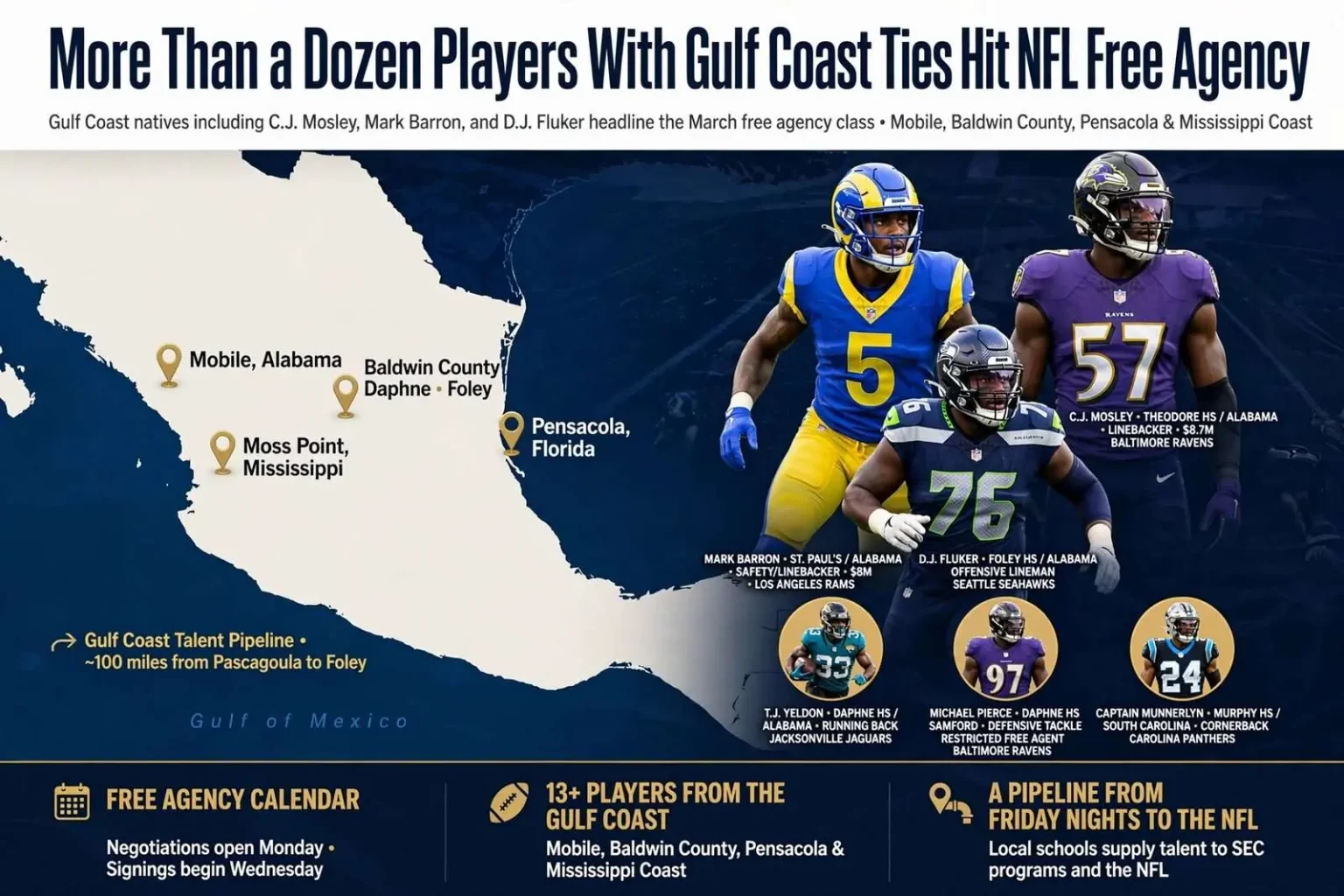
The NFL’s free agency window opened with a long list of players who came up through Mobile area and Gulf Coast high schools, including one of the league’s better-known linebackers. Under the league calendar, free agents could begin negotiating with teams on Monday and start signing contracts on Wednesday.
Pro Bowl linebacker C.J. Mosley, a Theodore High School product who went on to Alabama, headlined the group. Mosley finished the previous season with Baltimore on total compensation of roughly $8.7 million, the highest figure among the area’s free agents. Mobile and Baldwin County products filled out much of the rest of the board.
Mark Barron, who prepped at St. Paul’s before starring at Alabama, entered the market after a season with the Los Angeles Rams and compensation of about $8 million. Offensive lineman D.J. Fluker, a Foley High School graduate who also played at Alabama, was coming off a season in Seattle. Daphne produced two of the group: running back T.J. Yeldon, another Alabama alum, was leaving Jacksonville, and defensive tackle Michael Pierce, who played collegiately at Samford, was a restricted free agent with Baltimore.
Defensive tackle Darius Philon, a Vigor High School product who played at Arkansas, was leaving the Los Angeles Chargers. Cornerback Captain Munnerlyn, out of Murphy High School and South Carolina, was coming off a season with Carolina.
Northwest Florida and Mississippi Ties
Several others in the group came from just across the state lines. Defensive back Tremaine Brock, of Long Beach and Belhaven, was leaving Denver. Defensive tackle Tom Johnson, a Moss Point graduate who played at Southern Miss, was coming off a season in Minnesota. Terrell McClain, a Pensacola product from South Florida, was leaving Atlanta. Running back Alfred Morris, of Pine Forest and Florida Atlantic, was coming off a season with San Francisco, as was defensive back Jimmie Ward, a Davidson High School graduate who played at Northern Illinois. Defensive lineman Ahtyba Rubin, an Escambia High School product, rounded out the list of defensive names with Gulf Coast roots.
The concentration is no accident. The Mobile area and the surrounding stretch of the northern Gulf Coast produce football talent at a rate that outpaces cities many times its size, and the rosters of the league’s 32 teams have reflected that for generations. Every March, when the free agency list is assembled, local fans can scan it and find names they watched on Friday nights in Mobile, Baldwin County, Pensacola, and the Mississippi Gulf Coast before those players ever appeared on a college Saturday.
How the Free Agency Calendar Works
The Monday-to-Wednesday sequence is a deliberate feature of the league’s offseason design. Once the new league year’s negotiation window opens, agents and team executives may discuss parameters of deals — term, structure, general money — but nothing can be signed until the window closes and contracts become official two days later. In practice, the two-day gap produces a flurry of reported agreements that may not be confirmed by clubs for days, and it occasionally produces reversals when a player visits a second team or a deal falls apart at the finish line.
Players enter the window in different categories, and those categories shape their leverage. Unrestricted free agents, like most of the veterans on this list, are free to sign anywhere. Restricted free agents are younger players whose contracts expired with fewer accrued seasons; their old team retains the right to match any offer sheet they sign, and to receive draft compensation if it declines to. Michael Pierce’s status as a restricted free agent with Baltimore meant the Ravens controlled his market in a way Mosley’s did not, regardless of how highly the young tackle’s season had rated.
Compensation figures like the ones attached to Mosley and Barron represent total value, combining base salary, signing bonus, and any roster or workout bonuses for the season in question — not the headline totals of long-term contracts. Those numbers matter for the players’ markets: a Pro Bowl linebacker fresh off an $8.7 million season and a former first-round safety coming off an $8 million year each entered the window expecting multiyear security, while role players from the same pipeline sized themselves up for one-year prove-it deals.
A Pipeline Built on Friday Nights
Look down the list and the geography tells its own story. Theodore, St. Paul’s, Murphy, Vigor, Davidson, Foley, and Daphne are all schools whose football programs feed college rosters year after year, and Mobile’s inner-city programs have historically produced defensive players at an especially high rate. The city sits at the western anchor of a corridor that runs east through Baldwin County into Pensacola and west along the Mississippi coast to Pascagoula and Moss Point — a stretch of roughly a hundred miles that has sent dozens of players to SEC programs and, from there, to the NFL.
The Senior Bowl, played annually in Mobile, keeps the region at the center of the professional game every winter, bringing the country’s top college seniors — and hundreds of NFL coaches, scouts, and executives — to the area for a week of practices that shape the draft. That annual spotlight reinforces the local pipeline in practical ways: area prospects grow up attending the game, meeting the players, and understanding the route from a Mobile high school to a college campus to a professional roster. The list of March free agents is, in effect, the senior class of that pipeline a decade after the fact.
Alabama’s national-championship era under Nick Saban multiplied the pipeline’s output. Players like Mosley, Barron, Yeldon, and Fluker went from Gulf Coast high schools to Tuscaloosa, played in multiple championship games, and entered the league as high draft picks with instant credibility. That Alabama-to-NFL relay has made Gulf Coast prospects some of the most heavily recruited athletes in the country each cycle, and it explains why so many names on the free agency board share both a hometown and a college.
What the Market Meant for Each Group
For the headliners, free agency was about topping an already comfortable tier. A Pro Bowl inside linebacker in his prime is one of the scarcer commodities in the league, and Mosley’s market was expected to reflect that scarcity, with teams that run 3-4 defenses and lack a signal-calling middle linebacker lining up first. Barron’s case was different: a converted safety who had matured into a hybrid box defender, his value depended on how the league’s evolving passing games priced versatility against pure coverage skill.
The veterans in the middle tier — Fluker, Munnerlyn, Johnson, McClain, Rubin, and Brock — were playing out the reality of NFL economics for players on the wrong side of their first contract. Teams pay sharply for proven starters in their prime, but a player entering his late twenties or thirties typically finds the market shorter and cheaper, and the smart move is often a one-year deal with a contender that restores value for the following March. Running backs like Yeldon and Morris face the same math at an even harsher rate, as the league’s declining investment at the position compresses free agent markets for everyone not named among the very best.
Philon and Pierce represented the opposite bracket: young interior defensive linemen whose best seasons were likely still ahead of them. Interior rushers and run-stuffers of that age profile are among the safest bets on the market, since their skills age slowly and their salaries remain modest relative to edge players. Pierce’s restricted status aside, both players were positioned to turn solid seasons into significant raises, whether with their old clubs or new ones.
For the home region, the annual free agency list carries a meaning beyond payroll figures. Every contract signed by a Theodore, Murphy, Vigor, Foley, or Daphne graduate is a local story with national reach, one that high school coaches retell every August to the next class of prospects. The pipeline from Gulf Coast Friday nights to NFL Sundays is one of the region’s most consistent exports, and March — when the league’s money moves and rosters reshuffle — is when the size of that pipeline is easiest to count.
The week’s transactions also matter for the players themselves in career terms. Free agency is the first time most NFL players negotiate from anything approaching a free market, and the difference between a well-timed signing and a quiet market can amount to millions over the back half of a career. Agents for players with Gulf Coast roots spent the negotiation window doing what agents everywhere do: courting the teams with need at their client’s position, floating figures to reporters, and positioning clients for visits that the Wednesday signing window would convert into contracts.
By the time the signings became official, the group’s destinations would be settled for another season — some returning to familiar locker rooms in Baltimore, Carolina, and Minnesota, others starting over in new cities. But whatever the addresses, the starting point of every story on the list was the same: a high school in Mobile, Baldwin County, Pensacola, or along the Mississippi coast, and a Friday night in the kind of football country that keeps supplying the league with its next class.