Motorcycle Deaths Are Climbing Across the Gulf Coast — Here’s What Riders and Drivers Need to Know
Gulf Coast motorcycle deaths are climbing. A Mobile safety push examines helmet laws, crash trends, and hosts a Riders for Riders Bike Night.
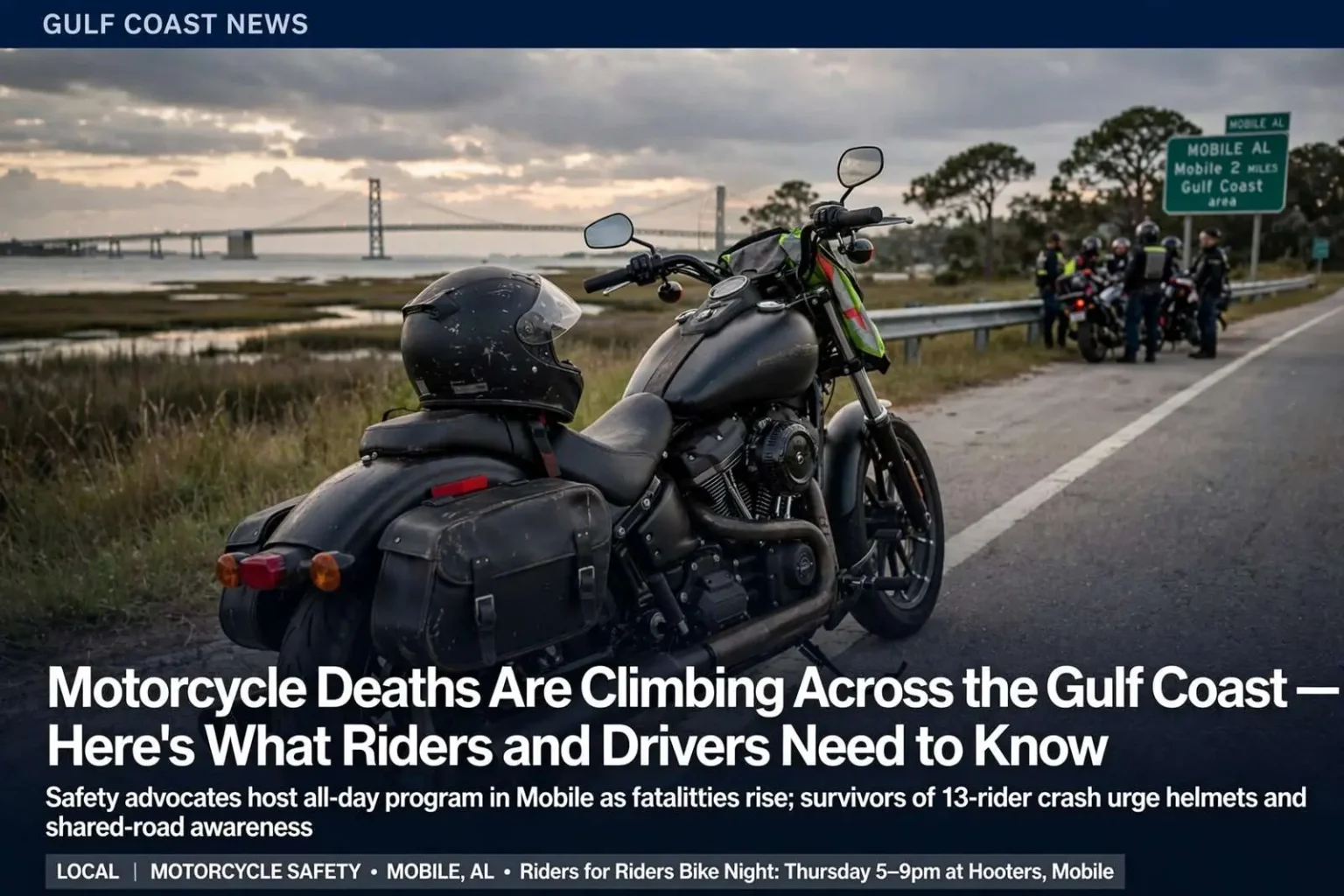
Motorcycle deaths are on the rise across the Gulf Coast, and safety advocates are using a full day of motorcycle-safety programming in Mobile to push riders and drivers to share the road. The effort brings together the numbers behind the trend, the tangle of state-by-state helmet laws that riders navigate on regional trips, and the perspective of a local trauma surgeon who sees the outcomes of motorcycle crashes arrive at her hospital.
The coverage digs into those numbers, examines helmet laws state by state, and asks whether helmets have made a measurable difference in the crash cases the surgeon treats. The question carries real weight along the Gulf Coast, where riders cross state lines constantly — Alabama’s coast sits within a day’s ride of states with dramatically different helmet requirements — and where the rules a rider leaves behind at the state line do not change the physics of the crash on the other side of it.
With some neighboring states imposing no helmet requirements at all, riders from the Mobile area routinely travel to places where the choice to ride unhelmeted is legal. Safety advocates’ argument is that the law is the floor, not the ceiling: what protects a rider’s head in a crash is the helmet, whatever the sign at the state line says.
Survivors Who Beat the Odds
Among those featured in the programming are members of a group of 13 motorcyclists who survived a horrific group crash and still ride today. Their account has become a teaching story for exactly the scenario riders fear most — a collision that sweeps through an organized pack. “One approaching car at the last minute, this car turns at a 45 and just veered right into our pack of riders,” said rider Sam Wooley, describing the moment that scattered the group.
Group crashes of that kind compress every risk a rider faces into a single moment. A pack rides close together for visibility and cohesion; a single car’s mistake at a junction or on a curve can involve multiple bikes at once, and riders behind the point of impact have a fraction of a second to react to a wreck they are already inside of. That 13 riders survived the crash described — and that many of them still ride — is the part of the story the safety program leans on: the aftermath is survivable, the prevention is learnable, and the survivors themselves are the messengers.
Their stories underscore how quickly an ordinary ride can turn dangerous. No pattern of recklessness preceded the wreck Wooley described — an approaching car, a last-minute turn, a 45-degree sweep into a pack. That is how a large share of serious motorcycle crashes happen: not on the bike’s worst behavior, but on the car’s.
Common Factors in Gulf Coast Motorcycle Wrecks
Across the region, the same factors recur in the crash reports. Cars turning into riders’ paths — most often at intersections, where a driver misjudges an oncoming motorcycle’s speed or simply does not register it — are the classic scenario. Drivers failing to see motorcycles in traffic is the broader version of the same failure, with bikes hidden behind vehicles, lost in blind spots or overlooked in a glance. And speeding, by riders or drivers, converts those already-dangerous mistakes into fatal ones by shrinking the time everyone has to react.
Those patterns shape the safety messages being pushed in Mobile. For drivers: check mirrors and blind spots for bikes, give motorcyclists a full lane, and never follow too closely. Each of the three addresses a documented crash factor — the lane instruction exists because a motorcycle occupies its full lane’s width in practice, and the following-distance rule reflects how little protection a car’s bumper offers a rider it rear-ends.
For riders, the advice is equally concrete: wear protective gear, consider a helmet regardless of state law, and stay visible at intersections. The intersection guidance deserves emphasis locally — the coast’s tourist-season traffic, its mix of unfamiliar drivers and its heavy motorcycle travel make junctions the most dangerous ground a Gulf Coast rider crosses.
Why Gulf Coast Roads Are Hard on Riders
The Gulf Coast’s riding environment stacks risk factors that other regions spread out. The climate gives the area a long riding season, which means more exposure hours; tourist traffic swells each spring and summer with drivers unfamiliar with local roads; and the region’s highways carry a mix of commuter, commercial and recreational traffic at speed. Riders from Mobile ride year-round on roads where the seasonal driver population changes every few months — a backdrop that makes visibility campaigns a permanent necessity rather than a seasonal one.
The region’s riding culture amplifies both the appeal and the stakes. Organized group rides, bike nights and charity runs fill the calendar, and the packs those events create are exactly the formations Wooley’s crash involved — multiple bikes traveling together, counting on every driver around them to see a group and act accordingly. When a driver fails that assumption, the group’s tight formation, normally a safety feature, becomes a way for one mistake to reach many riders at once.
Hospital data completes the picture. Trauma surgeons along the coast treat motorcycle crash patients from every state in the region, and the injuries they see — head trauma foremost among them — are the ones helmet use most directly changes. The surgeon featured in Mobile’s programming addresses that link directly: in the crash cases she treats, the question of whether a helmet made a measurable difference has a practical answer in the emergency department, patient by patient.
Helmet Laws Along the Gulf
State helmet law is a patchwork across the Gulf Coast, and riders live inside that patchwork. Alabama requires helmet use for all riders — a universal law of the kind safety organizations have long advocated — while some neighboring states impose no helmet requirements at all for adult riders, and the rest fall somewhere between, with age or insurance conditions attached. A rider crossing from Mobile toward the east or west can pass through several legal regimes in a single day’s ride.
That patchwork is why the state-by-state examination in the programming matters locally. Riders plan routes, not just destinations, and a ride that crosses into a no-requirement state puts the rider’s own judgment in charge of the decision the law used to make. Advocates’ position is blunt: the fatality numbers that rise across the Gulf Coast include the states where helmets are optional, and the difference shows up in the mortality of the crashes that occur there. A crash in a no-helmet state is not more likely to happen than the same crash in Alabama — it is more likely to be fatal.
The riders’ own testimony carries the argument further. The survivors featured in the programming — riders who lived through a group crash that could have ended all 13 of them — still ride, and their continued riding gives their safety advice its weight. They are not asking anyone to stop riding; they are asking riders and drivers to change the specific behaviors that turn a ride into a wreck.
Riders for Riders Bike Night
The awareness effort continues in person at the “Riders for Riders Bike Night” at Hooters in Mobile on Thursday from 5:00 to 9:00 p.m., where riders can gather to discuss motorcycle awareness and road safety with fellow enthusiasts. The event’s rider-to-rider format is deliberate: the safety messages land differently coming from fellow riders than from agencies or advertisements, and the survivors’ stories are the kind of testimony that changes behavior in a way statistics alone do not.
Bike nights of this kind serve as the social infrastructure of the region’s riding community — a place to show the bike, hear about road conditions, swap route advice and, in this case, absorb the lessons of riders who have been through the worst. The 5-to-9 window draws the after-work crowd and the serious enthusiasts alike, and the conversation about awareness is embedded in an evening riders would attend anyway.
The underlying message of the day’s programming is shared responsibility. Riders can wear the gear, choose the helmet and stay visible at intersections; drivers can check mirrors and blind spots, give motorcycles a full lane and keep their distance. Motorcycle deaths are climbing across the Gulf Coast — and the people asking the region to reverse that trend are, for the most part, the riders themselves.
The Numbers Behind the Trend
The rise in motorcycle deaths across the Gulf Coast is part of a pattern riders’ advocates have watched with growing alarm: motorcycle travel has grown more popular even as the vehicles around it have grown larger and heavier, and fatality numbers have climbed in parallel. A motorcycle offers none of the protection a car’s structure provides — no crumple zone, no airbag, no cage — so every crash that would dent a car’s fender becomes, for a rider, a test of gear and luck.
That exposure math is why the behavioral messages matter so much. The factors that recur in the region’s crash reports — cars turning into riders’ paths, drivers failing to see motorcycles, speeding — are all preventable in the moment. A driver who checks a mirror before turning left has stopped the region’s most common fatal motorcycle crash before it happens; a rider who covers the brake approaching an intersection has bought himself the fraction of a second that visibility alone might not provide.
The trauma surgeon’s contribution to the programming grounds the discussion in what arrives at the hospital. Crash outcomes divide sharply along the line of head injury, and helmets are the one piece of equipment that directly changes that line. Her account of whether helmets have made a measurable difference in the cases she treats — drawn from the patients in her own bay — answers the question in the concrete terms the debate usually lacks.
The Survival Story That Teaches
The story of the 13 riders who survived the group crash remains the programming’s emotional center, precisely because it resists easy lessons. The pack was riding normally; the car approached; the driver turned at a 45-degree angle into the group with no warning. Wooley’s description of that moment — the last-minute turn, the sudden intrusion into the pack — is the scenario every group ride leader warns about, told by someone who lived through it.
What followed the crash matters as much as the crash itself. The riders’ survival, their recovery and their return to riding give the safety campaign its most persuasive voices: enthusiasts who cannot be accused of anti-motorcycle bias, telling other riders exactly what an ordinary afternoon can become. Their message to drivers mirrors their message to riders — see us, predict us, give us room — and their presence at events like Thursday’s bike night turns abstract statistics into faces.
Sharing the Road, in Both Directions
The safety reminders distributed through the day’s programming fit on one hand. Drivers: check mirrors and blind spots for bikes, give motorcyclists a full lane, and never follow too closely. Riders: wear protective gear, consider a helmet regardless of state law, and stay visible at intersections. Neither list asks for anything heroic — only for the attention and margin that keep an ordinary ride ordinary.
The Thursday evening gathering at Hooters in Mobile puts those reminders where the riding community lives. From 5:00 to 9:00 p.m., “Riders for Riders Bike Night” gives the region’s riders a room of their own to talk awareness and road safety with fellow enthusiasts — and gives the safety campaign the audience that most needs to hear it. On a Gulf Coast where motorcycle deaths are climbing, the conversation starts with the riders, and the riders are showing up.