
Motorist Stuck by Hypodermic Needle Left on Gas Pump Handle in Stapleton
Loxley police are investigating after a motorist was punctured by a hypodermic needle left on a gas pump handle in Stapleton, Alabama.
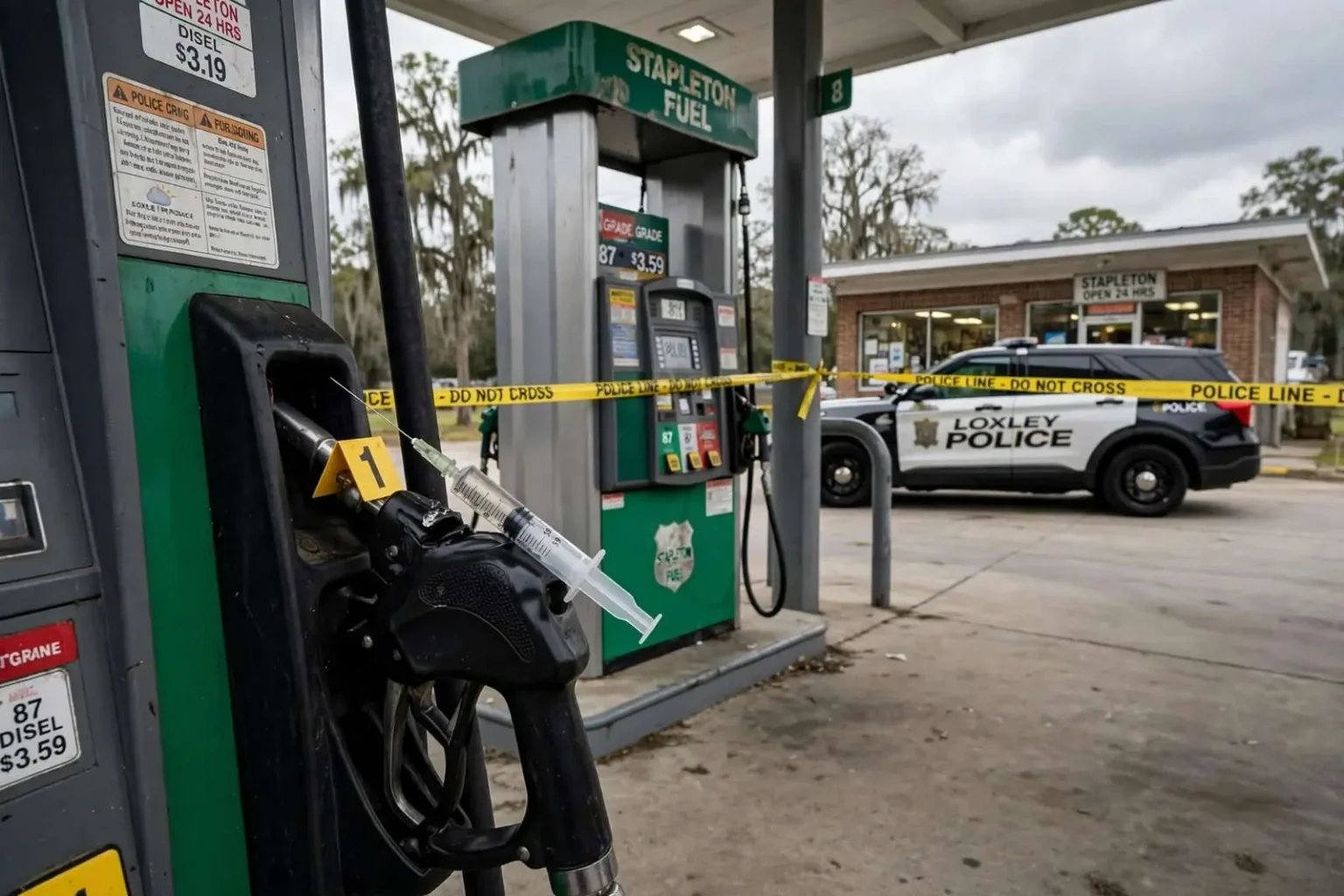
A motorist filling up at a Stapleton gas station was punctured by a hypodermic needle that had been left on a gas pump handle, and Loxley police say they are investigating the incident. What began as an ordinary fuel stop in the small Baldwin County community ended with the driver facing the uncertainty that comes with any needle-stick injury — and with a reminder to law enforcement that even the most routine errands carry a risk no one expects.
According to the Loxley Police Department, the driver was stuck in the hand or finger area while gripping the pump handle, an encounter that turned a routine fuel stop into a potential health scare. The palm and fingers are among the most exposed parts of the hand when someone grabs a handle, and a puncture in that area can go deep enough to break skin before a person even realizes what has happened. The motorist’s injury underscored how quickly a situation like this can unfold: there is no warning, no time to pull away, and no way to know what the needle may have been exposed to before it was touched.
Why needle-stick injuries are taken seriously
Needle-stick injuries carry a risk of exposure to bloodborne illnesses, and medical guidance typically calls for prompt washing of the wound and an evaluation for post-exposure treatment. Health care workers have long treated needle-sticks as serious occupational hazards for exactly this reason, and the same principles apply to anyone stuck by a discarded or abandoned syringe. Washing the area immediately with soap and running water is the first step, followed as soon as possible by a medical evaluation to determine whether preventive treatment is warranted.
The concern centers on viruses that can be transmitted through blood, including hepatitis B, hepatitis C and HIV. Not every exposure results in infection — transmission depends on the depth of the puncture, the amount of blood involved and the status of the source — but doctors prefer to assess the situation quickly because some preventive measures are time-sensitive. Post-exposure evaluation may include blood tests, vaccination decisions and, in some cases, a course of preventive medication. Follow-up testing over the following weeks and months is often recommended to confirm that nothing was transmitted.
Medical providers in Baldwin County and along the Gulf Coast are familiar with these protocols, and anyone stuck by a needle of unknown origin is generally advised to seek care the same day rather than wait to see whether symptoms develop.
Investigation underway
Police have not said whether they believe the needle was left on the pump deliberately or accidentally, and no arrests had been reported in connection with the case. Investigators are working to determine how the needle came to be on the handle and whether anyone placed it there intentionally. That distinction matters both for the potential criminal exposure and for how the department warns the public: a discarded syringe that rolled onto a handle is a hazard, but a needle deliberately positioned where a driver’s hand would land would be treated as something far more serious.
The investigation also involves practical steps that may not be visible to the public. Officers can review the station’s surveillance footage to see who used the pump before the injury, check whether other drivers reported anything unusual, and canvass the area for witnesses. Gas stations along the Baldwin County corridor keep camera systems over their fuel islands precisely because incidents there — fuel thefts, hit-and-runs, and occasional tampering — are among the most common they are called on to document.
In the meantime, the incident serves as a reminder for drivers to give pump handles and other high-touch surfaces a quick visual check before grabbing them. The habit takes only a second, and it applies to more than fuel islands: door handles, keypad surfaces and anything in public that dozens of hands touch each day deserve the same glance.
Stapleton and the Loxley policing connection
Stapleton is a small community in central Baldwin County, one of the fast-growing county’s quieter pockets compared with the booming beach communities to the south. Its gas stations serve local residents and drivers moving along the area’s connecting highways, and incidents there rarely draw the attention that a similar event in Mobile or Pensacola would. That is part of what made this one notable: a hypodermic needle on a pump handle is out of place anywhere, and especially so at a neighborhood station where many customers are regulars.
The Loxley Police Department’s role reflects how law enforcement is organized in that part of Baldwin County, where smaller municipalities and unincorporated communities rely on nearby city departments, the Baldwin County Sheriff’s Office, or both depending on the location. Loxley is one of the county’s established inland towns, and its department handles investigations that cross into surrounding communities as jurisdiction requires. For a case like this, that means the department coordinates with the gas station’s management, preserves any footage before it is overwritten, and documents the injury scene while physical evidence is still available.
Investigators have not released a timeline for the inquiry, and departments generally avoid speculating in the early stages of a case like this. Anyone with information about the incident, or who may have noticed something at the station before the injury was reported, can contact the department directly.
What to do if it happens to you
The protocol for a needle-stick injury is straightforward, and knowing it in advance removes the hesitation that often costs time. First, wash the puncture with soap and running water — do not scrub hard or squeeze the wound, which can drive material deeper into tissue. Second, seek medical attention promptly, ideally the same day, so a provider can evaluate the exposure and decide on testing or preventive treatment. Third, report the incident to law enforcement, both so there is a record and so investigators have the best possible chance of identifying how the needle got there.
If the needle itself is still present and safe to avoid, leaving it undisturbed can help investigators; if it poses a risk to others, it can be placed in a rigid container rather than handled bare-handed. Never recap or carry a loose needle in a pocket or purse. Workers who find discarded syringes on the job — custodial staff, maintenance crews, gas station attendants — should use gloves and proper disposal containers, and employers in Alabama are required to follow bloodborne pathogen standards that cover exactly these situations.
Drivers who spot something suspicious on a pump — a needle, tape, a loose fitting or anything that does not belong — should notify the station attendant immediately and, if they believe it was placed deliberately, report it to police. The same advice applies to card skimmers and other tampering: the people who use these stations daily are the ones most likely to notice when something is wrong.
A wider lesson about shared surfaces
Beyond the specifics of this case, the injury is a reminder of how much trust is built into everyday routines. Fueling a vehicle is one of those tasks people perform weekly without a thought, hands closing around the same handle that hundreds of strangers have gripped. Most of the time that trust is repaid without incident, and Baldwin County’s gas stations are not hotspots of danger. But the episode shows why a moment of attention — a look at the handle before lifting it, a glance at the keypad before entering a PIN — costs nothing and can spare a family weeks of worry and medical follow-up.
For the motorist who was injured, the immediate medical steps were the priority; for everyone else, the case stands as a low-cost lesson delivered at someone else’s expense.
How departments handle these investigations
When police investigate an abandoned or planted needle, the early questions are usually the same ones Loxley officers are asking now: Was the needle visible in a place a person could have missed it, or was it positioned where contact was nearly guaranteed? Does the station’s footage show anyone lingering at that pump? Have there been similar reports in the area? Answers to those questions determine whether the case is closed as an accident or pursued as a crime, and they shape how much the department emphasizes a public warning.
Departments that conclude a hazard was placed intentionally typically treat it with the gravity of an assault investigation, because the act itself — leaving a contaminated sharp where an unsuspecting person’s hand will land — is what creates the danger, regardless of whether infection ultimately occurs. Baldwin County agencies have handled scattered reports of discarded syringes in public places over the years, a pattern seen in communities nationwide as loose needles have become an occasional byproduct of drug use, but a needle found on a pump handle remains rare enough that it generates attention well beyond the immediate area.
The gas station itself plays a role in the aftermath as well. Attendants can walk the fuel islands on their regular rounds, station owners can add the pumps to their camera coverage checks, and management can brief staff on what to do if a customer reports an injury or a suspicious object. Those steps cost little and are the kind of preventive habit that keeps a single incident from defining how customers feel about a business.
Bloodborne exposure in plain terms
Much of the fear around needle-sticks comes from uncertainty, so it helps to be clear about what the actual risks are. Exposure to hepatitis B is considered the most efficient of the bloodborne transmissions, which is why vaccination — a routine part of medical care — is so valuable; people who are vaccinated carry protection that removes most of the worry from any future exposure. Hepatitis C, which was once difficult to treat, now has highly effective cure rates with modern antiviral therapy, though treatment decisions rest with a physician. HIV transmission from a single community needle-stick is statistically uncommon, and preventive medication started quickly can further reduce the risk. None of this makes an injury trivial — it makes medical follow-up worthwhile rather than hopeless.
Doctors also counsel patients about the ordinary things that matter after any puncture wound: keeping the site clean, watching for signs of infection such as redness and swelling, and staying current on tetanus protection, which is a separate concern from bloodborne viruses. A tetanus booster may be recommended depending on when the patient was last vaccinated, since puncture wounds are among the injuries most associated with that risk.
For family members who are helping someone through the aftermath, the practical support is logistical — rides to appointments, help keeping up with follow-up testing schedules, and patience while results come back. The medical system handles these exposures routinely, and patients who follow the protocols almost always get clear answers within the recommended testing windows.
Staying alert without overreacting
The balance for residents is to absorb the lesson without letting a single incident change daily life. A quick visual check of the pump handle takes a second and becomes automatic with practice. Reporting anything unusual to the station or the police costs nothing and helps agencies see patterns across multiple locations. And knowing the first steps after any needle-stick — wash, get evaluated, report — turns a frightening surprise into a manageable medical situation.
Loxley police have not said how long their investigation will take, and updates will come through the department if there is a development. In the meantime, the case gives Gulf Coast drivers one more reason to keep their eyes open at the fuel island — and one more reason to be glad they did.