
National Shrimp Festival 2011: Fine Artists Steal the Show in Gulf Shores
A look back at the 2011 National Shrimp Festival in Gulf Shores: fine artists Joe Sheffield, Jeff Libson, Steve Dark and the craft booths that lined the.
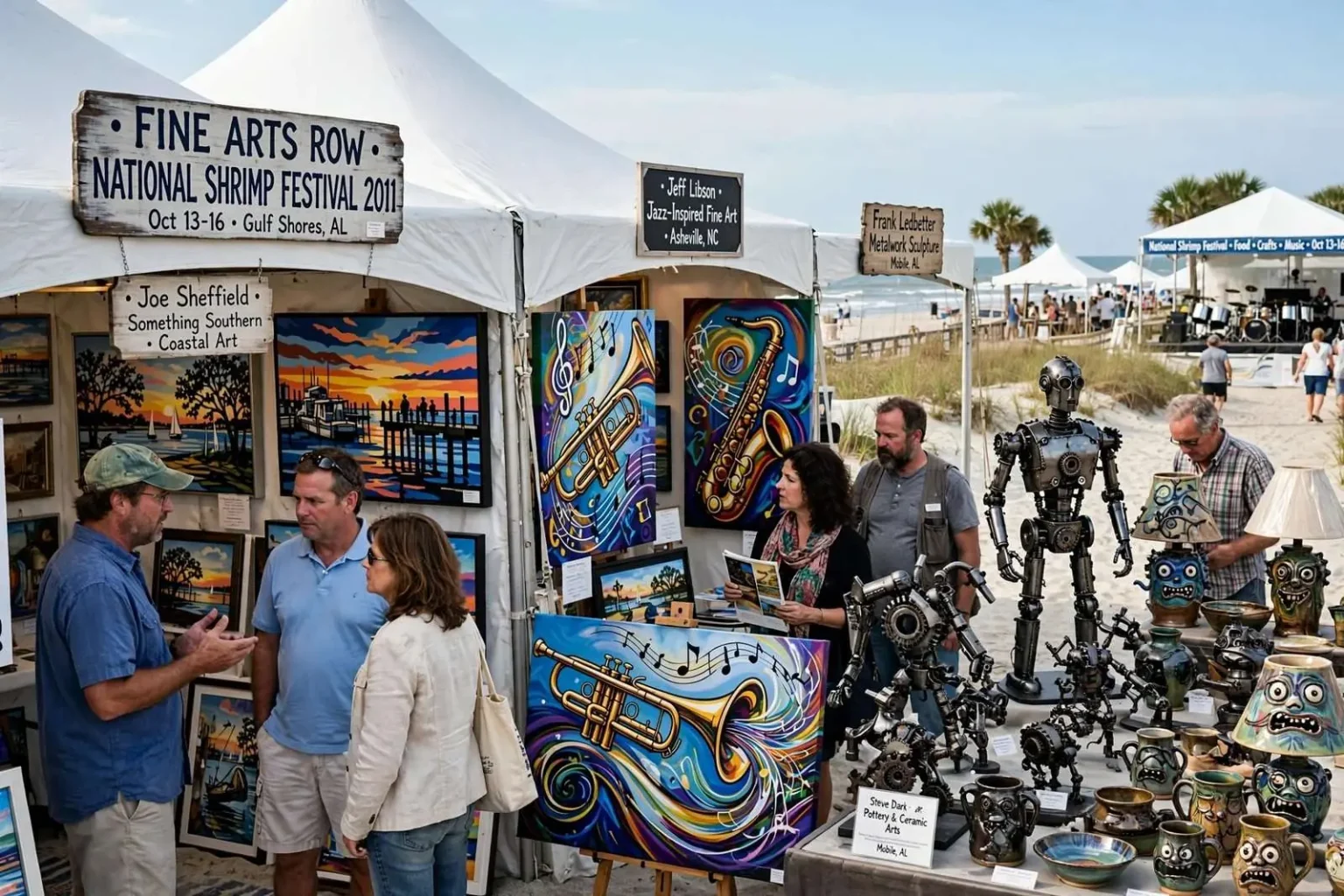
The Annual National Shrimp Festival drew its usual crowds of locals and winter visitors to Gulf Shores in mid-October 2011, with boardwalk food vendors and steel-drum stages flanking the event’s two main art sections — a sprawling arts-and-crafts area and a quieter fine-arts row that wound past the festival stages. For the artists who return to the festival year after year, the October edition is the crown jewel of the coastal show circuit, a four-day gathering that transforms the beach into one of the largest outdoor galleries on the Gulf.
The festival’s layout has long split its art offerings into two distinct worlds. The arts-and-crafts area, nearest the food court and the main stages, hums with the carnival energy the Shrimp Festival is famous for; the fine arts row, a little removed from the bustle, offers a slower browsing pace where collectors linger and artists talk. Both sections filled the sand behind the boardwalk, with steel-drum bands and festival programming providing the soundtrack that makes the Gulf Shores event unlike any other show in the region.
Standouts in the Fine Arts Section
Daphne painter Joe Sheffield, working under his Something Southern banner, showed acrylic coastal scenes drawn from Daphne, Fairhope and Gulf Shores, pairing vivid backgrounds with crisp silhouettes of piers and fishermen for a clean, almost graphic quality. Sheffield’s Eastern Shore subjects — the bayfronts, boat docks, and sunset skies of Baldwin County’s oldest communities — translate naturally into his high-contrast style, and festivalgoers recognized views they see every day rendered in colors bolder than nature provides.
Frank Ledbetter exhibited gnarled robotic metalwork sculptures, while Chris Hartsfield’s photorealistic paintings took on Southern subjects from Maker’s Mark tumblers to Alabama football imagery. Ledbetter’s welded figures — assembled from scrap metal into improbable, mechanical poses — drew the steady stream of amused inspection that such work invites, while Hartsfield’s near-photographic canvases found their audience among fans of Southern iconography and gift-worthy Alabama themes.
Among the most talked-about pieces were Jeff Libson’s jazz-inspired bursts of acrylic color, with swirling lines of musical notation erupting from brass-instrument bells. Libson said he spent roughly 20 years teaching jazz composition in Miami before settling in Asheville, North Carolina, and taking up visual art as a second act informed by improvisation.
The musical roots show. Libson’s canvases treat a trumpet or saxophone the way a composer treats a melody line — the instrument’s bell opens onto streams of color and handwritten notation that spill across the painting like a solo taking flight. Collectors who stopped at his booth described the work as synesthesia in acrylic, and the artist himself frames the paintings as translations: the same instincts that once shaped a classroom of jazz students now shape his brushwork, with each canvas composed around rhythm, repetition, and the visual equivalent of a rising phrase.
His path from Miami music rooms to Western North Carolina studios and Gulf Coast festivals is a familiar one among working festival artists — a first career that ends, a move to a smaller city, and a second act built on the skills the first one taught. At the Shrimp Festival his booth drew some of the strongest word-of-mouth of the fine arts row, with festivalgoers doubling back for second looks at pieces they had passed an hour before.
A familiar face from Mobile
Gulf Shores potter Steve Dark — an art appreciation instructor who also keeps a downtown studio and shows regularly at Mobile’s monthly art walks — displayed his eerie, cartoonish functional claywork, including lamp designs with expressive monster faces. Dark’s pieces walk a line that few ceramicists attempt: the work is genuinely useful, thrown and glazed with the care of a production potter, but the faces leering from the lamp bases and vessel walls give it a personality that ranges from mischievous to unnerving.
Dark is a fixture on the regional circuit, splitting his time between the classroom, his studio, and the art walks that have become a monthly ritual in downtown Mobile. Lower Dauphin Street galleries and studios open their doors on those evenings, and Dark’s claywork has been part of the scene long enough that Mobile art walkers stopping by his Gulf Shores booth greeted him like a neighbor. For the Shrimp Festival, the home-crowd advantage is real — Baldwin County and Mobile residents make up a large share of the October audience.
His booth was briefly displaced during the festival to make room for other programming, a common frustration for artists paying booth and business fees at large coastal events. The disruption was resolved without lasting harm to Dark’s weekend sales, but it illustrated the behind-the-scenes tensions of a festival that has grown into one of the Gulf Coast’s biggest events: every square yard of beachfront at the footprint is claimed by someone — a vendor, a stage, a sponsor, or an artist who paid for the spot.
Booth fees and jurying costs add up quickly on the festival circuit, and artists who travel the Southeastern show season budget their calendars around a handful of anchor events like Gulf Shores. A displacement, even a brief one, costs foot traffic at the hours when the crowd is heaviest, which is why veteran artists scout their assigned spots early and lobby organizers when the layout shifts mid-show. Most festivals have tightened their site maps in recent years precisely to avoid such conflicts as sponsor activations and performance programming claim more ground.
The crafts side of the sand
The crafts side offered the expected shrimp-themed kitsch alongside more serious work: potters selling lamps and vases, bottle trees and feeders, and a Native American trio playing guitar, mandolin and pan flute between sets. The bottle trees — a Southern garden tradition said to trap evil spirits in their colored glass — drew browsers in the garden-art category, while the potters’ tables offered the functional ware that keeps local audiences coming back each October to replace what broke during the year.
The musical lineup on the crafts side gave that end of the festival its own character, with the trio’s blend of guitar, mandolin, and pan flute drifting over the aisles between the officially scheduled stage acts. Festival organizers have long mixed regional and touring performers across multiple stages, and the smaller acoustic sets scattered through the vendor areas are as much a part of the Shrimp Festival’s atmosphere as the headliners.
Of course, no account of the Shrimp Festival’s crafts area ends without the shrimp itself — the theme that drives the entire event. Vendors sold the expected tide of crustacean merchandise, from novelty signs and coastal décor to jewelry and painted driftwood, alongside the food stands that give the festival its name and draw tens of thousands of visitors to the public beach each October.
A solid October on the beach
Attendance was brisk but thinner than the spring Hangout Festival crowds, and the October weather cooperated where the May event’s heat had not. The comparison between the two Gulf Shores festivals is a perennial one: the Hangout Music Festival packs the same stretch of beach in May with a national touring lineup and a younger audience, while the Shrimp Festival draws a broader demographic — families, retirees, and the winter visitors whose arrival along the Alabama coast each fall marks the start of the tourism high season.
For the fine artists, that audience difference matters. October browsers skew toward collectors and second-home owners furnishing coastal homes, a buying public that spends on original work rather than souvenirs. Artists on the fine arts row reported steady sales through the weekend, buoyed by cooler temperatures that kept visitors on the sand past sunset — a contrast to the punishing heat that often drives the May crowds off the beach by early afternoon.
The festival closed out another October with its familiar formula intact: shrimp by the ton, music by the stage-load, and a fine arts row that has quietly become one of the most respected outdoor shows on the northern Gulf Coast — proof that the Shrimp Festival’s cultural reach extends well beyond the food court.
The economic footprint of the Shrimp Festival extends well past the beach. Gulf Shores restaurants, hotels, and retailers count the October weekend among their busiest of the fall, and the artists and crafters who fill the footprint pay booth fees that help fund the festival’s operations each year. City officials have long described the event as a bookend to the tourism season — the weekend that ushers the year’s final wave of visitors onto the island before the quieter winter months, when the seasonal residents and snowbird crowd take over.
The festival’s art sections have grown alongside that tourism economy. What began decades ago as a modest seafood celebration now fields a juried fine arts show whose exhibitors travel from across the Southeast, competing for the same October dates they might spend elsewhere — Atlanta, Fairhope, Orange Beach — with Gulf Shores consistently ranked among the stops worth the trip. Artists plan their entire fall around invitations to shows of this scale, and the ones who return to Gulf Shores year after year cite the beach setting, the organized layout, and the buying crowd as reasons the Shrimp Festival anchors their season.
Why the fine arts row keeps growing
The quiet success of the fine arts section reflects a shift in what coastal festival audiences expect. A generation ago, beach festivals meant craft booths and little else; today’s audiences arrive expecting original paintings, sculpture, and studio pottery alongside the shrimp-themed merchandise, and the Shrimp Festival’s organizers have expanded the fine arts footprint to meet that demand. The row that wound past the festival stages in 2011 carried work ranging from the high-contrast coastal canvases of Joe Sheffield to the welded sculpture of Frank Ledbetter — a spread of media and price points designed to let a family browse for a $30 print while a collector considers a several-hundred-dollar original.
That range is deliberate, and it mirrors the strategy of the strongest outdoor shows nationwide: keep the crowd broad, and the sales follow. The 2011 edition bore that out, with the fine arts row drawing steady traffic through all four days and the crafts area carrying its own dependable sellers — the potters, the garden-art makers, and the vendors whose shrimp-themed inventory has become as much a part of the festival’s identity as the food.
As the crowds headed home on the festival’s final afternoon, the artists packed their booths into vans and trailers for the drive to the next show on the circuit — Sheffield back across the bay to Daphne, Dark back to his Gulf Shores studio and the next Mobile art walk, Libson on to the next festival in a season that runs through the holidays. The Shrimp Festival had done what it does every October: turned a stretch of Alabama beach into a gallery, a concert venue, and a seafood hall all at once, and sent the Gulf Coast’s artists home with a weekend worth repeating.