New lights brighten Herndon Park as Mobile police and fire face off on the court
Mobile police and firefighters tipped off at Herndon Park on Sage Avenue to celebrate new court lighting that extends play time and boosts neighborhood.
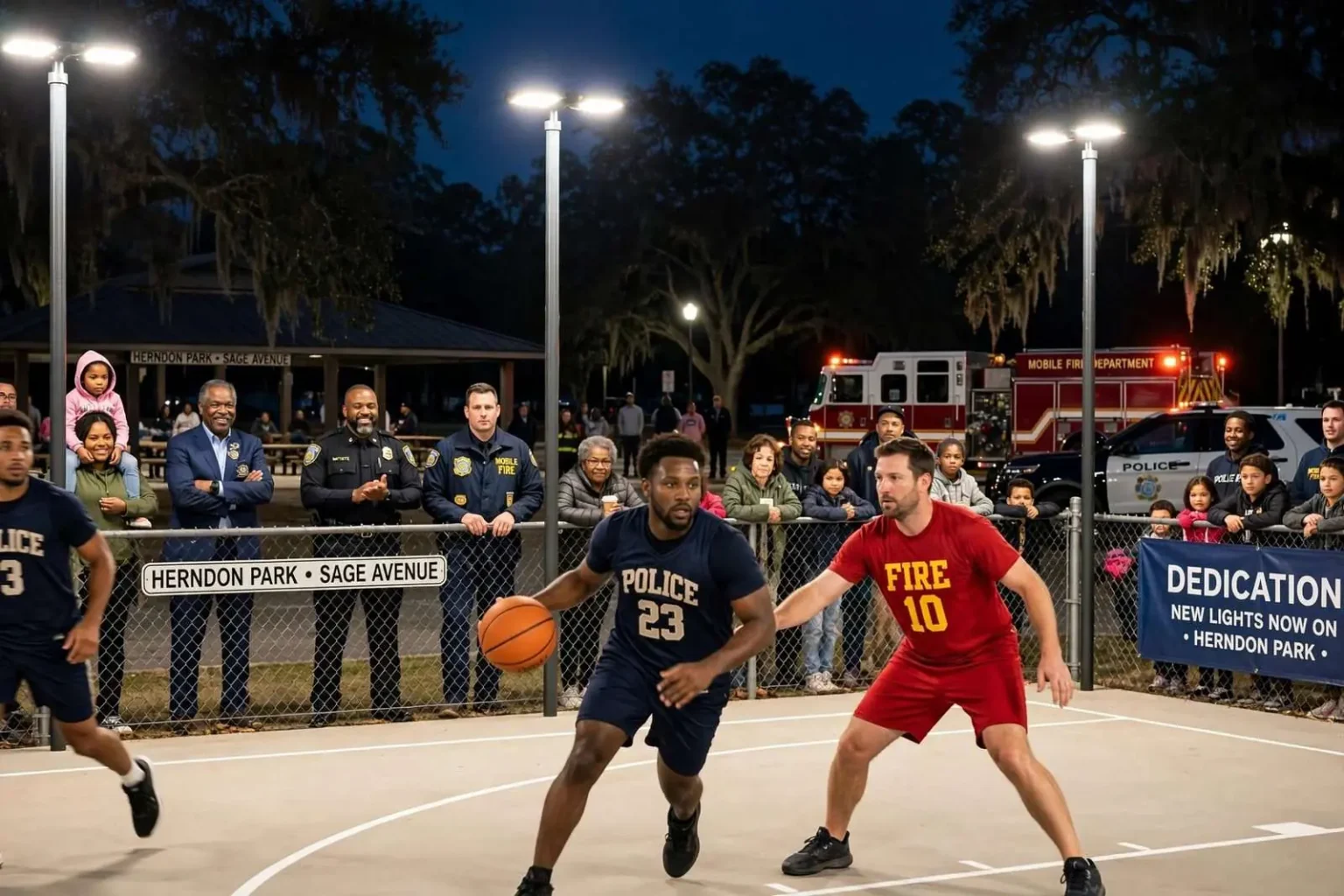
MOBILE, Ala. — Mobile police and firefighters traded uniforms for jerseys this week, squaring off on the basketball court at Herndon Park on Sage Avenue to show off newly installed lighting. The game was equal parts dedication ceremony and community gathering, staged to demonstrate to the neighborhood that the court’s new lights mean the park can be used after dark — extending hours for pickup games, youth leagues and everything else that happens on a neighborhood court when the sun goes down.
The new lights mean the court can be used after dark, a change that transforms the park’s daily calendar. In practice, lighting is the difference between a park that empties at dusk and one that stays alive through the evening — parents walking over after dinner, teenagers with a place to be, coaches running practices that no longer end at 5:30 in winter. For a city that has invested heavily in its parks system, the addition is the kind of improvement residents notice immediately.
District 1 Councilman Fred Richardson, who said the project had been about two years in the making, called seeing the lights switch on “a dream come true.” The timeline he described reflects the reality of municipal improvements: funding has to be identified, contracts let, and electrical infrastructure built before the first bulb ever glows. Richardson, one of the longest-serving members of the Mobile City Council, has represented the district that includes Herndon Park through years of advocacy for neighborhood infrastructure on his side of the city.
The Game Itself
The choice of a police-versus-fire basketball game for the dedication was no accident. Matchups between the departments are a staple of civic life across the Gulf Coast, drawing crowds of families, coworkers and neighborhood kids who line the fence to watch sworn officers and firefighters compete at something other than their jobs. At Herndon Park, the game put the departments on the new court under the new lights — testing the illumination in real conditions while giving the community a reason to come see it.
Mobile Police Chief Lawrence Battiste said the lighting gives local children more time on the court and helps keep them engaged in positive activity. “As long as they’re out here playing ball, that’s usually a good thing,” he said. The sentiment reflects a philosophy shared by police departments nationwide: structured recreation competes directly with the idle hours and street corners where juvenile trouble starts, and every additional hour a park is usable is an hour the neighborhood’s children have somewhere constructive to be.
Battiste also pointed to a public-safety benefit, saying added lighting gives the surrounding community “a sense of security” and can help deter crime. The principle is well established in crime-prevention practice — dark, unused public spaces invite problems, while lit, active ones discourage them. A court full of players and spectators is its own form of surveillance, and the lights extend the hours during which that informal guardianship operates.
Herndon Park and Its Neighborhood
Herndon Park sits along Sage Avenue in the part of the city Richardson has represented for decades, a neighborhood park in the tradition of Mobile’s network of community recreation grounds. Parks like it carry a particular weight in the city’s neighborhoods: they are where summer leagues play, where pickup games run year-round in the mild Gulf Coast climate, and where the park’s condition is read as a barometer of the city’s commitment to the neighborhood around it.
When a park’s lights fail or its courts fall into disrepair, residents notice; when the city reinvests, the message travels just as fast. The two-year project Richardson described thus represents more than a lighting retrofit — it is a visible answer to the question every neighborhood asks about its public spaces. The dedication game, with police and firefighters on the court, made that answer public in the most literal way: here are your departments, on your new court, under your new lights.
The chief’s joke that the police and fire departments were simply there to enjoy the game landed as more than a throwaway line. Departments that show up to play — rather than merely to stand in uniform at a ribbon-cutting — meet the neighborhood as people, and the basketball court has long been one of the few places where an officer and a teenager meet as equals. Battiste’s department has emphasized community engagement throughout its recent history, and a game at a neighborhood park fits that mission as snugly as any formal program.
Why Park Lighting Pays for Itself
Lighting projects like Herndon Park’s are among the highest-return investments a city can make in its recreational infrastructure. A court already exists; lights simply unlock the hours between sunset and closing that the Gulf Coast’s early winter darkness would otherwise erase. Compared with building new facilities, extending the usable hours of existing ones is inexpensive, and the benefits compound: more league time, more informal play, more informal supervision of the park after dark.
The security dimension Battiste described works alongside the recreational one. Studies of park design consistently find that active, well-lit spaces experience less vandalism and fewer incidents than dark ones — the presence of people is the most reliable deterrent there is. Lighting that draws families to a park in the evening effectively staffs the park with its own users, and the sense of security that neighbors feel walking past a lit court is part of the return on the city’s investment.
For the children Battiste mentioned, the extended hours arrive at a valuable age. Youth sports researchers have long connected access to courts and fields with everything from physical health to academic engagement, and in a city where summer heat pushes play toward the evening hours anyway, lighting is what makes evening play possible at all. A teenager who has somewhere to be at 8 p.m. — a team, a game, a coach who notices absence — has a protective factor that statistics on juvenile crime quietly confirm.
The Council District’s Investment Pattern
Richardson’s district, stretching across much of central and north Mobile, contains a dense network of neighborhood parks, and the councilman has built a career on steering improvements to them — new equipment, resurfaced courts, upgraded facilities — block by block. The Herndon Park lighting fits that pattern, and the two-year timeline he cited is typical of the council’s funding process, in which capital improvements are budgeted, engineered and contracted over successive fiscal years.
Council districts in Mobile operate under a system that gives each member significant influence over capital spending within his or her district, which is why park improvements often arrive as a result of a specific councilman’s advocacy. Richardson’s presence at the dedication — and his “dream come true” description of the moment — underlined that ownership. For residents of the Sage Avenue area, the project is proof that advocacy at City Hall translates into floodlights at the neighborhood court.
The departments’ participation in the dedication completed the circle. Police Chief Battiste’s remarks tied the lights to engagement and safety; firefighters filled out the roster on the court; and the neighborhood got both a show and a message. Parks, police and fire — three arms of city government — converged on a single court on Sage Avenue to say the same thing in different ways: this space belongs to you, it is safer now, and it will be open longer.
What Comes After the Lights
Dedications mark beginnings more than endings. The test of the Herndon Park project will be written over the coming seasons — in the leagues that extend their schedules, the pickup games that now run under the lights, the evenings the court stays busy instead of empty. Richardson’s two-year effort and the city’s investment will be measured in those ordinary evenings, one game at a time.
For Mobile’s neighborhoods, the project offers a template. Lighting, resurfacing and basic upgrades to existing parks deliver outsized returns for the cost, and the dedication game showed how to celebrate them properly — with the people who will use the space and the departments sworn to serve them. As long as they’re out here playing ball, as the chief put it, that’s usually a good thing.
A Closer Look at the Dedication Evening
The dedication evening carried the texture of a small-town event in the middle of a city. Folding chairs lined one sideline, residents greeted the councilman and the chief between whistles, and children who normally watch their elders talk about park improvements got to watch those same officials miss layups on the new court. Events like this one succeed precisely because they blur the line between ceremony and recreation — the speeches are short, and the game is long.
For the police officers and firefighters on the rosters, the game is a working night of a different kind. Departmental athletic rivalries stretch back generations in Mobile, and the competitive fires burn as hot at a neighborhood park as they once did in department gyms. The crowd gets the show, the departments get the camaraderie, and the park gets a packed house on its first lit night — three results from one scoreboard.
Battiste’s presence on the sidelines was consistent with his broader approach to the chief’s job, which has emphasized getting officers out of their vehicles and into conversations with residents. A basketball game at Herndon Park accomplishes what a community meeting often cannot: it draws the families who would never attend a forum but will come to watch a game, and it lets officers connect with the neighborhood’s children over something they all enjoy.
The Economics of a Two-Year Project
The two-year timeline Richardson described is worth unpacking, because it explains why park improvements generate such anticipation in their neighborhoods. Municipal lighting projects pass through budget hearings, engineering assessments, procurement rules and contractor scheduling before the first trench is dug, and electrical work at a park must account for trenching, conduits, poles, fixtures and controls that will survive Gulf Coast weather — hurricanes, humidity and lightning included.
That patience is also what makes the result durable. Lighting installed to municipal standards runs for decades with routine maintenance, which means the children playing under the Herndon Park lights this season will likely be bringing their own children to the same court in twenty years. Capital projects of this scale are bets on a neighborhood’s future, and the city’s willingness to make them in established neighborhoods like the Sage Avenue area is its own signal of confidence.
Richardson’s “dream come true” reflected that patience rewarded. Council members hear the same requests year after year — fix this court, light that field — and each delivered project represents a promise kept after the long municipal middle passage between request and ribbon-cutting. For the residents who asked, the two-year wait ended the moment the switches were thrown and the court glowed.
The Neighborhood’s Return
The returns to the neighborhood are both measurable and not. Recreation departments can count league registrations and facility hours; police can track calls for service around a park. But the quieter returns — teenagers with somewhere to be, parents who feel safe walking to the court at night, a park that anchors community life instead of fading at dusk — resist measurement even as they accumulate.
Mobile’s park system serves a city whose mild climate makes outdoor recreation possible nearly year-round, and every improvement to that system multiplies across the calendar. A lit court in January does what no summer program can: it keeps neighborhood life going through the seasons when darkness falls before dinner. That is the quiet achievement celebrated at Herndon Park this week — police and firefighters played the game, the lights stayed on, and the neighborhood watched its park become, in the plainest sense, more its own.
The departments joked that they were just there to enjoy the game. The neighborhood knew better. The game ended, the visitors went home, and the lights stayed on — night after night, exactly as the councilman had dreamed and the chief had hoped, for every child on the court and every neighbor who can now see, plainly, that the park is alive after dark.