
New Orleans Royalty at the Saenger: Allen Toussaint and Irma Thomas Bring Six Decades of Soul to Mobile
New Orleans legends Allen Toussaint and Irma Thomas brought six decades of soul classics to Mobile's Saenger Theater on April 2, 2011.
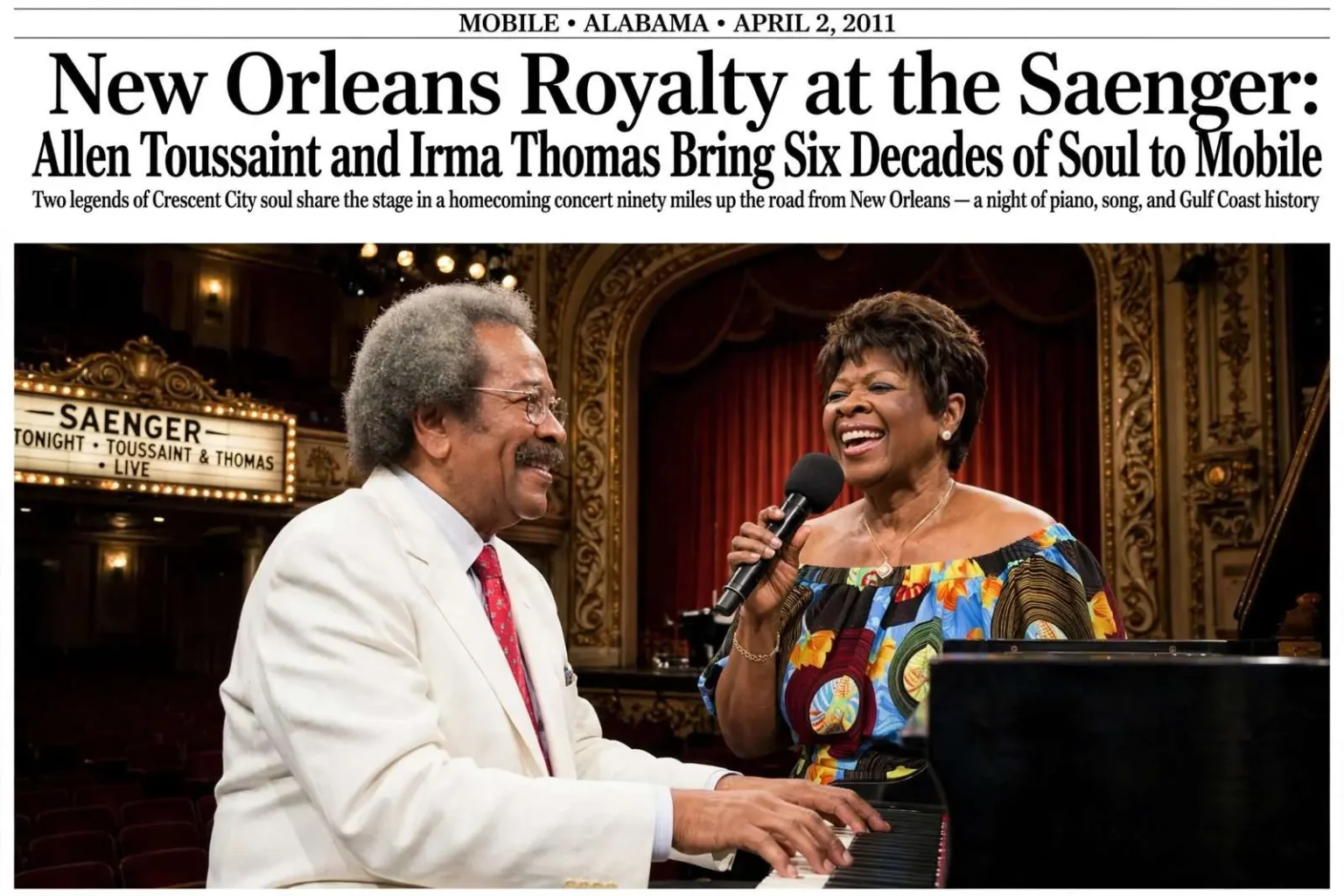
MOBILE, Ala. — Few bills could match the pedigree that landed at Mobile’s Saenger Theater on Saturday, April 2, 2011, when New Orleans piano legend Allen Toussaint shared the stage with Irma Thomas, the Soul Queen of New Orleans. A Saturday night of pure Crescent City soul ninety minutes up the road from its source, the pairing brought two artists whose careers have shaped American music for six decades to one of the Gulf Coast’s grandest rooms — and for a Mobile audience, it was in every sense a homecoming show.
The Saenger itself is a fitting venue for such a bill. The 1920s movie palace on Joachim Street, restored and reopened after years of post-storm recovery, has served as downtown Mobile’s showcase for touring legends, Broadway tours and symphonic nights, and its ornate proscenium has hosted generations of performers who came up through the New Orleans music scene just across the lake. Toussaint and Thomas belong in that company — both are artist laureates of a city whose musical tradition runs through Mobile like a tributary of the same river.
A songbook that reads like a history of American pop
Toussaint’s songbook alone reads like a history of American pop and soul. He wrote “Working in the Coalmine,” a groove so durable that Devo later covered it, along with “Southern Nights,” taken to the top of the charts by Glen Campbell in one of the decade’s most beloved crossover hits. His catalog reaches into nearly every corner of popular music: “Yes We Can Can” became a signature for the Pointer Sisters; “Sneakin’ Sally Through the Alley” was recorded by Robert Palmer and by Ringo Starr; “On Your Way Down” was cut by everyone from The Doors to Phish and Widespread Panic, making it a standard on both the album charts and the jam-band circuit.
The reach does not stop there. “Get Out of My Life Woman” has been heard from Jerry Garcia’s band, and “Fortune Teller” was taken on by the Rolling Stones, The Who, and Robert Plant with Alison Krauss — a spread of interpreters across rock, blues and bluegrass that few songwriters in any genre can claim. When an artist of that stature sits down at the piano in a theater the size of the Saenger, the concert carries the weight of a catalog audience already knows by heart, even the songs they did not know were his.
An Alabama starting line
Toussaint’s break came early — and, fittingly for a Mobile audience, in Alabama itself. At 17, he got his first big shot sitting in for Huey Smith at a performance with Earl King’s band in Prichard, just across Mobile Bay from the theater where he now headlined. That substitution gig launched a career that would define the sound of New Orleans rhythm and blues, first as a session pianist and arranger at Cosimo Matassa’s studios and later as a producer and label executive shaping the city’s greatest records.
His session work and production ran through decades of New Orleans music, including collaborations with Paul McCartney, Elvis Costello, and The Band. Toussaint’s horn arrangements and piano work became the connective tissue of the city’s sound, and his work with Costello — particularly the celebrated collaboration that paired the New Orleans rhythm section with the British songwriter — introduced his catalogue to yet another generation of listeners. For a performer whose roots include a formative night in Prichard, a Saenger appearance carried a personal geography: the young sideman who got his chance across the bay returned as a master whose songs had crossed every border in popular music.
The Soul Queen of New Orleans
Sharing the bill was Irma Thomas, whose stature in New Orleans music is every bit as tall. Thomas, whose hits include “It’s Raining” and “Ruler of My Heart,” has been covered by countless international artists across her career and remains one of the Gulf Coast’s most revered voices. “Ruler of My Heart” in particular became a foundation stone of soul music when it was reinterpreted as “Pain in My Heart,” helping to carry the New Orleans sound into the national bloodstream, and “It’s Raining” endures as one of the great declarations of the genre — a record that generations of singers, in New Orleans and far beyond, have learned from.
Thomas’s career has run from the rhythm-and-blues clubs of the early 1960s through decades as the matriarch of the city’s music scene, and her live performances have long been regarded as the standard by which New Orleans soul singing is measured. She built her reputation the old way — show by show, record by record — and a Gulf Coast audience at the Saenger represented territory she has worked her entire life: the coastal corridor where Louisiana and Alabama share the same musical dialect.
Two cities, one musical tradition
The Mobile-New Orleans connection gives a bill like this special resonance. The two port cities share a Mardi Gras tradition older than any in the country, a Gulf Coast geography, and a musical lineage that has always moved back and forth across the state line — from the Gulf Coast chitlin-circuit clubs to the studios of Rampart Street. Prichard, where Toussaint’s career took its first turn, sits a few miles north of downtown Mobile, and the Saenger stage where he played that April night sits squarely in the district where Mobile’s own rhythm-and-blues history was made.
For local fans, the concert was a rare chance to see the two traditions in one seat: Toussaint the composer whose melodies other artists turned into hits, Thomas the interpreter whose voice made songs her own. The pairing worked because New Orleans soul has always depended on both halves — the writers and the singers, the piano benches and the microphones — and seldom do two figures who embody those halves so completely share a stage in one night.
The Saenger’s role on the Gulf Coast cultural map
The Saenger Theater has long been downtown Mobile’s premier stage for touring artists, and its post-restoration era has seen the venue anchor a revitalized Joachim Street entertainment corridor. A theater of its scale offers something that modern arenas cannot: the intimacy to hear a piano played well and the grandeur to mark a night as an occasion. Shows by artists of Toussaint’s and Thomas’s generation depend on that balance, because their appeal is not spectacle but craft — the phrasing of a singer, the touch of a pianist, the arrangements that make a familiar song sound brand new.
An April Saturday at the Saenger also captures the rhythm of the Gulf Coast cultural calendar. Between the festival seasons that fill Mobile’s spring and the tourism economy that carries visitors along the coast, a night of New Orleans music in Mobile draws audiences from both states — day-trippers from Baldwin County, music fans up from New Orleans, and locals who understand exactly what the bill meant. The concert stood as one of the region’s musical high points of its spring season: two legends, one historic room, and a songbook that needed no introduction on either side of Mobile Bay.
Toussaint’s influence extends into the way records themselves were made. As an arranger and producer, he built the framework that New Orleans artists recorded within, crafting the horn charts and rhythm-section settings that gave the city’s sound its signature lift. Producers and arrangers rarely get their names on the marquee, but their fingerprints are on every record that flows from them — and Toussaint’s fingerprints are on an extraordinary share of the American songbook’s most durable material. An evening at the Saenger therefore doubled as a master class: the audience was hearing not just songs, but the architectural mind behind them.
Thomas’s presence on the bill offered the complementary lesson. Where Toussaint represents the craft of composition and arrangement, Thomas represents the art of interpretation — the way a great singer takes a song and makes it sound like lived experience. Her voice, weathered and authoritative, carries the history of the genre inside it, and audiences who know her records only from playlists often describe hearing her live as a revelation of what soul singing is supposed to be. On the same stage, the two halves of the tradition met in their purest form.
For the Saenger, the booking reflected the venue’s standing on the Gulf Coast touring circuit. Agents routing New Orleans artists through the region have long looked to Mobile as the natural second stop — close enough for the bands, established enough for the audiences, and housed in a theater whose restored grandeur suits veteran performers. A dual-bill of this caliber does not come together often, and its appearance on the Saenger’s calendar underscored the theater’s ability to attract the kind of once-in-a-season pairing that fills a house on reputation alone.
The concert also served as a reminder of how deep the region’s musical roots run. From Prichard’s club stages in the 1950s to the Saenger’s restored auditorium, the lineage that produced Toussaint and Thomas is a Gulf Coast story as much as a New Orleans one — a story of session players, club singers, arrangers and songwriters who built a body of work now owned by the entire world. On that April Saturday, two of its living architects stood in the room where Mobile could thank them properly.


