
No Bond for Man Charged After 5-Year-Old Shot in Mobile’s Farnell Drive Attack
Reginald Pryor faces attempted murder charges after 14 rounds were fired into a car, critically injuring a 5-year-old boy on Farnell Drive.
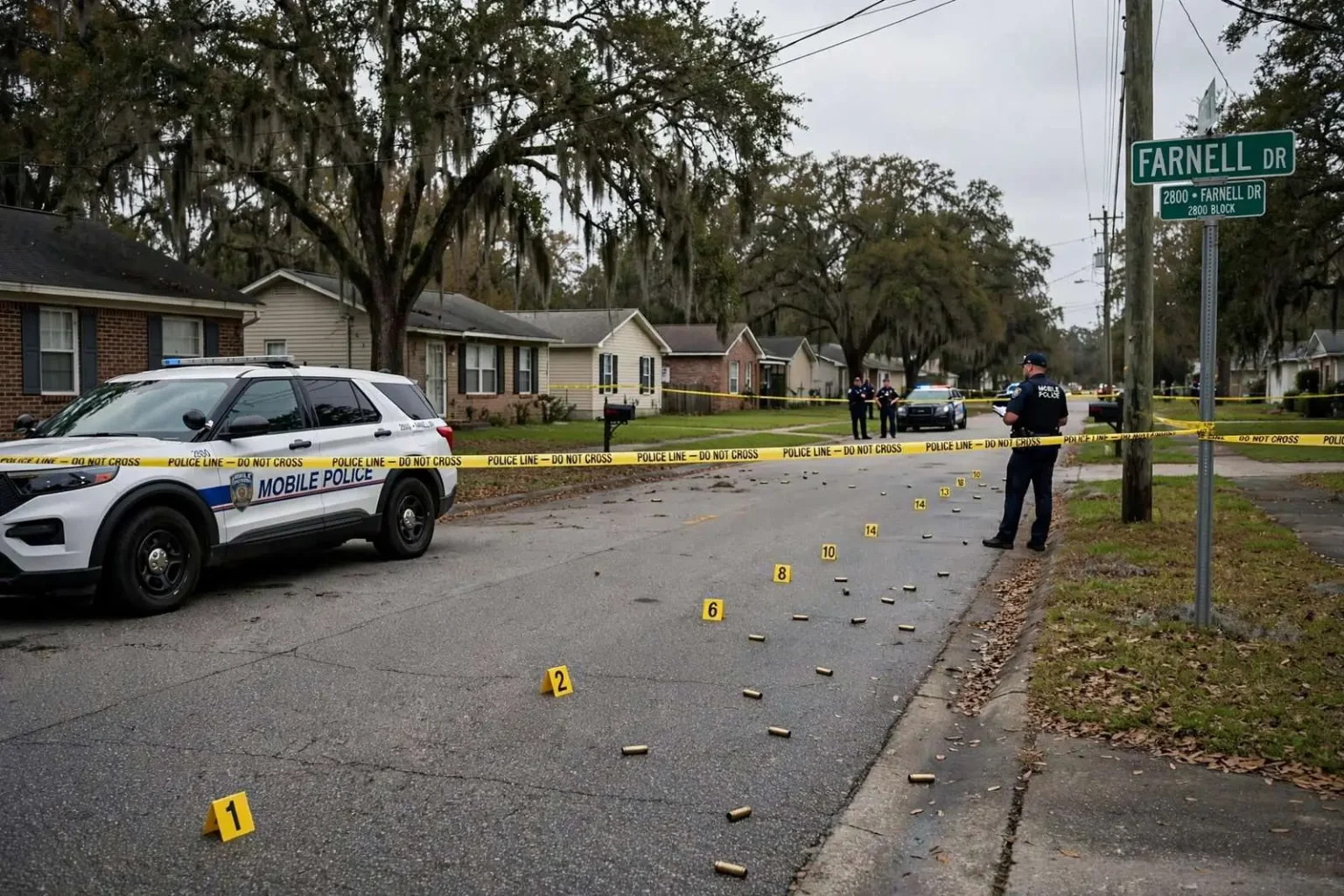
A judge has ordered 21-year-old Reginald Pryor held without bond on charges that he fired 14 rounds into a car carrying a 5-year-old boy, critically wounding the child. The order came after a Tuesday bond hearing in a case that has drawn the city’s attention to a single block of Farnell Drive, where a Saturday evening shooting left a family shattered and a child in surgery.
Gunfire erupted about 5 p.m. on a Saturday on Farnell Drive. Police Chief Lawrence Battiste, who came to the scene himself, said someone sprayed the vehicle with 14 rounds while the boy sat inside with his father, a sibling and another adult. None of the others was hurt.
The child was rushed into surgery Saturday evening and was listed in critical condition. Investigators placed markers beside shell casings scattered along the street as they worked to identify who opened fire, photographing and collecting the spent brass that would later become part of the case against the man now charged with the shooting.
A chief appearing at a crime scene personally is a measure of how seriously the department takes it, and Battiste’s presence on Farnell Drive that evening signaled what the charges now make explicit: a child was shot in his car seat’s neighborhood, and the department committed its resources accordingly from the first hour.
The charges Pryor faces
Pryor was charged with four counts of attempted murder and two counts of firing into a building or vehicle. The arithmetic of the charges tracks the people in the car — four counts of attempted murder for the four occupants, including the 5-year-old — and the firing-into counts cover the act of directing gunfire at an occupied vehicle regardless of whether each shot found its mark.
Attempted murder is among the most serious charges Alabama prosecutors can bring short of a killing, and each count stands separately, meaning a conviction could bring stacked sentences measured in decades or longer. The firing-into charges, though lighter on paper, carry their own prison terms and often serve as the counts that describe what physically happened — rounds into a car, casings on the street — when the attempted murder counts are argued in the abstract.
Court records show Pryor has prior bookings on the same firing-into charges as well as second-degree assault and reckless endangerment. That history — a prior encounter with the same category of gunfire charge — became part of the record the judge weighed when the question of bond arrived.
The bond hearing
At a Tuesday bond hearing, a judge ordered Pryor held without bond and set another court appearance for Monday, March 8. Holding a defendant without bond is a step reserved for the most serious cases, and Alabama law allows it where the proof is evident, the presumption great, and the charge one where release would pose a risk the court is unwilling to take.
The decision reflects more than the charges alone. A 21-year-old with prior bookings for firing into a vehicle, second-degree assault and reckless endangerment, now charged with spraying 14 rounds into a car with a child inside, presented the court with a record that made pretrial release difficult to justify. The without-bond order keeps Pryor in custody through the early stages of the case, beginning with the March 8 appearance.
What the scene told investigators
The 14 rounds and the casings scattered along Farnell Drive gave investigators a physical record of the shooting’s intensity. Fourteen shots fired at a vehicle is not a warning or a stray burst — it is sustained gunfire at a car with four people in it, including two children. The markers investigators placed beside each casing documented where the shooter stood and how the gunfire moved along the street, and the brass itself can link a weapon to a shooting through laboratory comparison.
The family inside the car
The vehicle held a family in the middle of an ordinary Saturday: a 5-year-old boy, his father, a sibling and another adult, and by every account the evening was routine until the gunfire started. The boy took the worst of it — struck and critically wounded — while the others escaped physical harm, and the family’s evening ended at a hospital, where surgeons worked into the night to save the child’s life.
Shootings that wound children land differently in a city’s consciousness, and Mobile’s response followed a pattern residents know from past cases: grief, anger, and calls from city leaders and neighborhood residents for the shooting to be answered. The charges against Pryor arrived within days, and the without-bond order within a week — a pace that reflects both the evidence investigators assembled and the priority the department assigned the case.
The father and the other adults in the car now face the aftermath every family touched by gunfire describes: a child in a hospital, a courtroom calendar, and a long road through a case that will move at the speed of the justice system rather than the speed of their grief.
Farnell Drive and the city’s struggle with gunfire
Farnell Drive sits in a residential stretch of West Mobile where shootings of this kind are rare enough that the sound of 14 rounds would carry from one end of the neighborhood to the other. The shell casings on the street, the markers beside them, and the police tape through the weekend made the block a scene for days, and neighbors who spoke with officers in the aftermath described the same disbelief that follows any shooting where children are the victims.
Chief Battiste has made cases involving young victims a public priority, and his decision to come to Farnell Drive — rather than receive briefings from afar — put the department’s leadership at the scene while the investigation was young. Departments along the Gulf Coast have learned that the first hours and days matter most in shooting cases: witnesses are reachable, cameras still hold their footage, and the neighborhood’s willingness to talk is highest before fear and fatigue set in.
The legal road ahead
Pryor’s case will move through Mobile County’s courts on the track reserved for its most serious charges: an appearance in district court, a grand jury review for indictment, and eventually circuit court, where four counts of attempted murder would be resolved by plea or by trial. The without-bond order means he will await those stages in the county jail rather than at home.
The Monday, March 8 court appearance is the next scheduled step, an early procedural date in a case whose full arc will take months at minimum. Prosecutors will build from the physical evidence — the 14 rounds, the casings, the car — and from whatever witnesses came forward in the days after the shooting, when investigators marked the casings and worked the block.
For now, the court’s answer to the question of release is no: a 21-year-old charged with firing 14 rounds into a car carrying a 5-year-old will stay in custody, and the child he is accused of wounding remains the reason the case will be watched from the first hearing to the last.
How the case came together so quickly
An arrest within days of a Saturday-night shooting requires a fast and disciplined investigation, and the sequence in this case shows the layers working in order. The casings collected from Farnell Drive gave detectives a starting point, the occupants of the car provided accounts of the evening, and the canvass of the neighborhood — door to door, in the days when memories are freshest — filled in the rest. By the time Pryor stood before a judge on Tuesday, the charges were filed, the bond hearing was held, and the court had ruled on custody.
Investigators have not detailed what led them to Pryor, and they have not said publicly whether they believe the shooting was targeted or random. That distinction matters enormously in attempted murder cases, both for the prosecution’s theory and for the sentencing landscape, but it is a question the evidence and the trial will answer rather than the early press accounts.
The two firing-into-vehicle charges, paired with the four attempted murder counts, give prosecutors flexibility. The firing-into counts can proceed even where the attempted murder counts are harder to prove for a specific occupant, and juries in Mobile have historically weighed gunfire directed at occupied vehicles with gravity when the victims include children.
What a without-bond order means
A without-bond order is not a conviction, and the presumption of innocence still governs the case, but it changes the practical shape of the months ahead. Pryor will meet with counsel in the county jail, appear at hearings in custody, and wait out the case behind bars unless the order is revisited on appeal or by a later ruling. For the family of the wounded child, the order removes the immediate concern of encountering the defendant in the community while the case is pending.
Judges weigh several factors at bond hearings: the seriousness of the charges, the strength of the evidence as presented, the defendant’s record, and the risk of flight or danger to the community. In this case, the record — prior bookings on firing-into charges, second-degree assault and reckless endangerment, layered under four attempted murder counts from a shooting that wounded a child — left little room for a release arrangement the court could trust.
The community’s stake
Cases like the Farnell Drive shooting become tests of a city’s response. The department’s early commitment — the chief on the scene, the arrest within days, the without-bond order by Tuesday — is the part the system controls. The rest belongs to witnesses and to the courts, and both carry weight in a case where the alleged conduct, 14 rounds at a car with two children inside, shocked a neighborhood that did not expect gunfire of that scale on its street.
Police have continued to encourage anyone with information to come forward, and in cases without an eyewitness arrest, additional tips can strengthen the evidence before trial. The March 8 court appearance will be the first public checkpoint, and the case will be measured from there against the standard the charges set: accountability for the shooting of a 5-year-old boy in a car on a Saturday evening in West Mobile.
Until then, the casings are in an evidence locker, the markers are gone from the street, a child remains in the care of surgeons, and a 21-year-old man sits in the county jail without bond — the early chapters of a case Mobile will be watching.