No Injuries as Mobile Fire-Rescue Knocks Down House Fire on South Carolina Street
Mobile Fire-Rescue extinguished a house fire on South Carolina Street. No one was home and no injuries were reported; the cause is under investigation.
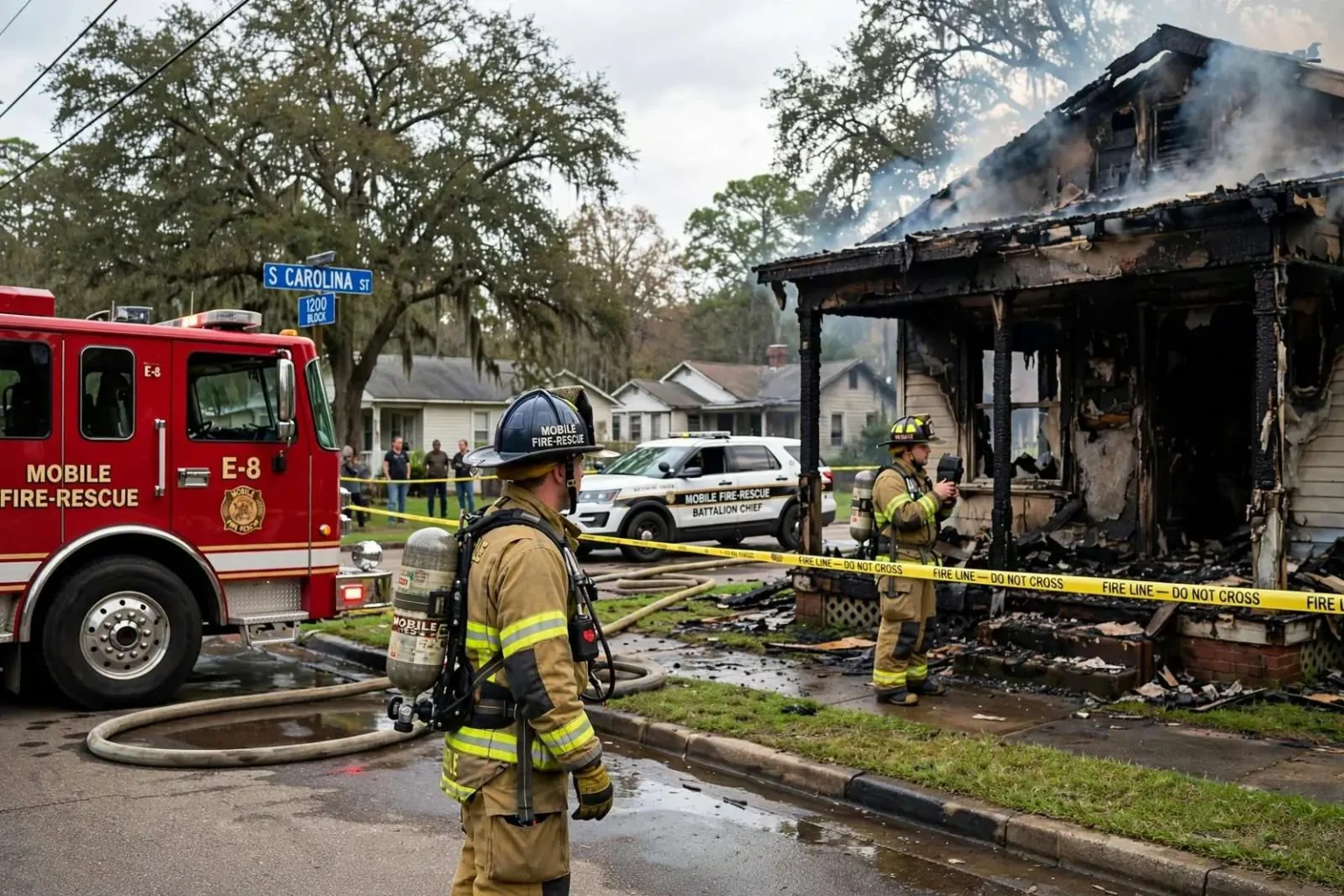
MOBILE, Ala. — Mobile Fire-Rescue crews responded to a house fire on South Carolina Street, bringing the blaze under control with no injuries reported. Fire officials said the residents were not home at the time of the fire, which means the department’s worst fear on any house call — people trapped inside — never materialized. The fire was extinguished at the scene, and investigators were working to determine what caused it.
The response brought together the elements that define a modern urban fire department: a fast alarm, an aggressive interior attack, and a scene preserved for investigators once the flames were down. South Carolina Street sits in a residential section of the city where homes stand close to the street and, in some blocks, close to each other, so an uncontrolled house fire is never just one family’s problem. Crews worked to keep the blaze from extending to neighboring structures while knocking down the fire in the original home.
A response without injuries
The absence of injuries is the detail fire officials highlight first in cases like this, and for good reason. When crews arrive at a house fire, the accounting begins immediately: is anyone inside, are pets unaccounted for, is the structure occupied or vacant? Learning that the residents were not home changes the priorities but not the urgency. A burning house still threatens the firefighters entering it, the neighbors whose homes share a property line or a wall, and anyone who might wander into the scene. A fire in an unoccupied home is a property fire rather than a life-safety emergency, and that distinction shapes every decision from water supply to ventilation.
For the residents, the news was still hard. Even a fire that injures no one can destroy a home’s interior in minutes, and the smoke and water damage that follow the flames often render a house unlivable until repairs are done. Mobile households displaced by fire typically turn to the American Red Cross of Alabama and the Gulf Coast region, which responds to residential fires throughout the area and helps with temporary lodging and immediate needs, while insurance carriers and contractors take over the longer recovery. Neighbors along South Carolina Street, as in most of the city’s older residential blocks, usually provide the first wave of help — a place to stay, help with pets, an offer to store what was saved.
The department has not yet said what stage the fire was in when the first engine arrived, but the outcome — a fire brought under control with no injuries — reflects a response that went right. Bringing a residential fire under control requires getting water on the flames before they extend beyond the room or floor of origin, and every minute of that timeline matters. Fire officials urged no conclusions about the cause, and investigators were methodically working to determine what started it.
How Mobile Fire-Rescue works a house fire
Mobile Fire-Rescue operates fire stations across the city, and a reported house fire triggers a standard assignment: engines, a ladder truck, a battalion chief, and typically an ambulance, all rolling within minutes of the alarm. The first-arriving company gives a size-up — smoke conditions, fire location, exposure risks — and the incident commander builds the attack from there. Interior crews stretch hose lines to the fire while other crews search the structure, ventilate to release heat and smoke, and establish a water supply from the nearest hydrant. On South Carolina Street, that choreography ended with the fire under control and no one hurt.
The department’s role does not end when the flames go out. Fire investigators walk the scene once crews deem it safe, reading burn patterns, checking appliances and electrical components, and interviewing neighbors and residents to establish a timeline. Origin-and-cause work is careful, slow, and essential: it determines whether an accidental fire traces back to cooking, heating, electrical faults, or smoking materials, whether a code violation contributed, and whether insurers can process the claim. In cases where investigators cannot rule out foul play, police become part of the picture, though officials had not indicated that step in this fire.
The department also tracks the data. Mobile Fire-Rescue, like departments nationwide, responds to more residential fires than any other single type of structure fire, and the lessons from each one feed into the department’s prevention outreach. Cooking remains the leading cause of home fires nationally, followed by heating equipment and electrical distribution problems, and the causes Mobile’s investigators identify locally tend to mirror that list. The findings on South Carolina Street will join that record once the investigation concludes.
Fire risk in Mobile’s older neighborhoods
The housing stock along streets like South Carolina Street is part of Mobile’s architectural inheritance — early- and mid-century homes, many with mature trees, porches, and additions built across decades. That character comes with fire considerations. Older wiring can be overloaded by modern appliance loads, older panels and circuits may lack the protection of newer construction, and space heaters, window units, and extension cords carry risks that building codes now address in new homes but cannot retroactively fix in old ones. Fire officials consistently point to these factors when explaining the pattern of residential fires in the city’s established neighborhoods.
The time of day and season matter as well. Fires that begin when no one is home can burn longer before being reported, which is why neighbors’ calls to 911 are so consequential — a fire spotted early from a passing car or a neighboring yard is a fire met with a smaller head start. In a close-knit block, that early report often makes the difference between a room fire and a house fire, and Mobile’s older neighborhoods, with residents outside on porches and familiar with each other’s schedules, are well positioned to provide it.
For the families on the block, the practical lessons repeat regardless of what investigators find. Working smoke alarms save the lives of the people who live in the house, and they are the first thing fire departments check in every outreach visit. A fire extinguisher in the kitchen, a habit of never leaving cooking unattended, and a plan for getting out at night cover most of the scenarios investigators encounter. None of them cost much, and all of them pay for themselves the first time they are needed.
When residents are away
Fires in unoccupied homes present their own kind of danger, and they are common enough that departments plan for them. A house with no one inside can burn longer before anyone notices, especially during weekday work hours or overnight, when a block’s most alert observers are asleep or away. Smoke that pours from a vacant-seeming house also raises a grim calculus for arriving crews, who must weigh whether someone could still be inside — a question they answer with searches unless a resident is definitively accounted for. That the residents here were confirmed not home spared crews that uncertainty.
There is also the aftermath to consider. A family returning to a fire-damaged home faces decisions that begin at the tape: whether the structure is sound, what can be salvaged, how smoke odor and water damage will be remediated, and where the household will live in the meantime. Damage mitigation specialists advise acting quickly — boarding up openings, tarping a damaged roof, and starting drying within days — because soot and moisture do their own destructive work after the flames are out. Photographs for the insurance claim, a copy of the fire report, and a list of damaged property all happen in the first week.
Community response usually fills the gaps. The Red Cross chapter serving the Gulf Coast responds to house fires across Mobile and Baldwin counties and can arrange temporary lodging and urgent needs, and Mobile’s congregations and neighborhood associations have long experience rallying around fire-displaced families. Fire departments themselves often field the first questions — who to call, what the report number is — because crews meet the family at the scene before any agency paperwork exists.
What investigators look for
The cause determination on South Carolina Street will follow the same method investigators apply to every structure fire. Work starts at the area of lowest burn and deepest char, where the fire most likely began, then moves outward through burn patterns, heat shadows, and the positions of melted materials. Investigators rule out or rule in the ordinary suspects: a stovetop left on, a space heater too close to bedding, an overloaded circuit, a dryer vent, a battery charger, smoking materials, or an outdoor fire that reached the structure. Appliances and wiring are examined, and utility records can confirm or exclude electrical involvement.
Timing and occupancy help the analysis. A fire that starts in an empty house has a known window — between the last time residents left and the first 911 call — and that window narrows the possibilities considerably. Investigators will also want to know whether the home was occupied at all, whether renovations or repairs were underway, and whether any alarms sounded before neighbors noticed smoke. None of these questions implies anything suspicious; they are simply the grid every origin-and-cause investigation fills in before a conclusion is reached.
The findings matter beyond the household. An accidental-fire cause feeds the department’s prevention data and often produces a public reminder — about cooking safety, charging lithium batteries, or winter heating — drawn from a real fire in a real neighborhood. A determination of equipment failure can ripple into recalls and insurance claims. And when investigators do encounter something unexplained, early scene preservation is what makes the later work possible, which is why fire departments ask residents and bystanders to stay out of a fire scene entirely until crews release it.
The block after the trucks leave
By the time fire crews clear a residential scene like the one on South Carolina Street, the neighborhood has usually collected on the sidewalk: neighbors comparing accounts, the family arriving to see the damage, and the quiet inventory of what the fire took. The department’s parting instructions follow a pattern — keep everyone out of the structure, watch for smoldering in the coming hours, and expect an investigator’s follow-up call. Utilities are typically shut off at the scene, and the red or yellow tape on the doors is a legal barrier as well as a visual one.
For the rest of the block, the event usually fades into a story retold at porches and mailboxes, along with a resolution to check the smoke alarms. Fire officials would count that as a good outcome: a fire contained, no one hurt, a cause to be determined, and a neighborhood reminded — without a tragedy — of how fast a house can burn and how much a working alarm and an early 911 call are worth. The investigation into the South Carolina Street fire continues, and its conclusions will be added to the record once investigators complete their work.