No one claims the Clotilda, last known U.S. slave ship, clearing path for state
With no one claiming the wreckage, Alabama can pursue permanent possession of the Clotilda, the last known U.S. slave ship, found in the Mobile River.
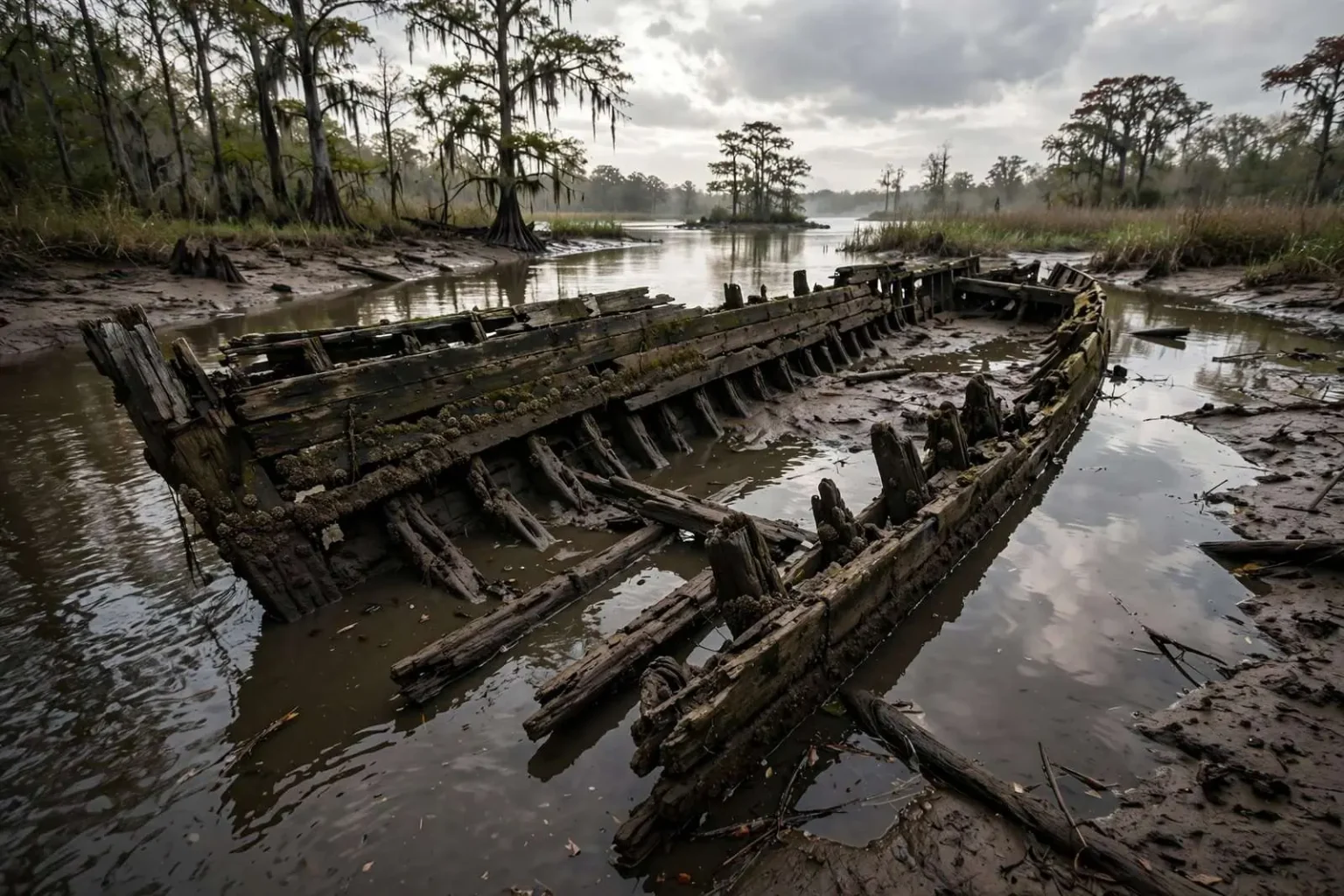
Alabama’s state historical commission appears poised to retain control of the Clotilda, the last known slave ship to bring enslaved people to the United States, after a legal deadline passed with no one stepping forward to claim the vessel’s remains. Friday was the deadline for any potential owners to claim the wreckage of the wooden schooner, which was burned near Mobile after illegally carrying about 110 captives from Africa to Alabama in 1860 — more than five decades after the international slave trade was outlawed.
Because no one came forward by the deadline, the state can now move forward in federal court to take permanent possession of the wreck. That path would place the remains under the stewardship of the Alabama Historical Commission, the state agency charged with preserving Alabama’s historic sites, and would formally settle a question that has shadowed the wreck since its identification.
Researchers confirmed the identity of the wreckage earlier this year, locating it in the Mobile River north of Mobile. The find closed a mystery that had lasted more than 150 years and ignited a community conversation about how — and whether — the remains should be preserved, studied and eventually interpreted for the public.
Officials say they are unsure how much of the Clotilda survives, but they believe at least part of the hull could be intact, sealed in the muddy bottom of the Mobile River near an island. That sediment, which both hid the wreck for generations and now protects it, has left archaeologists cautiously optimistic that significant portions of the vessel remain. What might ultimately be done with the wreckage, or whether it can be raised at all, remains unclear.
The voyage of the Clotilda
The Clotilda’s story is one of the darkest chapters in Alabama’s history. In 1860, on the eve of the Civil War, the schooner made a clandestine voyage to West Africa on a bet that a ship could reach Mobile Bay with a cargo of enslaved captives without being caught, defying the federal ban on the importation of enslaved people that had been in place since 1808. About 110 men, women and children were carried across the Atlantic in the ship’s hold on a voyage lasting weeks in brutal conditions.
After delivering its human cargo up the river, the conspirators scuttled the evidence. The schooner was burned and sunk in the waters north of Mobile, and those involved kept the operation quiet, hoping the vessel would never be found. The captives, many of whom spent years in bondage before emancipation, went on to establish their own community along the river after the Civil War — a settlement that became known as Africatown and endured as a living link between Alabama and West Africa.
Generations of Africatown residents passed down the story of the ship that brought their ancestors, even as the vessel’s exact resting place remained unknown. Over the decades, searches came and went, and false alarms — including a wreck long believed to be the Clotilda — complicated the record. The confirmed identification earlier this year finally validated what the community had always maintained.
The legal path ahead
With the claim deadline passed, the matter shifts to federal court, where the state will seek permanent title to the wreck. Admiralty proceedings of this kind are the standard mechanism for establishing ownership of historic vessel remains found in navigable waters, and the absence of competing claimants positions the state to prevail. Once possession is formalized, the Alabama Historical Commission would hold authority over the site’s protection and any future study.
Legal custody is only the first step in a longer process. Determining what to do with a fragile wooden wreck buried in a working river involves archaeology, engineering, environmental review and money, and officials have made no commitments about raising the vessel. Options under discussion in similar cases have ranged from leaving a wreck in place as a protected site to carefully excavating and conserving portions of it for museum display.
The condition of the hull will drive much of that decision. Wooden vessels submerged in muddy, low-oxygen sediment can survive for more than a century and a half, but exposure to air after recovery can cause rapid deterioration unless extensive conservation work is undertaken. Divers and archaeologists who have examined the site continue to assess how much of the original structure survives beneath the riverbed.
What the discovery means for Africatown
For the Africatown community north of Mobile, the confirmed wreck is more than an archaeological find. The neighborhood, founded by the Clotilda’s survivors and their descendants after the Civil War, has preserved the memory of the vessel for generations through family accounts, church records and community tradition. The identification of the ship validates that history in the most concrete way possible and has renewed attention to a community that many outsiders had overlooked.
Community leaders and preservation advocates have long hoped that recognition of the Clotilda would bring investment, tourism and educational opportunities to the area, along with a proper telling of the story of the people who arrived aboard her. The vessel’s remaining structure, whatever its ultimate fate, is regarded as one of the most significant maritime artifacts in American history — the physical evidence of the final documented arrival of enslaved Africans in the United States.
State officials have emphasized that any decisions about the wreck will involve the community and descendant families. The site sits in the Mobile River near an island north of the city, and its remote, submerged location has so far limited disturbance. Securing the wreck against unauthorized exploration and salvaging is among the immediate concerns once state ownership is settled.
Preserving a fragile wreck
The science of shipwreck preservation is unforgiving. Wood that has spent more than 150 years in anaerobic river mud is structurally delicate, often saturated to the point that it cannot support its own weight if lifted. Marine archaeologists who study Gulf Coast wrecks typically recommend extensive documentation in place before any recovery attempt, and some wrecks are deliberately left buried because excavation poses greater risks than protection.
The Alabama Historical Commission has experience with sensitive heritage sites across the state, from historic forts and plantations to civil rights landmarks, but the Clotilda presents unusual challenges: it is a site of international significance, it sits in an active industrial waterway, and it carries profound emotional weight for a community whose ancestors were its cargo. How those considerations are balanced will shape the project for years.
Federal involvement is also likely. Wrecks of this significance often attract support from national agencies and preservation organizations, and the legal process now underway runs through the federal courts. Any long-term plan — whether in-situ preservation, partial excavation or full recovery — would require substantial funding that neither the state nor the local community has yet identified.
A story whose ending is still unwritten
Officials remain candid that they do not know what the future holds for the wreckage itself. It is unclear what might be done with the remains or whether the Clotilda can ever be raised from the river bottom. What is clear is that the window for private claims has closed, clearing the way for the state to act as steward of a vessel whose voyage ended more than 160 years ago in smoke and secrecy on the Mobile River.
Historians note the wider significance of the moment. The Clotilda is the last known slave ship to reach the United States, and its confirmed identification earlier this year drew attention from around the country and beyond. For the descendants of the 110 captives who survived the crossing, the wreck is a family heirloom of national proportions — evidence of both a crime and a community’s improbable survival and endurance in the years that followed.
The next milestones will come in the courtroom, where the state’s petition for possession proceeds, and in the river itself, where continued study will determine how much of the schooner still exists. Until then, the remains lie where they were left in 1860, preserved by the same mud that kept their secret, waiting on a decision about how Alabama should remember what happened there.
What happens next
The immediate steps are procedural but consequential. The state’s filing in federal court will seek to formalize ownership, and once that is granted, the Alabama Historical Commission can move from waiting on the legal question to planning for the site’s protection. Security, access restrictions and a formal survey of the wreck are the likely early actions, all aimed at making sure the remains are not disturbed while the longer debate continues.
Researchers will also keep working to answer the central technical question: how much of the schooner actually remains. The answer determines everything downstream, from whether any portion could be conserved for display to whether the site is better preserved where it lies. The muddy conditions that concealed the wreck for generations are now its best protection, and archaeologists have stressed patience over speed in evaluating the find.
For now, the wreckage of the Clotilda rests in the Mobile River north of the city, unclaimed by any private owner and headed toward state stewardship. The community that kept its story alive for more than a century and a half is watching closely, and the decisions made in the months ahead — in courtrooms, at agency meetings and along the riverbank — will decide how this final chapter of a painful history is preserved for the generations that follow.