
NOAA Sets 62-Day Federal Red Snapper Season for Gulf Charter Boats
NOAA announced a 62-day federal for-hire red snapper season for 2020, opening June 1 and closing August 2 for Gulf charter boats.
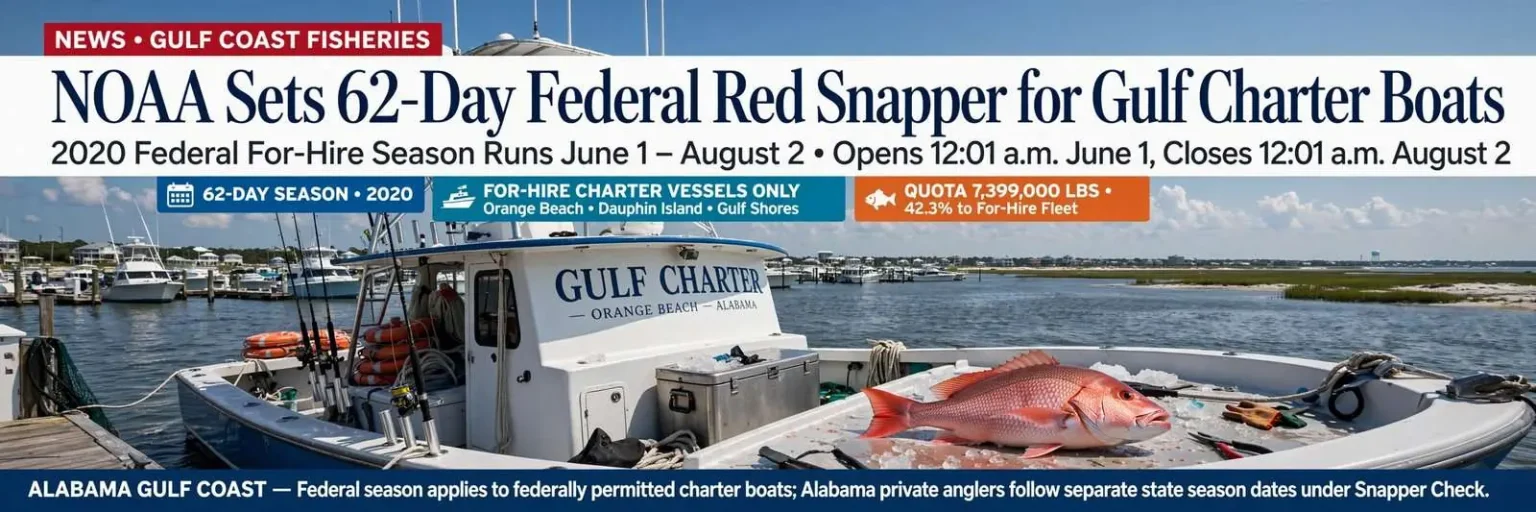
Charter boats across the Alabama Gulf Coast now know their window for the 2020 federal red snapper season. The National Oceanic and Atmospheric Administration announced that the 2020 Red Snapper Recreational For-Hire season will open June 1 and run 62 days, closing at 12:01 a.m. local time on August 2. For an industry that plans its entire summer around the species, the announcement sets the calendar that bookings, staffing and bait orders all hang on.
The dates apply to federally permitted for-hire vessels — the charter operations that carry paying anglers out of ports like Orange Beach, Dauphin Island, and Gulf Shores. Those boats form the backbone of the recreational fishing economy between the Perdido Pass and Mobile Bay, running customers to artificial reefs and natural bottom where red snapper gather in numbers that few other Gulf fisheries can match.
The 62-day season is shorter than the private-angler window Alabama anglers have enjoyed under state rules in recent years, and that gap between the two fleets remains one of the most closely watched — and most debated — dynamics in Gulf fisheries management.
Private anglers set their own dates
Unlike the charter fleet, private recreational anglers are not bound by the federal calendar: each Gulf state decides its own private-angler season dates at its discretion. Alabama has in recent years run state seasons that extend well past the federal window, using state-waters authority and programs such as Snapper Check to monitor its own harvest.
Alabama’s state-waters season applies within three miles of the coast — nine miles off some portions of the Gulf — but the state has also used its data-collection and monitoring programs to justify extending private-angler harvest in federal waters under exempted fishing permits in recent seasons. The result is that an Alabama family fishing from their own boat typically has far more days on the water than customers aboard a federally permitted charter, a difference charter operators have complained about for years.
State officials have argued that Alabama’s monitoring system — among the most robust in the Gulf — earns the state greater flexibility. Charter captains counter that the discrepancy is unfair competition: the same fish, the same docks, but two very different rulebooks depending on who owns the boat.
How the quota breaks down
Under the framework set by the Gulf of Mexico Fishery Management Council, the total recreational red snapper quota stands at 7,399,000 pounds whole weight. Of that, 57 percent is allocated to private anglers and 42.3 percent to the for-hire component. The announcement gives charter operators certainty as they book summer trips for one of the Gulf’s most popular — and most closely managed — fisheries.
Those percentages trace back to allocations negotiated in Amendment 28 to the reef fish management plan, which divided the recreational quota between the two fleet segments and has governed Gulf red snapper harvest ever since. The split reflects an attempt to balance the historical catch patterns of private anglers — who vastly outnumber charter customers — against the for-hire industry’s role as the on-ramp for Gulf fishing, carrying tourists, children and first-time anglers who never own a boat of their own.
Seven million pounds sounds abundant, but it disappears quickly when spread across five states and a season that peaks in June and July. Federal managers watch the pace of harvest through reporting systems, and if landings run hot, seasons can be cut short — a threat that hangs over every announcement like this one.
Why red snapper matters on the Alabama coast
No Gulf fishery looms larger over the Alabama coast’s summer economy. Orange Beach and Gulf Shores built charter fleets over generations, and the region’s artificial reef program — the most extensive in the nation — has turned Alabama’s otherwise featureless shelf into snapper habitat that holds fish within easy reach of the inlets. Thousands of Reef Zone blocks and hundreds of documented reef structures give Alabama anglers some of the shortest runs to productive bottom in the Gulf of Mexico.
That geography is why the state punches far above its population in recreational snapper landings, and why every federal season announcement lands hardest here. A charter captain in Orange Beach may run two or three trips a day during open season, and each cancelled booking ripples outward to deckhands, marinas, tackle shops, seafood restaurants and the motels that house visiting anglers.
The management fight behind the dates
Red snapper management has been contentious in the Gulf for decades. The species’ recovery from overfishing became one of the great success stories of federal fisheries management — stocks rebuilt to the point that anglers routinely report abundant fish — yet the seasons grew shorter at the same time, because managers must hold total catch within a quota set to protect the recovering population’s long-term health. Anglers see more fish and fewer days, and the contradiction has fueled lawsuits, congressional hearings and repeated efforts to shift authority toward the states.
The Gulf of Mexico Fishery Management Council, which sets the framework, must balance biological targets against the realities of a recreational fleet that has grown every year. Each state’s approach to its private-angler season feeds into that calculus, and Alabama’s willingness to run long state seasons while documenting its catch has made it a central voice in the debate over state-versus-federal control.
What 62 days means for the charter fleet
For the 2020 season, the federal for-hire calendar runs from June 1 to August 2 — the heart of summer, spanning Memorial Day’s aftermath through late July. Captains will pack as many trips as weather and demand allow into that stretch, and many already structure their whole year around it, running snapper trips in season and pivoting to other reef species, trolling or nearshore trips once the closure begins.
The certainty the announcement provides cuts both ways. Operators now know they can sell a snapper trip for any date through August 1, which stabilizes summer bookings. But every year also brings the risk of in-season closures if the quota is projected to be met early, and captains know from experience that the final announced day is not always the last day the fish are actually open.
Vessels fishing under the federal window are also subject to reporting requirements that let managers track the fleet’s harvest nearly in real time — a level of scrutiny the private fleet does not face to the same degree. Charter operators argue they have paid their dues in accountability; their hope each season is simply that the days are long enough to pay for them.
The ports and the people behind the fleet
Each of the three launch points named in the announcement plays a distinct role in the fishery. Orange Beach, with its direct access to Perdido Pass, is the epicenter of Alabama’s charter industry — a marina town where the charter docks sit minutes from the Gulf and where red snapper has been the economic anchor for generations. Gulf Shores, just to the west, funnels the resort crowds that fill charter boats during peak vacation season, while Dauphin Island serves anglers working the western side of the county and the approaches to Mobile Bay, with its own long history as a working fishing village.
Together they support a for-hire industry that includes everything from six-pack charter boats carrying a handful of paying customers to multi-passenger party vessels. During a 62-day season, the number of angler trips can run into the tens of thousands, and the reporting those trips generate is what allows federal managers to track the quota week by week.
What anglers should know before booking
Anglers planning a charter trip in 2020 should confirm dates directly with their captain, since operators will schedule around the June 1 opening and the August 2 close. Red snapper trips typically run from a few hours to a full day depending on how far the captain runs to reach productive bottom, and Alabama’s reef zone means even half-day trips can reach fish-holding structure. Bag limits and size rules for the season are set under the same federal framework, and crews handle the details — anglers’ job is to book early, because the best summer dates fill fast once the season is confirmed.
Private anglers, meanwhile, should watch for the state’s separate announcement of its own season dates and for Snapper Check requirements, which make reporting a condition of fishing. The state season and the federal season run on different calendars, and knowing which rules apply to a given trip — and given boat — is the single most important piece of knowledge a Gulf Coast angler can carry into the summer.
Looking ahead
The 2020 season arrives amid continuing discussion about the long-term structure of Gulf red snapper management — how quotas are divided, how state and federal seasons coexist, and whether the data systems now in place can support longer seasons for both fleets. Each year’s announcement is a snapshot of that ongoing negotiation between biology, economics and politics.
For now, the numbers are what they are: 62 days for the charter fleet, opening June 1 and closing at 12:01 a.m. on August 2, carved out of a 7,399,000-pound recreational quota shared between private anglers and the boats that carry paying customers. From Orange Beach to Dauphin Island, captains will spend the weeks before June 1 booking trips, servicing boats and rigging bait — ready to make the most of every day the season provides.