Of Montreal Brings Daughter of Cloud Tour to Alabama Music Box in Mobile
Indie rock legends Of Montreal return to Mobile's Alabama Music Box, touring in support of their B-side compilation Daughter of Cloud.
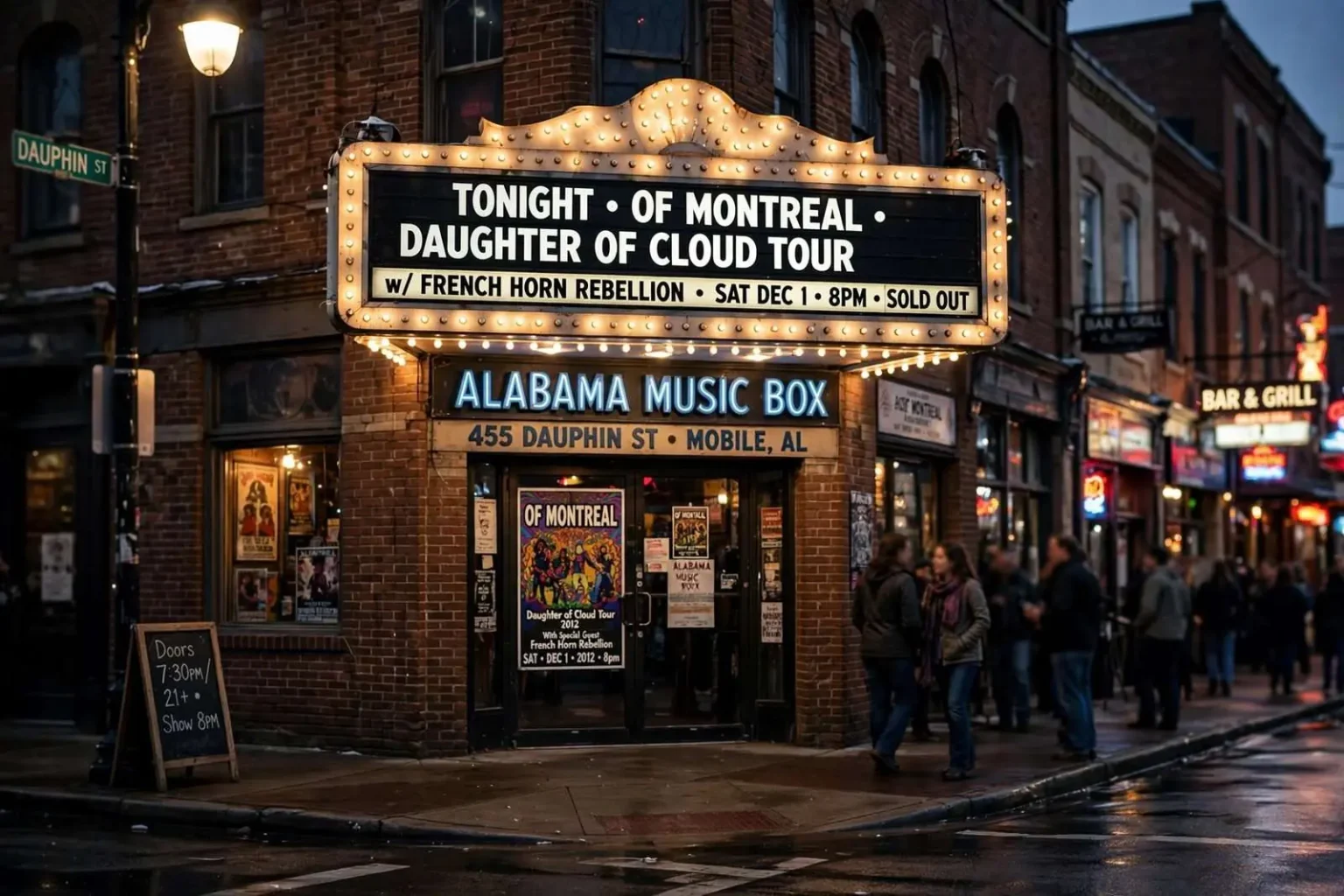
Indie rock icons Of Montreal are set to return to Mobile’s beloved Alabama Music Box on Saturday, December 1, 2012, with support from French Horn Rebellion. The show marks the band’s second appearance at the intimate Dauphin Street venue this year, following a memorable abbreviated set back in March. For local fans, the December date offers something the spring visit could not: a full-length performance from one of the most theatrically ambitious live acts in independent music, on a Saturday night in the heart of downtown.
The Alabama Music Box has become one of downtown Mobile’s most reliable stops for national touring acts, sitting along the Dauphin Street corridor that anchors the city’s nightlife district. The street’s concentration of bars, music rooms and restaurants has made it the natural gathering point for concertgoers from across the central Gulf Coast, drawing audiences from Baldwin County, the Eastern Shore and the Mississippi line for shows that might otherwise require a drive to New Orleans or Pensacola. An appearance by a band of Of Montreal’s stature in a room that size is the kind of booking that tends to fill the floor well before the headliner takes the stage, and the March visit already demonstrated how hungry Mobile audiences are for this corner of the indie rock world.
The abbreviated nature of that spring set has become part of the local story. Rather than leaving a bad impression, it left an unfinished one, and word among fans since March has centered on the chance to finally hear the band run through a complete show. The December return answers that, pairing the band with a national touring act and a weekend slot designed for out-of-town visitors as much as locals.
From Athens to the World
Led by frontman Kevin Barnes, Of Montreal emerged from the fertile Athens, Georgia music scene as part of the legendary Elephant 6 Collective. The collective, born in the early 1990s from a group of independent musicians pooling resources to support one another, produced some of the most beloved acts in indie rock history, including Neutral Milk Hotel, Olivia Tremor Control and The Apples in Stereo. What began as friends sharing four-track recorders, studio time and mailing lists grew into a loose artistic movement whose handmade, psychedelic sensibility still runs through independent music more than two decades later.
Of Montreal joined as part of the collective’s celebrated second wave alongside Elf Power, Beulah, Dressy Bessy and The Music Tapes. While the first generation of Elephant 6 bands earned much of the era’s critical attention, the second wave carried the collective’s cooperative spirit into the 2000s, and Of Montreal ultimately became its most commercially durable graduate. The interconnected nature of Elephant 6 remains strong, with Of Montreal guitarist Bryan Poole also contributing to Elf Power over the years — a reminder that the collective functions less like a record label than an extended family of overlapping projects whose members drift between bands as casually as neighbors borrowing tools.
That cooperative history gives the band an unusual pedigree on a 2012 club stage. Few acts touring today can trace their lineage directly to a movement that prized homemade pop melodies, baroque arrangements and absolute creative independence over commercial calculation. Barnes has kept that ethos at the center of Of Montreal, writing, recording and producing nearly all of the band’s material himself while treating each successive album as a full reinvention rather than a continuation, a habit that has kept both critics and fans guessing for more than fifteen years.
For a Gulf Coast audience, the Athens connection carries its own resonance. The Southeast has long punched above its weight in independent music, and the corridor of college towns and port cities stretching from Athens through Atlanta, New Orleans and Mobile has exchanged bands, fans and venue bookings for decades. Of Montreal’s routing through Mobile places the city squarely on that map, in the company of markets many times its size.
A Band That Defies Categories
Drawing from influences as varied as The Beatles, David Bowie and vaudeville theater, Of Montreal resists easy genre classification. Critics have applied labels ranging from psychedelic pop and indie rock to twee pop, progressive rock, experimental rock, neo-psychedelia and even R&B, and none of them quite stick. The band’s catalog can swing from bright, ornate pop to abrasive electronic passages in the space of a single song, and Barnes has openly welcomed the whiplash, treating genre boundaries as material to be cut up and reassembled rather than rules to be observed.
The Bowie influence in particular surfaces in the band’s approach to persona. Barnes has periodically performed under invented alter egos, dressing the songs in fictional biographies the way Bowie did with his own 1970s characters. The Beatles’ fingerprint shows up elsewhere, in stacked vocal harmonies and melodic turns that smuggle pure pop craft into otherwise experimental arrangements. The vaudeville strand, meanwhile, explains everything about the band’s stage presentation, which owes more to traveling revue theater than to the standard guitar-bass-drums club format.
Their live performances are equally eclectic, often featuring elaborate costumes, theatrical skits, masks, inflatables and enthusiastic audience interaction. In larger markets the band’s production has grown into full-blown stage spectacle, complete with costume changes and staged confrontations that unfold alongside the music. The format translates strikingly well to a club the size of the Alabama Music Box, where the distance between performer and audience nearly disappears and the theatrical elements land at arm’s length rather than across an arena floor. Mobile audiences saw a taste of that energy during the March appearance, and the December show arrives with expectations considerably higher.
Daughter of Cloud: A Treasure Trove of Rarities
The current tour supports the band’s latest release, Daughter of Cloud, a 17-track B-side compilation issued on Polyvinyl Records in October 2012. The collection gathers rarities dating back to 2007, many originally released as limited-edition 7-inch singles that have since become prized collectibles. For dedicated listeners, the album functions as an archaeology of the band’s most productive period, assembling songs that previously circulated only among collectors willing to hunt down out-of-print vinyl through specialty shops and online auctions.
Unlike many rarities collections, Daughter of Cloud is not built from scraps. Several tracks received new mixes for the compilation, and the sequencing gives the songs the feel of a proper album rather than a warehouse clearing. The release also serves listeners who came to the band late and want to trace how Barnes’ songwriting evolved across the late 2000s without tracking down a shelf of imported and long-sold-out singles. Polyvinyl, the Illinois-based independent label that has handled the band’s recent catalog, has built a national reputation on exactly this kind of devoted catalog curation, keeping material in print that larger labels would have let lapse.
The vinyl-collecting culture surrounding these releases is worth noting for anyone new to the band. Limited 7-inch pressings from the band’s catalog have historically sold out on pre-order, then changed hands among collectors at steep markups, which is precisely what makes a widely available compilation like this one such an event for the fanbase. Songs that once existed as a few thousand fragile copies now reach every streaming playlist and record store bin, and the tour gives those songs their first widespread live airing.
A Companion to a Darker Chapter
The album serves as a companion piece to the band’s most recent studio effort, Paralytic Stalks, which took a notably darker and more dissonant creative direction than the shimmering pop that made the band’s reputation. Across its longer compositions, Barnes examined fractured relationships and unforgiving self-examination with an acidity that startled even longtime listeners, layering baroque arrangements over rhythms that borrowed as much from art rock as from guitar pop. Daughter of Cloud draws from the same stretch of writing, which means Mobile audiences are likely to hear both unfamiliar textures and older favorites recast in that mood.
The pairing of the two records also marks a turning point in how the band presents itself. Where earlier tours leaned on the band’s sunnier catalog, the Daughter of Cloud material drags the rarities out of the shadows and gives them equal standing with the hits. Longtime fans will recognize deep cuts that were once recited from memory by the front rows alone; newcomers get a single evening that surveys nearly two decades of a band that has never repeated itself.
What the Tour Means for the Gulf Coast
For Mobile, the booking reflects the Alabama Music Box’s growing ability to attract nationally recognized independent acts that once bypassed the Gulf Coast entirely between New Orleans and Pensacola. The venue’s position on Dauphin Street places it within walking distance of downtown hotels and restaurants, letting a concert night spill into the surrounding entertainment district in a way suburban multiplex shows never can. Local music fans have increasingly argued that a healthy club circuit keeps touring dollars — and touring bands — in Mobile rather than sending them to larger markets, and each successful national booking strengthens that case.
The economics of club touring make these appearances possible only when the venue and the audience both deliver. Bands routing between Atlanta, New Orleans and the Florida panhandle weigh every off-path date carefully, and a strong turnout on Dauphin Street is the strongest argument a local promoter can make for the next one. Mobile’s recent run of indie bookings suggests the argument is being won, show by show, in front of crowds that keep showing up.
French Horn Rebellion, the Brooklyn-based electronic project opening the night, brings its own dance-floor instincts to the bill, setting a muscular tone before Of Montreal takes the stage. The pairing suits the material well: the headliner’s newer songs lean toward beat-driven arrangements, and an opening act built around electronic grooves primes the room for them. For attendees, the practical advice is straightforward — arrive early, wear comfortable shoes and expect a crowd that came to participate rather than simply watch.
With a Saturday date, a full-length headlining set and a catalog that spans psychedelic pop, orchestral art rock and dance-floor experimentation, the show shapes up as one of the more ambitious indie bookings of the season on the central Gulf Coast. The band that once played Athens house parties now arrives in Mobile as a traveling carnival with a fourteen-album catalog behind it, and the Alabama Music Box remains one of the few rooms on the Gulf Coast where that entire history can be experienced at close range. Tickets are available through the venue, and given how the March visit ended, early arrival looks like the safer bet.