One month after Terri Sullivan vanished near Tibbie, children plead for her return
A month after Terri Sullivan vanished on her way to work in Tibbie, Alabama, her children plead for her return as investigators name persons of interest.
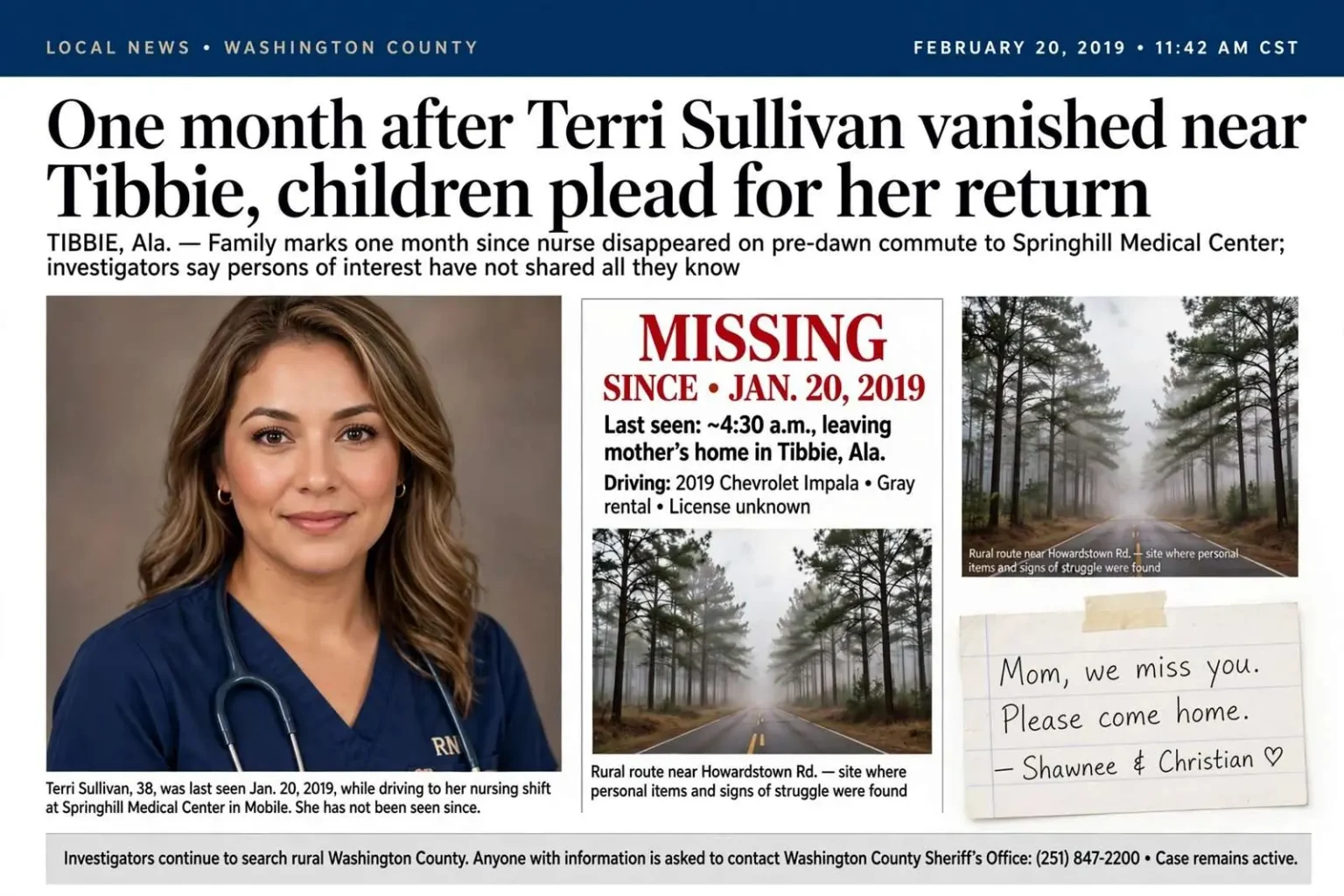
TIBBIE, Ala. — One month after Terri Sullivan disappeared on her way to work, her children are pleading for her return, and investigators say they are speaking with several people who may know more than they have shared. Sullivan, a nurse and mother, left her mother’s home in Tibbie around 4:30 a.m. on Jan. 20, 2019, heading to her job at Springhill Medical Center in Mobile. She never arrived at the hospital and has not been seen since.
The disappearance has stretched across a month of searching, evidence collection and unanswered questions for a family that marks time now in days since her last phone call. For Sullivan’s children, the case is not a news item but a daily absence, and they have made their appeal directly to the public and to whoever may be holding information about their mother’s whereabouts.
“The last time I called her phone to get a hold of her, a deputy answered,” said Shawnee Taylor, one of Sullivan’s children. “I really hope they will return her to us because we need her back.” Her brother, Christian Taylor, added, “I want to tell her I love her again. I want to hear her say it back.”
A Morning Route That Never Reached Mobile
Sullivan’s daily routine took her from rural Washington County to Mobile, a commute of more than an hour that she made for her nursing job at Springhill Medical Center. Leaving her mother’s home in Tibbie before dawn was part of that routine, and nothing about the morning of Jan. 20 suggested it was different from any other shift — until she failed to arrive at the hospital and contact with her was lost.
Tibbie is a small community in Washington County, in Alabama’s southwestern timber country, where the roads between communities pass through miles of pine forest and farmland. The drive south toward Mobile crosses rural stretches where traffic is light before dawn, a fact investigators must weigh as they reconstruct her route and search for anyone who may have seen her gray rental car on the road that morning.
The vehicle — a Chevrolet Impala rental car she was driving — has never been found, a detail that has shaped the investigation from the start. A missing car narrows the possibilities considerably: it means the vehicle did not simply run out of fuel, break down in an obvious spot, or sit unnoticed along a roadway where a passing driver would have reported it.
Evidence on the Ground
Investigators say they have gathered thousands of pieces of evidence and executed dozens of search warrants in the month since Sullivan vanished. The physical search has produced concrete finds: signs of a struggle about half a mile from Howardstown Road, along with a bracelet and Sullivan’s cellphone. But no other sign of Sullivan herself has turned up at the scene or anywhere else.
The discovery pattern — signs of a struggle, personal items scattered near the roadside, and a missing vehicle — is the kind that investigators treat as evidence of foul play rather than a voluntary disappearance. Each recovered item passes through forensic testing, and authorities are awaiting DNA results that could tie evidence from the scene to a specific person.
Investigator Tim Landrum said detectives are speaking with several people who have information about the case, and he was direct about the limits of their cooperation so far. “We feel like they haven’t told us everything they know yet. I’d say they are persons of interest,” he said.
The Family’s Wait
For the Taylor family, the month since Jan. 20 has been an exercise in holding two possibilities at once — hope for a return and dread of what the evidence suggests — while cooperating with investigators and keeping Sullivan’s name in public view. The children’s statements carry the specific, personal details of a family that still expects their mother to answer the phone: Shawnee Taylor recalling the deputy who picked up when she called, Christian Taylor thinking about the words he wants to say back to her.
The family continues to ask why. “She’s too good of a person to have this happen to her. She never did any wrong by anybody,” Shawnee Taylor said. The description matches the picture that has emerged of Sullivan through this case — a working nurse, a mother, and a daughter whose pre-dawn drive to care for patients was part of the ordinary discipline of her life.
Family members in missing-person cases often become the investigation’s most public advocates, holding press appearances, sharing flyers and keeping the case circulating on social media when the daily headlines move on. The Taylors’ public statements a month into the disappearance serve that purpose: they remind potential witnesses that the search is active and that information, even fragmentary, still matters.
The Investigation’s Next Phase
The transition from search to investigation is now well underway. With dozens of search warrants executed, detectives are working through phone records, financial activity and the accounts of the people Landrum identified as persons of interest. The DNA results authorities are awaiting could prove decisive — either by linking someone to the scene near Howardstown Road or by ruling individuals out — and investigators have indicated the laboratory work is among the case’s active threads.
Cases that begin on rural roads present particular challenges. With no cameras along the route Sullivan would have driven, investigators depend on human memory: anyone who was on the road between Tibbie and Mobile in the early hours of Jan. 20, anyone who saw the Impala, anyone who noticed something out of place near Howardstown Road. That is why authorities continue to appeal for tips, even a month later, and why the persons of interest Landrum described remain the focus of detectives’ attention.
The Washington County area has seen the community respond to the family’s appeals, and investigators have not ruled out the possibility that the case will be solved by a single tip from someone who has been waiting to come forward. Law enforcement agencies typically stress in such cases that even secondhand information — something heard from another person, an offhand remark, a change in someone’s account — can be the thread that unravels what happened.
What We Know About Terri Sullivan
The details of Sullivan’s life frame the loss the community is reckoning with. She was a nurse at Springhill Medical Center, a hospital in west Mobile that serves patients from across the region, and her work put her among the caregivers that southwest Alabama depends on daily. She was a mother whose children are now speaking publicly in her name, and a daughter who lived near her mother in Tibbie and left from that home on the morning she disappeared.
Her route that morning — from a rural Washington County community toward a Mobile hospital before dawn — is one thousands of southwest Alabama commuters travel in some form every day, which is part of why the case has resonated. A routine commute ended somewhere along those miles, and a month of searching has produced evidence of a struggle and scattered belongings, but no answers the family can hold onto.
Anyone with information about Terri Sullivan’s disappearance or the whereabouts of the Chevrolet Impala she was driving is urged to contact investigators. A month in, detectives say the case remains active, the persons of interest remain under scrutiny, and the family remains waiting.
The geography of the case continues to anchor the search. The area near Howardstown Road, where the signs of struggle and personal items were found, lies along the route Sullivan would have traveled away from Tibbie, and the concentration of evidence within that stretch has focused the investigation on the earliest moments of her morning. Searchers have returned repeatedly to the rural terrain around that area, where ditches, timber tracts and underbrush can conceal or preserve evidence in ways that urban scenes cannot, and the changing seasons and vegetation add urgency to completing a thorough ground search.
Investigators have also balanced the physical search with the financial and digital traces that outline a person’s final days. In missing-person investigations, the combination of phone records, banking activity and witness interviews usually establishes the timeline long before any single piece of forensic evidence does, and the thousands of pieces of evidence gathered so far suggest detectives have been building that timeline methodically since the first reports.
Missing Persons Work in Rural Alabama
Rural counties face distinct hurdles in cases like this one. A sheriff’s office in a county like Washington must mount a major investigation — evidence processing, forensic testing, dozens of warrants — with a small detective staff, often supplemented by assistance from state agencies and neighboring departments. The first hours of a missing-person case are spent ruling out the ordinary explanations: hospital admissions, car trouble, a change of plans. When the vehicle itself disappears along with the person, those explanations fall away quickly, and the case shifts to a criminal footing.
The rental car adds another investigative layer. Rental companies maintain records of the vehicle’s location technology, condition and mileage, and the car itself — a Chevrolet Impala that vanished along with Sullivan — remains an object of the search. Vehicles in cases like this are often located in wooded areas, waterways or remote property, which is why investigators have repeatedly asked the public, particularly landowners and hunters, to report anything unusual on their property.
Forensic science has become the backbone of such cases. DNA analysis of items recovered from the scene — the bracelet, the cellphone, materials from the area where the struggle occurred — can establish presence in a way witness testimony cannot, and the results authorities are awaiting could reshape the investigation in either direction: toward a suspect or away from the people detectives have been questioning.
A Community Watching
A month of coverage has kept Sullivan’s case alive across southwest Alabama, and the case has touched the networks that connected her to the community: the hospital where she worked, the churches and schools of Washington County, and the extended family spread across the region. Nurses who work the same pre-dawn shifts have followed the case with particular attention, recognizing how ordinary her morning was until the moment it stopped being ordinary.
For the Taylor children, the public appeals are also a message to their mother, wherever she is. The words they chose for the cameras — the deputy answering her phone, the love they want to exchange — are the kind of specific, human details that often move reluctant witnesses to come forward. Investigators have made clear the door for information remains open, and that persons of interest in the case know detectives are still listening to everything they say.
The case remains under active investigation, with DNA results pending and detectives continuing to work the list of people Landrum identified. The family’s plea, one month in, is unchanged: return her to us.