
Opposition To Bayway Tolls Widens As Mobile Delegation And Sen. Elliott Press Ivey
Mobile's legislative delegation and State Sen. Chris Elliott urged Gov. Kay Ivey to rethink $3 to $6 tolls for the Mobile River Bridge and Bayway project.
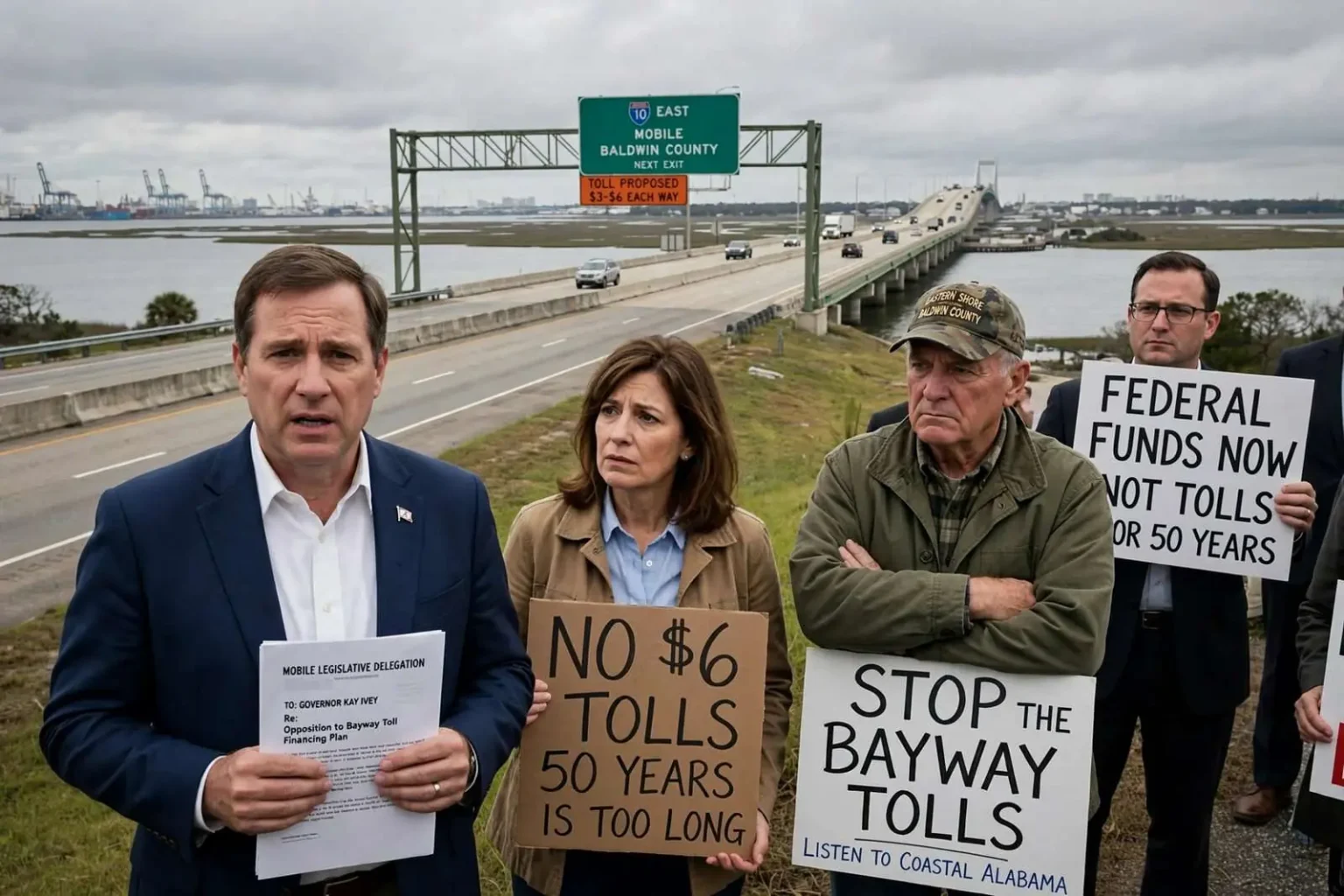
MOBILE, Ala. — Resistance to the toll plan behind the Mobile River Bridge and Bayway project keeps broadening, with Mobile’s legislative delegation sending Gov. Kay Ivey a letter this week laying out its concerns about how the work would be paid for. The financing proposal on the table would charge drivers between $3 and $6 each way, a figure that has become a sore point for the thousands of commuters who cross between Mobile and Baldwin County every day.
The letter adds the city’s own delegation to a roster of elected officials who have publicly objected to the toll structure, and it signals that opposition is no longer confined to Baldwin County, where drivers would face the charges most often. Members of the delegation argued in the letter that the region desperately needs additional Interstate 10 capacity but cannot accept a financing plan that places the burden so heavily on the drivers who use the crossing daily.
A Growing List of Critics
The delegation’s letter puts it alongside U.S. Rep. Bradley Byrne, the mayors of the Eastern Shore cities, and roughly 25,000 members of the “Block the Mobile Bayway Toll” Facebook group organized by State Auditor Jim Zeigler. The grassroots group has grown steadily as details of the toll proposal have circulated, turning the funding mechanism into one of the most politically charged infrastructure questions on the Gulf Coast.
State Sen. Chris Elliott has now added his name to the list of officials objecting to the funding mechanism. “It is clear that this project and the funding mechanism that is being proposed right now is simply unacceptable for coastal Alabama,” Elliott said. The senator, whose district includes part of Baldwin County’s rapidly growing Eastern Shore, has made the toll question a defining issue of his legislative work on transportation matters.
Elliott has consistently argued the region needs the new bridge and says he still does. His objection is to paying for it with high tolls locked in for decades. He raised the possibility that a federal infrastructure package could arrive within a couple of years and cover a share of the cost, leaving drivers committed to 50 years of tolls that might not have been necessary. In his view, signing a decades-long toll agreement now would foreclose the option of reducing or eliminating the charges later if outside money becomes available.
Why the Crossing Matters So Much
The existing Interstate 10 route between Mobile and Baldwin County runs through the George Wallace Tunnel beneath the Mobile River, a structure built in the early 1970s that carries two lanes in each direction. Decades of population growth on the Eastern Shore have turned the tunnel and its approaches into one of the worst congestion points in Alabama, with backups that routinely stretch for miles during rush hours, holiday weekends and when accidents close the bore. The Bankhead Tunnel, the Cochrane-Africatown Bridge and the Jubilee Parkway on the Bayway all funnel traffic into the same constrained corridor.
The Mobile River Bridge and Bayway project was conceived as the long-term fix: a new bridge over the Mobile River paired with reconstruction and widening of the Bayway across Mobile Bay. Planners have estimated the crossing serves tens of thousands of vehicles a day, and Baldwin County’s status as one of the fastest-growing counties in Alabama has only intensified demand. Local officials agree on the need for the project; the fight is entirely over who pays and for how long.
Decision Sits With a State Authority
Elliott said he plans to urge the governor to wait and see whether federal money materializes. Ivey chairs the Toll Road, Bridge and Tunnel Authority, the body with the power to advance or halt the project. Of its nine members, only two have any connection to the Gulf Coast, a composition that critics have seized on as evidence that the people deciding coastal Alabama’s toll future are mostly appointed from elsewhere in the state.
The authority structure means that the governor and the appointed board — not the Legislature, and not local governments — hold the decisive vote on whether the toll plan moves forward. That arrangement has concentrated the political pressure on Ivey, whose office has received letters, resolutions and petitions from across the two-county region. Municipal councils in Daphne, Spanish Fort, Fairhope and other Eastern Shore communities have taken formal positions against the tolls, and Baldwin County’s legislative delegation has pressed for a public airing of alternatives before any financing contract is signed.
ALDOT’s Next Steps
ALDOT Director John Cooper offered little detail when he met with Baldwin County’s legislative delegation the week prior, saying only that the department had “discussed some concepts with them that might be ready for public dissemination in the near future.” Cooper is expected to hold a news conference Wednesday at ALDOT’s Mobile office, where observers expect the department to lay out revisions to the financing plan or new options for paying for the project.
Whatever the department presents will land in a charged environment. The toll figures under discussion — $3 to $6 each way — would fall hardest on daily commuters, including the thousands of workers who live in Baldwin County and drive to jobs in Mobile, and on commercial traffic moving along the Interstate 10 corridor between Florida, Alabama and Mississippi. Freight haulers have warned that tolls on the primary east-west route could push truck traffic onto U.S. 90 and local roads, shifting congestion and safety problems into the very neighborhoods the new bridge is meant to relieve.
What Happens Next
The letter from Mobile’s delegation gives the governor’s office a fresh signal that opposition to the current financing plan extends across the bay, and it raises the stakes for Cooper’s news conference and any proposal ALDOT puts forward. Options that officials have discussed publicly in recent months include scaling back elements of the project, seeking additional federal funding, revising the toll structure, or some combination of the three, though the department has not confirmed any specific alternative.
For now, the region’s elected officials remain aligned on the core point: the bridge and Bayway improvements are needed, and the dispute is about the financing mechanism that would lock in tolls for half a century. With roughly 25,000 residents organized against the current plan, a federal infrastructure debate brewing in Washington, and a state authority chaired by the governor holding the decision, the next few months are likely to determine whether coastal Alabama gets its long-sought new crossing — and at what price for the drivers who use it.
The History Behind the Project
The Mobile River Bridge and Bayway project has been in development for years, emerging from long-range planning studies that identified a new Interstate 10 crossing as the region’s top transportation priority. Federal environmental review work, preliminary engineering and public meetings have all been completed in stages, and state officials have repeatedly said the project cannot be built under conventional funding formulas alone, which is why a toll-financing approach was proposed in the first place. Earlier toll estimates that circulated publicly drew immediate backlash, forcing several rounds of reassessment before the current figures emerged.
The geography explains both the necessity and the controversy. Mobile Bay separates Alabama’s largest city from one of its fastest-growing counties, and the Interstate 10 corridor is the only full-movement interstate link between them. Drivers who want to avoid the tunnel congestion have few alternatives: the Causeway along the bay’s northern edge carries local traffic but adds significant time, and the circuitous routes around the upper bay are impractical for daily commuting. That bottleneck effect is why planners have insisted for years that a new crossing would transform regional mobility — and why residents feel they have little choice but to use whatever crossing exists, making tolls feel less like a user fee and more like a captive charge.
The Economic Stakes for Coastal Alabama
Beyond commuting, the toll question carries substantial economic weight. Mobile’s port, the aerospace and manufacturing employers along the I-10 corridor, and Baldwin County’s tourism economy along the beaches all depend on reliable movement through the bay crossing. Business groups have generally supported building the new bridge, noting that congestion at the tunnel costs the region in lost productivity and complicates freight movement, but many have stopped short of endorsing the specific toll rates proposed, urging state officials to find a balance that funds construction without suppressing traffic or pushing costs onto local workers.
Eastern Shore municipal leaders have been among the most vocal critics, in part because their residents would pay the tolls most frequently — driving to Mobile for work, medical care at USA Health facilities, and the airport. City councils in Daphne and Spanish Fort have passed resolutions opposing the current plan, and the mayors of the Eastern Shore cities joined Byrne and the delegation in asking the state to consider alternatives before locking in the financing. The concern they raise is straightforward: a tolled crossing could influence where people choose to live, work and shop, reshaping growth patterns that both counties have spent decades cultivating.
Waiting on the Governor
As the authority’s chair, Ivey holds the gavel over the process, and her administration has faced mounting pressure to slow the timeline and publicly vet alternatives. The delegation’s letter joins a stream of correspondence from local officials asking for a delay until federal funding prospects become clearer, particularly with Congress periodically weighing large infrastructure packages that could direct new money to projects of exactly this kind. Elliott’s argument — that a couple of years of patience could save drivers 50 years of tolls — has become the organizing theme of the opposition, and it frames the decision now before the governor and her board.