Orange Beach mayor hopes to reopen beaches by Saturday after Hurricane Sally
Orange Beach Mayor Tony Kennon said he hopes to reopen the city's beaches by Saturday as crews clear damage left by Hurricane Sally.
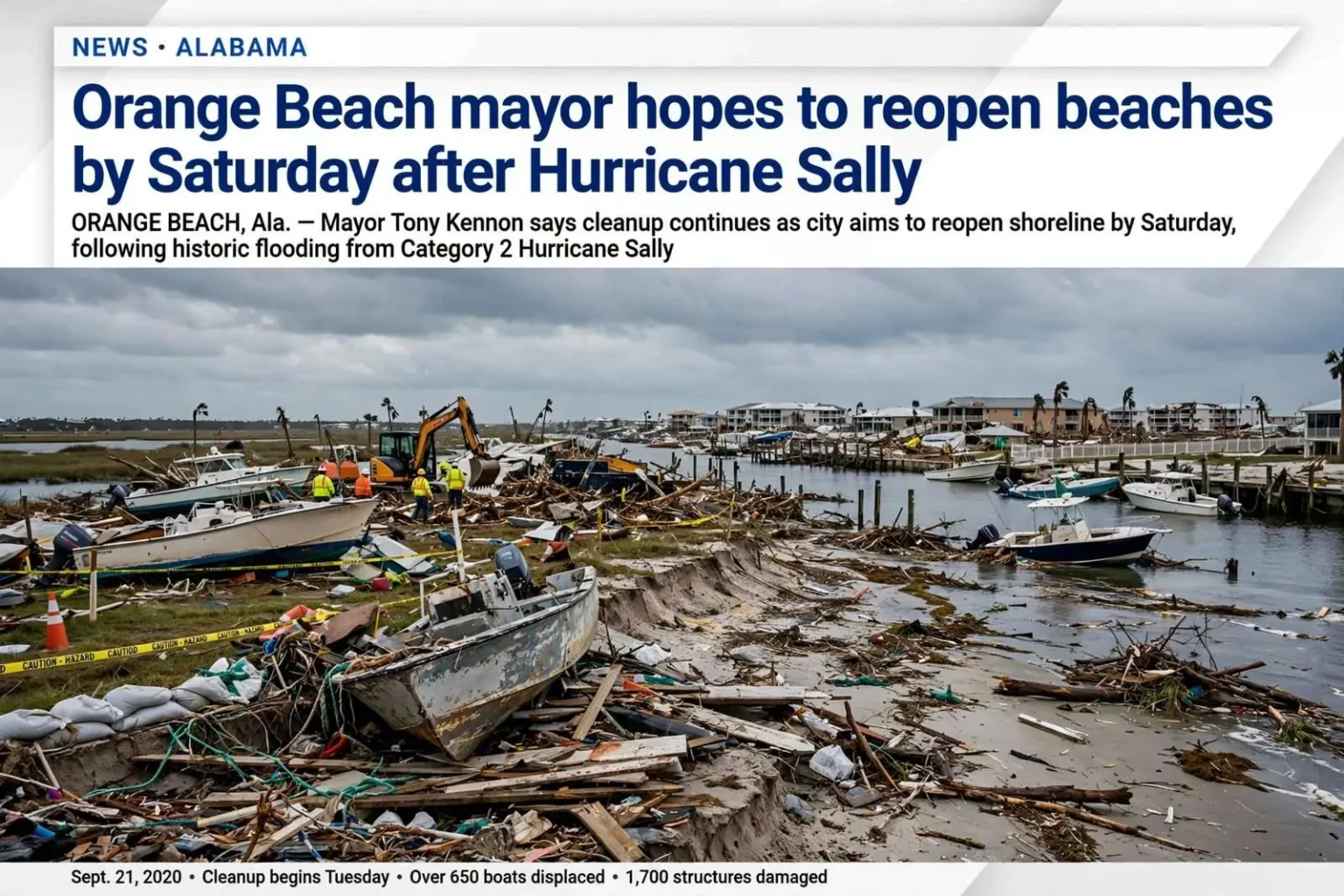
ORANGE BEACH, Ala. — Orange Beach Mayor Tony Kennon said Monday he wants the city’s beaches open by Saturday as cleanup continues across the coastal community following Hurricane Sally, the slow-moving Category 2 storm that hammered the Alabama Gulf Coast with historic flooding. Kennon said marine cleanup across the city is set to begin Tuesday, marking the next phase of a recovery that residents woke to find transformed their waterfront.
The mayor’s figures captured the scale of the damage: more than 650 boats were displaced during the storm, and about 1,700 structures suffered water and flood damage. The mayor’s goal is to get the popular shoreline back open to the public as soon as it is safe, even as recovery work continues across the community.
For a city whose economy runs through its beaches, marinas, and charter fishing fleet, the timeline Kennon described was both ambitious and essential. Every weekend the sand stays closed is a weekend of lost revenue for condominium owners, restaurants, charter captains, and the service workers who make Orange Beach’s tourism economy run — and city leadership has long understood that reputation moves at the speed of the shoreline’s condition.
What Hurricane Sally Did to Orange Beach
Sally came ashore near Gulf Shores on Sept. 16, 2020, but its most destructive weapon was water rather than wind. The storm slowed to a crawl as it approached the coast, lingering over the region for hours and dropping extraordinary rainfall totals across the coastal counties. Storm surge and rainfall flooding combined to inundate low-lying neighborhoods in Orange Beach and Gulf Shores, and the surge shoved vessels of every size — from jet skis to shrimp boats — off their lifts, out of their slips, and into streets, yards, and canals.
That is the story behind the count of more than 650 displaced boats. Orange Beach’s canals and marinas are the heart of the community’s identity; the city bills itself as a boating paradise, and its canal system threads through neighborhoods where homes stand within reach of their own backyard docks. When the surge rose, it lifted vessels over seawalls and set them adrift in force, leaving a marine debris field that had to be catalogued, refloated, and cleared before the waterways could safely function again.
The 1,700 Structures
The count of roughly 1,700 structures with water and flood damage reflected the breadth of the inundation. In a city of Orange Beach’s size, that figure touched a substantial share of the built environment — condominium towers along Perdido Beach Boulevard, canal-front homes, restaurants and shops along the Highway 161 and Perdido Beach Boulevard corridors, and the public infrastructure the city itself maintains.
Flood damage differs from wind damage in how it complicates recovery. Saltwater intrusion ruins electrical systems, insulation, and appliances in ways that require gutting and rebuilding rather than patching, and the drying-out process determines whether a structure is saved or lost to mold. City building officials spent the days after the storm assessing habitability, and the assessments fed directly into the recovery decisions Kennon described — which areas could welcome visitors back, and which needed more time.
Why the Beaches Had to Close
The beaches themselves took the storm’s full force. Sally’s surge eroded the sand, scattered debris across the strand, and left hazards buried in the shoreline — everything from construction material to portions of destroyed structures. Public safety officials closed beach access while crews worked, a precaution that protects visitors from unseen dangers and clears the way for heavy equipment to operate without bystanders in the swing radius.
Kennon’s Saturday target, announced Monday, gave crews a five-day window to clear and inspect the sand. The beach reopening in a Gulf Coast resort city is a carefully staged operation: debris removal crews with heavy machinery work the strand, hazard assessments follow, and lifeguard and public safety staffing is confirmed before officials declare the beach open to swimmers and sunbathers.
Marine Cleanup Begins Tuesday
The marine cleanup Kennon said would begin Tuesday was the recovery phase unique to a boating city. Displaced vessels are not simply towed away; each one must be identified, matched to its owner, and either recovered intact or dismantled where it sits if it cannot be moved without breaking apart. Derelict boats leak fuel and oil, and environmental teams monitor the waterways for pollution as the recovery proceeds.
In Orange Beach’s canal system, the work is delicate. Vessels came to rest against docks, seawalls, and each other, sometimes stacked several deep in the narrow waterways. Salvage crews worked methodically canal by canal, and the city coordinated with state agencies and federal partners on the removal of vessels that ended up in sensitive areas, including the wetlands and grassbeds that line parts of the bayfront.
FEMA, State, and Federal Response
Sally’s damage across Baldwin County was extensive enough to earn a federal disaster declaration, unlocking assistance programs that Orange Beach and its neighbors relied on for recovery. The Federal Emergency Management Agency’s individual assistance program helped homeowners and renters with repairs and temporary housing needs, while public assistance reimbursed governments for debris removal, emergency protective measures, and infrastructure repair.
The Small Business Administration made low-interest disaster loans available to homeowners, businesses, and nonprofits, a critical channel for the city’s tourism businesses — charter fishing operations, pontoon rental companies, restaurants, and the condominium associations that manage the buildings along the beachfront. Alabama Gov. Kay Ivey toured the damaged coast in the days after landfall, and state agencies coordinated with Baldwin County municipalities on the recovery’s logistical challenges, from debris hauling contracts to traffic management on the damaged Highway 98 bridge and the other crossings the storm compromised.
The Economy on the Line
Orange Beach and Gulf Shores together anchor one of the Southeast’s most productive beach tourism economies, drawing visitors from across the Southeast for spring break, summer, and the shoulder seasons. The storm arrived in mid-September, late enough in the year that the summer season had concluded but early enough that fall — fishing rodeo season, the shoulder-season conventions, and the leading edge of snowbird arrivals — remained on the calendar.
That timing shaped the recovery’s urgency. A beach reopened by Saturday preserved a slice of the fall visitation that sustains coastal businesses through the off-season months. Charter captains whose boats were displaced needed the marinas functioning before they could book again; restaurants needed the power restored and the staff back in town; and the condominium towers needed habitability clearances before owners could welcome returning guests. Kennon’s public optimism about the Saturday timeline was, in that context, a message to the tourism market as much as to residents: Orange Beach intended to be open for business.
Recovery in a Storm-Tested City
Veterans of the Alabama coast will recognize the pattern in Orange Beach’s response. The community was rebuilt after Hurricane Ivan in 2004 and battered again by storms in the years since, and each event has refined the recovery playbook — pre-negotiated debris contracts, mutual aid agreements, and communication plans designed to get accurate information to residents and visitors quickly. Kennon, the city’s longtime mayor, had guided the city through previous recoveries, and his instinct to set a public target for reopening reflected the experience of a city that knows the value of momentum.
What Residents Could Do in the Days After
City officials directed residents through the standard post-storm sequence: document damage with photographs before cleanup begins, contact insurance carriers promptly, register with FEMA once the disaster declaration opens the portal, and beware of the contractor fraud that follows every Gulf Coast hurricane. Local government supplemented those reminders with practical updates on curfew status, boil water notices where they applied, debris pickup schedules, and the locations where supplies and assistance were being distributed.
The displaced boats presented their own bureaucratic channel. Owners searching for vessels were directed to city coordinates and lists, and those whose boats were damaged beyond salvage worked with insurers and salvage contractors on removal. The city urged patience as the marine cleanup proceeded, noting that the work would take weeks, not days, even as the beaches themselves could be ready sooner.
Sally’s Place in Alabama’s Storm History
Sally joined the long line of hurricanes that have struck the Alabama Gulf Coast, a list that includes Ivan in 2004, Katrina’s glancing blow in 2005, Frederic in 1979, and earlier storms that shaped the coast’s building codes and its culture of preparation. What distinguished Sally was its rainfall and its pace — a storm that stalled and drowned rather than blew through, dumping rain totals measured in feet across parts of the coastal counties and producing flooding that exceeded what wind-focused preparation had anticipated.
The storm’s landfall near Gulf Shores placed Orange Beach on its eastern, more damaging side, and the two Baldwin County beach cities sustained the bulk of Alabama’s losses. Neighboring Perdido Key, Florida, and the communities of northwest Florida also took heavy damage as the storm moved inland, but the Alabama coast’s recovery — from the first post-storm weekend through the months that followed — became the reference point for the region’s response.
Looking Toward Saturday and Beyond
Kennon’s Monday announcement laid out the week’s trajectory: marine cleanup beginning Tuesday, beach clearing operations continuing through the week, and a target of Saturday for reopening the shoreline that gives the city its name. Achieving that timeline depended on crews, weather, and the pace of the hazard assessments that had to clear each section of beach before it opened.
The larger recovery — the 1,700 damaged structures, the hundreds of displaced vessels, the condominium repairs and canal restorations — would stretch over months, as Gulf Coast residents know from experience. But the immediate goal Kennon articulated captured what Orange Beach needed most in the storm’s aftermath: a visible sign that the city was coming back. When the beaches reopened and the first visitors walked back onto the sand, the message traveled through the tourism market the way it always does after an Alabama coast storm — the beach is open, the boats are running, and the city that lives by the water is back at work.