Orange Beach Mayor Tony Kennon Served Notice of October Ethics Commission Hearing
Orange Beach Mayor Tony Kennon has been served notice that the Alabama Ethics Commission will hold an October hearing on a complaint filed by three City Council members.
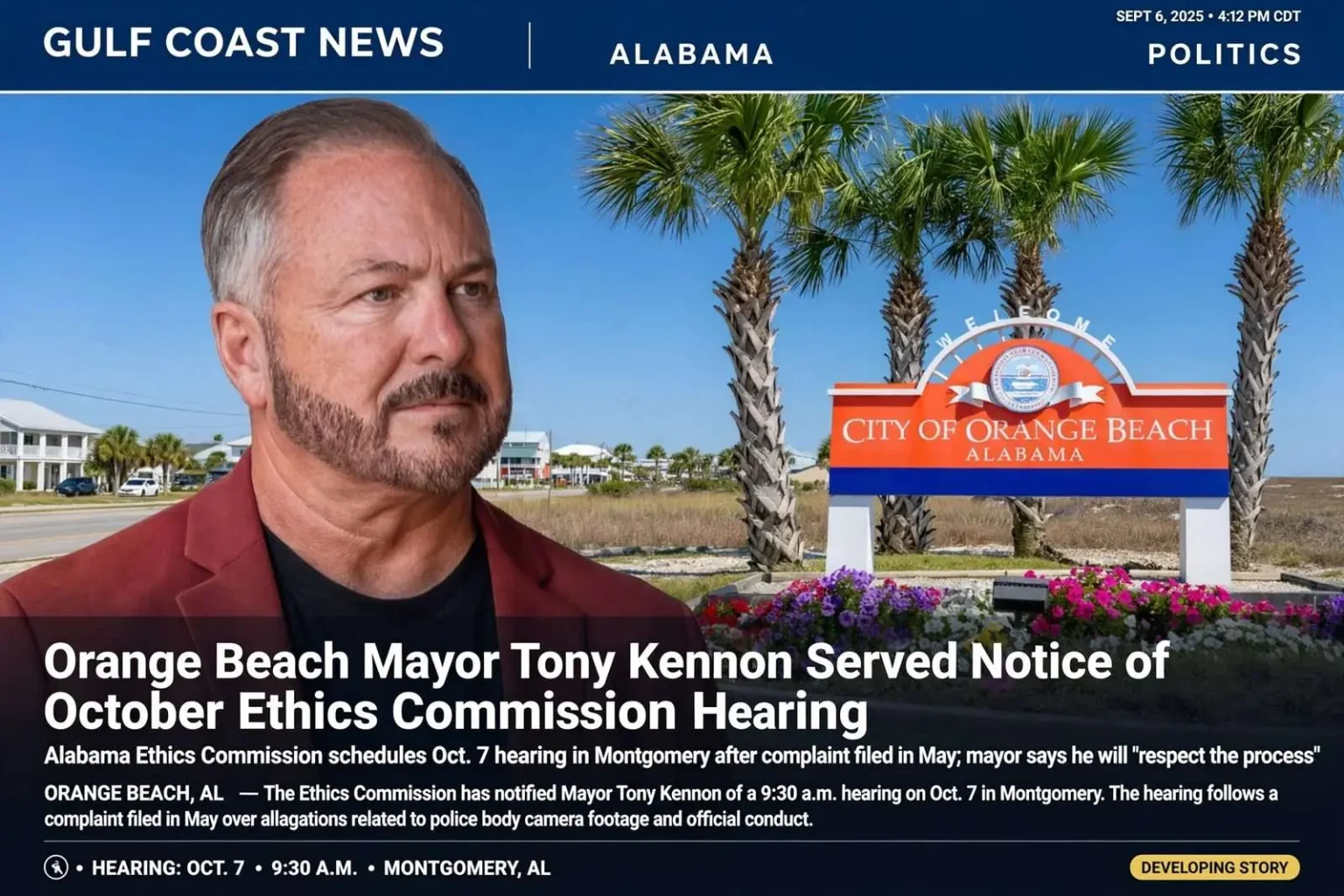
Orange Beach Mayor Tony Kennon has been served with notice that the Alabama Ethics Commission will hold a hearing in October regarding a complaint filed against him in May, a source familiar with the matter confirmed Friday afternoon. The 45-day notice sets the hearing for the Commission’s 9:30 a.m. meeting on Oct. 7 in Montgomery. It formalizes a process that has shadowed the beachfront city’s administration for months, moving the case from investigation to a public Commission review of the allegations.
Multiple sources speaking on condition of anonymity said Kennon has since asked people in the beachside community to submit letters of support on his behalf as the hearing approaches. Kennon had faced the possibility of an ethics commission hearing for months as investigators looked into allegations raised by three City Council members. The October session will be the first formal airing of the dispute before the state body. Kennon did not respond to several requests for comment, and he has said he intends to stay quiet until the hearing. “I’m done. I’m done,” Kennon said this week. “I’m going to respect the [Ethics Commission] process.” Earlier, in remarks first reported in June, he said he valued and respected the Commission and was “willing to just keep my mouth shut and let the process run its course.”
The allegations largely center on claims that Kennon blocked the release of police body camera footage showing him at the Coastal Resources Building after 1 a.m. on Sept. 2, 2024, as officers investigated an alleged domestic violence call to the building. The complaint questions why the footage — recorded during a police response to the building — was not made available, and what role the mayor played in keeping it from public release.
According to the complaint, council members saw the footage in a closed session and later floated releasing it publicly to save the city the expense of fighting a federal lawsuit seeking its release, filed by local attorney C.C. Dixon Moreno after a records request for the footage was denied. The complaint alleges that during an executive session in April, Kennon said he would pursue legal action against individual council members if they voted to authorize the release, statements the signers interpreted as threats meant to influence their votes. It further claims he used his office for personal gain and inserted himself into the city’s legal strategy for the lawsuit, and asks the Commission to examine whether his conduct violated Ethics Act provisions on conflicts of interest, use of official position for personal benefit, improper influence over public officials and interference with legislative authority.
The complaint also alleges that several high-ranking city officials knew of the Labor Day incident within about a day, that regular crime reports to the City Council did not initially reflect the call and police response, and that building security footage that could have shown the incident was not preserved. The city attorney has said security camera footage at the building is routinely overwritten after roughly 30 days, and City Clerk Renee Eberly confirmed in mid-2025 that video of that night does not exist.
How the Complaint Reached This Point
Council members Jeff Silvers, Ginger Harrelson and Robert Stuart filed the complaint May 1, putting the matter before the state’s ethics watchdog after weeks of tension inside city government. The filing by three members of the five-member council represented an extraordinary step in a resort city where the mayor’s office and the council typically operate in close alignment on tourism, development and public safety matters.
Kennon has repeatedly denied any wrongdoing but has acknowledged he was in the building at the time of the police response. He initially declined to answer specific questions when the incident became public in July 2025 before eventually making that admission. No criminal charges were ever filed, and Kennon and his wife, Paula Kennon, have denied that any assault took place. He has not publicly detailed the circumstances beyond that acknowledgment, and the underlying facts remain at the center of competing accounts inside City Hall. The Ethics Commission hearing will give both sides their first structured forum to present evidence and argument before the state panel.
When the Alabama Ethics Commission reviews the case, it will decide whether the allegations warrant potential actions that could include fines and recommendations that Kennon be investigated and prosecuted by law enforcement, or it could clear him of any wrongdoing. The range of possible outcomes is broad, and the hearing itself is only a step in the Commission’s process rather than a trial of the allegations.
The Alleged Incident at the Coastal Resources Building
It was previously reported that Kennon was found inside the Coastal Resources Building on Labor Day 2024 after a 911 call reported a man yelling and behaving aggressively toward a woman on the balcony of an office. A review of police body camera footage showed Kennon speaking to officers from behind the office door. The building, a city facility tied to Orange Beach’s coastal programs, would not ordinarily have someone present in the middle of the night, which is part of why the police response and the footage became the focus of so much attention.
The disputed footage sits at the intersection of two competing obligations: the privacy interests of individuals caught up in a police response to an unproven allegation, and the public’s interest in understanding what happened inside a municipal building involving the city’s top elected official. Complaints like the one filed by the council members argue that an elected official has no authority to interfere with the release of records from a police investigation, while Kennon’s position, as reflected in his denials, is that he did nothing improper.
The Baldwin County District Attorney’s Office has indicated it may investigate Kennon if the ethics commission recommends it do so. Both the District Attorney’s Office and the Alabama Attorney General’s Office had previously declined to investigate the incident. The DA’s reservation matters, because it means an adverse finding at the Commission could open a second, criminal investigative track — one with far higher stakes than the administrative penalties the Commission itself can impose.
What the Alabama Ethics Commission Does
The Alabama Ethics Commission is the state body charged with enforcing the state’s ethics law, which governs the conduct of public officials and employees at every level of government. Complaints filed with the Commission are reviewed by staff, investigated where warranted, and then presented to the Commission members, who decide whether probable cause exists to find a violation. The Commission’s jurisdiction covers everything from use of public office for personal gain to failures to comply with disclosure requirements, and its dockets routinely include cases involving municipal officials across the state.
The Commission’s powers are administrative but consequential. Where it finds probable cause to believe the ethics law was violated, it can order civil fines and — critically — refer the matter to district attorneys or the state attorney general for criminal investigation and prosecution. A finding of no probable cause ends the matter at the state level, though it does not erase the political consequences that have already accumulated inside the city. The October hearing in the Kennon matter will determine which of those paths the case follows.
Hearings before the Commission are structured proceedings, with evidence presented and the respondent given an opportunity to answer the allegations. The outcome is typically announced after the Commission members deliberate, and the agency’s findings become part of the public record of the case. For a sitting mayor, the announcement itself is a defining event regardless of which way it goes.
Deadlines and Timing
Under state law, the Commission has 180 days from the date a complaint is filed to review it and make a recommendation to the local district attorney or the Attorney General, and it can vote to extend that window by another 180 days at the request of its director. For the May complaint, the original deadline falls in November; an extension would push a decision to roughly May 2027. If the Commission makes no recommendation by either deadline, the complaint is dismissed and cannot be refiled on the same facts. State law also provides that if the Commission finds probable cause, “the case and the commission’s findings shall be forwarded to the district attorney for the jurisdiction in which the alleged acts occurred or to the Attorney General.”
Kennon may also request a 30-day extension of the hearing itself, which would likely move it to the Commission’s Dec. 2 meeting, the last time the four-member Commission is scheduled to meet this year. It was not clear whether he had requested one.
Letters of Support and the Shape of a Defense
The reported request for letters of support follows a familiar pattern in ethics proceedings across Alabama. Respondents in Commission cases frequently submit community letters attesting to character and service, aiming to give the Commission members context about the official’s record before they weigh the specific allegations. The letters carry no formal weight in the probable-cause analysis, but they color how a case is perceived in the community and in the press.
In Kennon’s case, the appeal for support comes from a mayor who has served the city through a period of dramatic growth and repeated hurricane recoveries. Orange Beach has been one of the fastest-growing cities in Baldwin County, and its mayor sits at the center of decisions about development along the Perdido Pass and Gulf-front corridors, budget matters funded heavily by tourism revenue, and the city’s relationships with state and county agencies. Supporters will likely frame the complaint against that record; critics have already framed the record as irrelevant to the specific question of the body camera footage.
The council members who filed the complaint have not wavered publicly in the months since the May filing. The dispute has divided city government at a level residents rarely see, with the council’s minority — or, depending on the alignment of other members, majority — formally asking a state agency to investigate the city’s own chief executive. That kind of split inside a small city’s government tends to persist, whatever the Commission decides in October.
What Happens Next
Between now and the October hearing, the Commission’s staff will complete its investigative file and the parties will prepare their presentations. Kennon, through the hearing notice he has now received, becomes a formal respondent rather than simply the subject of an inquiry. The three council members’ complaint remains the operative document, and the evidence trail runs through the Orange Beach Police Department’s records of the Sept. 2, 2024, response to the Coastal Resources Building.
Residents of the city will be watching for several things: whether the Commission finds probable cause on any of the allegations, whether any finding comes with a fine, and whether the Baldwin County District Attorney’s Office takes up the case on referral. Each outcome sets a different course. A clearance would leave Kennon to finish his term with the cloud lifted; a probable-cause finding would place the mayor’s future before prosecutors and, potentially, before the city’s voters in the next municipal election.
For now, the confirmed fact is narrow but significant: the notice has been served, the hearing is set for October, and a dispute that began with a 911 call and a set of body cameras in the early hours of Labor Day 2024 will be argued before the state body that polices the conduct of Alabama’s public officials.
Body Cameras and the Question of Public Records
The controversy has also drawn attention to how police body camera footage is handled in Alabama, where the release of such recordings is governed by a patchwork of department policies and state public records law rather than a single statewide standard. Departments generally treat footage from active investigations as exempt from immediate release, citing privacy interests of witnesses and victims and the integrity of any potential prosecution. But once a case closes without charges, the calculus shifts, and officials must weigh the public’s interest in records involving their own government against the privacy of everyone else the cameras captured.
When the subject of the footage is the mayor — captured, according to the complaint, at a city building after 1 a.m. during a police response — that balance becomes harder to defend. Government watchdog groups across the state have argued for years that records involving elected officials deserve heightened disclosure, not less, precisely because the public has a direct interest in the conduct of the people it elects. The complaint filed by the council members is, at its core, a claim that the mayor stood on the wrong side of that principle by blocking a release he had the power to influence.
Kennon’s acknowledgment that he was in the building is not, by itself, a violation of anything — being present at a municipal facility late at night is not against the law, and the original 911 allegation that brought officers to the scene involved someone else’s conduct on a balcony. The legal question the Commission will face is narrower and different: whether the mayor used his office to interfere with the handling or release of official records. That question turns on documents and testimony about what happened inside City Hall in the days and weeks after the police response, not on the early-morning encounter itself.
A City Government Under Strain
The public feud between the mayor’s office and the council members who filed the complaint has colored nearly every significant vote in Orange Beach since May. Council meetings in the city have drawn larger crowds than usual, with residents turning out to speak on both sides of the dispute during public comment periods. City business — budgets, contracts, hurricane recovery projects and the perpetual negotiations with developers that define a growing resort town — continues to move forward, but against a backdrop of open acrimony that is unusual even by the standards of small-city politics.
The tensions surfaced publicly in late June and early July, when council members clashed with Kennon over the footage and over filling a vacant council seat; Kennon moved to appoint a former school board member, but the council voted the appointment down and chose Pat Simpson instead. Kennon, who won a fifth term despite the controversy, said he would stop attending executive sessions after the complaint became public, and he has argued that whether the body camera footage is a public record should be settled in court.
The temperature has since eased somewhat. Nearly a month after Kennon publicly apologized to council members for the rift, he attended an executive session with the council this week for the first time since June, a session on land matters held after the regular work session, and the business meeting that followed passed without noticeable political theater.
The Stakes for Baldwin County Politics
The case is being watched beyond the city limits as well. Baldwin County’s municipal governments have a history of ethics complaints and disputed conduct among local officials, but a full Commission hearing involving a sitting mayor of one of the county’s largest cities is rare. County political observers note that whatever the Commission decides, the outcome will influence how other Baldwin County cities handle disputes between councils and mayors — and whether aggrieved council members see a state complaint as a viable route when internal remedies fail.
The District Attorney’s posture adds another layer. A prosecutor’s office that has said it will investigate if the Commission recommends doing so has effectively told the public that the state’s review will be the trigger for any criminal scrutiny. That sequencing keeps the county’s criminal justice apparatus out of the political fight for now, while leaving the possibility of a second act that neither the mayor nor his critics can control.
October will answer the first question. Until then, Orange Beach waits — with letters of support being gathered at the mayor’s request, a hearing notice in hand, and a city government that has been arguing about one night’s body camera footage for the better part of a year.