
Overturned 18-Wheeler Spills 150 Gallons of Diesel on Ziegler Boulevard
An 18-wheeler overturned on Ziegler Boulevard near Athey Road, spilling about 150 gallons of diesel and causing heavy traffic delays.
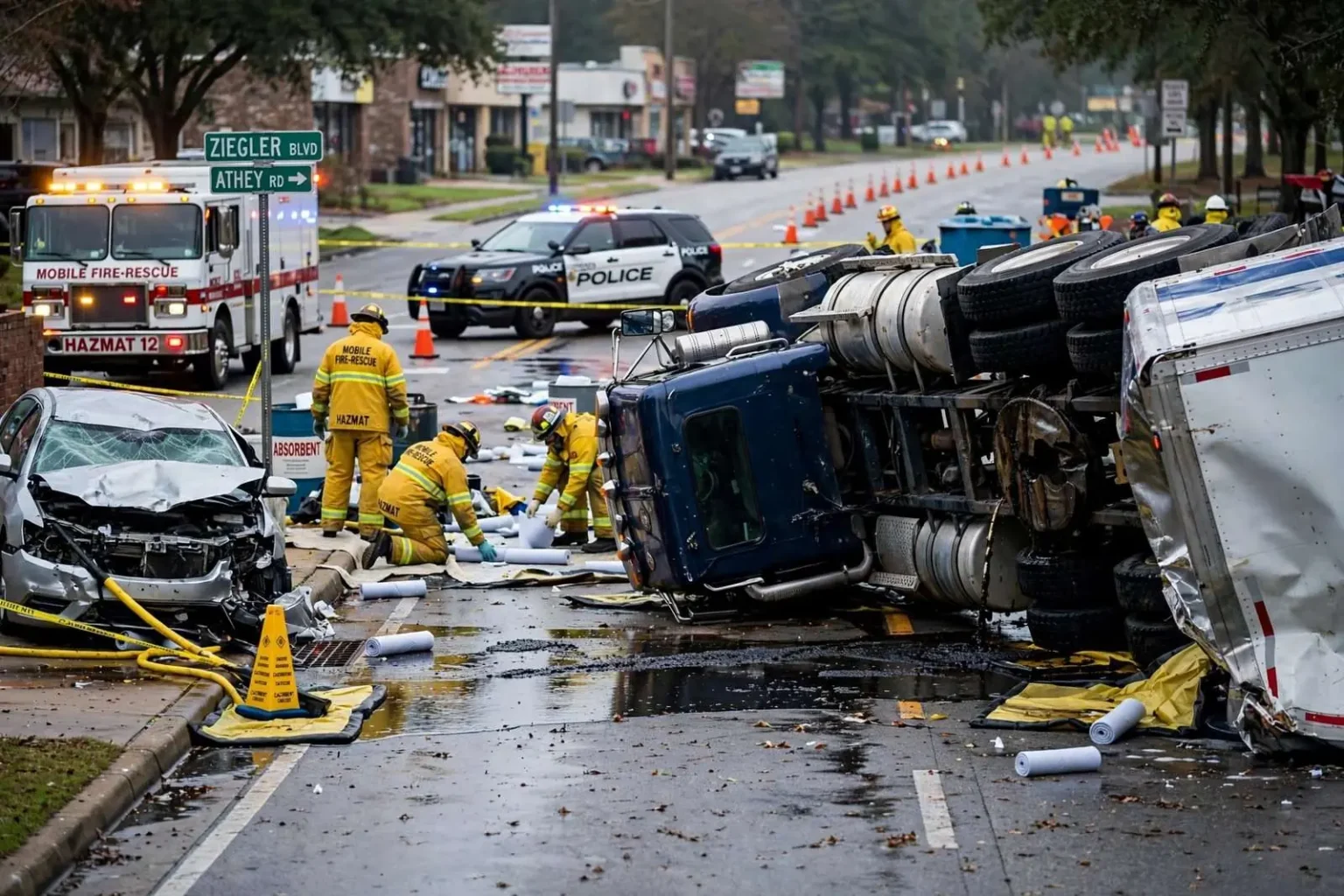
MOBILE, Ala. — An 18-wheeler overturned on Ziegler Boulevard near Athey Road on Saturday morning, spilling roughly 150 gallons of diesel fuel and snarling traffic in the area. The wreck shut down the corridor during the morning hours as emergency crews worked to contain the spill, right the scene and clear the roadway, and officials warned drivers to avoid the area while responders worked, citing heavy delays through the corridor. The incident turned a routine Saturday route for west Mobile drivers into an extended closure that rippled through the surrounding street network.
Mobile Fire-Rescue dispatched HazMat crews to clean up the fuel spill from the wreck, which officials said appeared to involve a collision between a sedan and the big rig. The crash left the tractor-trailer on its side along the roadway with diesel draining from its tanks, a scenario that requires more than a routine towing operation. HazMat response teams handle fuel spills of this scale with absorbent materials, containment booms and coordination with environmental cleanup contractors, working to keep the fuel from reaching storm drains and drainage ditches that carry runoff toward Mobile’s waterways.
The sedan’s driver was taken to a hospital with a head injury that was not life-threatening, according to crews on scene. The injuries were evaluated and treated, and the driver’s condition was reported as non-life-threatening, an outcome that avoided adding a fatal or critical-injury dimension to an already complicated morning. Officials said the cause of the crash remained under investigation, and no findings about speed, fault or contributing factors were released while that review continued.
A dangerous combination: big rigs and diesel fuel
An overturned 18-wheeler presents responders with two problems at once: the wreck itself and the cargo of diesel that almost every heavy truck carries in its saddle tanks. Diesel fuel spills differently than gasoline — it is heavier, less volatile and slower to evaporate, but it spreads across pavement quickly and seeps into soil and drainage systems where it can do lasting environmental damage. A spill of roughly 150 gallons is large enough to require formal HazMat response and environmental remediation, and small enough that experienced crews can typically contain it to the immediate roadway and shoulder when they arrive promptly.
The saddle tanks on a loaded tractor-trailer can hold far more than 150 gallons, which means Saturday’s figure likely reflects what escaped rather than the truck’s full capacity. Crews on scene work to stop further leakage first, plugging tanks or transferring remaining fuel, before beginning the slower work of collecting what has already spread. The pavement often requires sweeping and flushing after the bulk fuel is recovered, and contaminated soil near the roadway may need removal before the scene can be released.
Fire-Rescue units also stand by for fire risk during fuel spills, since diesel is combustible even though it is less flammable than gasoline. Traffic is kept well away from the spill area partly for that reason, and the closures that frustrate drivers during cleanup operations are also what keep the scene safe for the crews working in it.
Ziegler Boulevard and the west Mobile traffic network
Ziegler Boulevard runs through west Mobile, connecting the Highway 90 corridor with the residential and commercial neighborhoods between it and Schillinger Road, and the stretch near Athey Road carries steady local traffic on weekday mornings and weekend errand runs alike. The road feeds into some of the busiest commercial corridors in the western part of the city, and a closure at its midpoint forces drivers onto parallel residential streets that are not built for diverted truck and commuter volume.
Saturday morning crashes on corridors like Ziegler carry their own traffic dynamics. Weekend traffic volume is lighter than the weekday commute, but the drivers on the road are often heading to the same concentrated destinations — shopping centers, youth sports venues and the commercial strips along Highway 90 — so a blocked through-street creates immediate congestion on the surrounding network. Officials’ warning of heavy delays through the corridor reflected that pattern, and drivers who heeded the advice and stayed out of the area avoided the worst of the backups.
Collisions involving 18-wheelers on city streets rather than interstates add complications beyond the immediate wreckage. Heavy trucks need longer stopping distances, wider turning paths and stronger road surfaces than passenger cars, and when one overturns on a municipal road, the response involves not just police and fire but heavy-duty wreckers capable of righting a loaded trailer, city engineers assessing pavement damage and environmental contractors handling the cleanup. The roadway reopens only when all of those pieces have finished their work.
The investigation and what comes next
Officials said the cause of the crash remained under investigation, with the collision between the sedan and the big rig under review by the agencies handling the wreck. Investigations of commercial vehicle crashes typically examine the sequence that led to the overturn: point of impact, vehicle speeds, the truck’s load and its movement before the crash, and any mechanical factors. Statements from drivers and witnesses, scene measurements and damage patterns all feed the final determination, which can carry consequences ranging from traffic citations to insurance liability findings.
For the sedan’s driver, the hospital evaluation for a head injury was the immediate concern, and the non-life-threatening classification allowed the focus to shift to the scene cleanup. Head injuries in collisions warrant evaluation even when they appear minor, and hospital assessment is standard practice when a crash involves an impact significant enough to overturn a truck.
The trucking company involved typically sends its own response team to commercial wrecks, coordinating with the towing contractor on vehicle recovery and with environmental crews on the fuel cleanup. The 150-gallon spill estimate becomes part of the incident record used in environmental reporting and in any subsequent claims tied to the wreck.
How Mobile handles major-incident closures
Mobile’s emergency response system handled Saturday’s incident with the same multi-agency coordination that major wrecks in the city require. Mobile Fire-Rescue provides the HazMat capability that fuel spills demand, Mobile police manage the closures and the traffic detours, and the state or county authorities become involved depending on which roads the overflow affects. The public messaging — avoid the area, expect heavy delays — follows the standard protocol for incidents expected to block a corridor for hours rather than minutes.
Drivers in west Mobile have learned to treat those warnings seriously. The corridors between Highway 90, Schillinger Road and Airport Boulevard concentrate a large share of the city’s western traffic, and an unplanned closure on any of them sends ripples through every connecting street. Local news and police social media accounts carry the closure updates, and the fastest recoveries come when drivers reroute early rather than testing the delays firsthand.
Saturday’s overturned rig on Ziegler Boulevard near Athey Road ended with the roadway cleared, the diesel recovered, and one driver treated for injuries that were not life-threatening — an expensive and disruptive morning, but one that Mobile’s response system managed without greater harm. The investigation into the collision continues, and its findings will settle the questions that the morning’s warnings left open.
Environmental stakes of roadside fuel spills
South Alabama’s low terrain and high water table give fuel spills here environmental stakes that responders take seriously. Storm drains along city streets like Ziegler Boulevard feed the drainage network that carries rainfall to Mobile Bay’s tributaries, and diesel that enters those systems can travel far from the crash site before anyone can intercept it. HazMat crews therefore work the drains first, covering inlets and blocking flow paths before addressing the fuel on the pavement, a sequencing that protects the waterways even as it slows the visible cleanup. The Mobile area’s past experience with industrial and transportation spills has shaped a response culture in which containment is treated as urgent work, not an afterthought to the wreck recovery.
The cleanup also involves documentation. State environmental authorities require reporting of petroleum releases above thresholds, and the roughly 150 gallons spilled on Saturday falls into the range that generates formal remediation records. Soil samples near the spill area may be taken to determine whether fuel soaked below the pavement edge, and follow-up remediation can continue days after the road has reopened to traffic. For nearby residents and businesses, the visible sign of cleanup is usually the absorbent material and swept pavement; the invisible part is the monitoring that ensures the ground beneath the roadway is clean.
Commercial carriers bear the cost of that process, which is one reason the trucking industry invests in driver training for load securement, speed management on curves and defensive operation around passenger vehicles. A fuel spill transforms a traffic crash into an environmental incident, multiplying the cost of the original mistake many times over.
Sharing the road with heavy trucks in west Mobile
West Mobile’s commercial corridors carry a heavy mix of freight traffic and local driving, with 18-wheelers serving the distribution centers, building supply yards and retail hubs along Highway 90, Airport Boulevard and the connecting streets. Ziegler Boulevard itself sees truck traffic heading to and from that network, and the Saturday crash illustrates the physics that make those mixtures hazardous: a passenger sedan and a loaded tractor-trailer operate at very different weights, stopping distances and crash outcomes when the two meet at speed.
Driver-education guidance around heavy trucks is consistent: stay out of blind spots, pass promptly rather than lingering alongside trailers, allow extra following distance and anticipate wide turns at intersections. Crashes that overturn big rigs often involve abrupt maneuvers at the moment of impact, and the sedan-truck collision under investigation Saturday will be reconstructed from the physical evidence to determine exactly how the vehicles came together.
For residents along the corridor, the incident was a reminder of the infrastructure that daily commerce depends on. The trucks that deliver goods to west Mobile’s businesses share streets built for neighborhood traffic, and when one of them fails, the community absorbs the disruption together — closed roads, delayed trips and response crews working through the morning until the corridor is whole again.
The recovery, hour by hour
Incidents of this type follow a predictable clock. The first hour belongs to rescue and safety: extrication and medical care for anyone hurt, securing the scene and containing the fuel. The middle hours belong to recovery: heavy wreckers righting the trailer, transferring remaining fuel, loading the wreck for transport. The final hours belong to cleanup and reopening: sweeping the pavement, flushing residual fuel, inspecting the roadway and lifting the closures. Saturday’s scene on Ziegler Boulevard near Athey Road moved through that sequence with Mobile Fire-Rescue’s HazMat crews at the center of it, and the heavy delays officials warned about eased only when the last phase was complete.
What remains is the investigation, which will establish the cause of the collision between the sedan and the big rig and assign responsibility through the process that follows. The injured driver’s non-life-threatening head injury, the 150 gallons of recovered diesel and the Saturday of lost travel time will all be part of that final accounting.


